- The author runs a interesting site on What your PALM says. When I got to know he is from Bikaner requested him to write this piece. eSamskriti is grateful to him for sharing.
This is a
third article in our Food and Heritage Walk series, the earlier ones being- What to Eat during a Heritage Walk in Jodhpur and What to Eat during a FOOD WALK in the Walled City of
Ahmedabad – Editor Album links at end.
The
famous food of Bikaner, one stop at a time: GI-tagged bhujia at Kote Gate,
rasgulla by the station, rabdi in Mohta Chowk and kesar milk on winter nights,
with Junagarh Fort and the old temples and havelis in between.
Near Bikaner railway station, inside a sweet shop called Chhotu Motu Joshi, a man rubs bhujia dough through a sieve straight over boiling oil. “Anyone else would have burned their hands,” a visiting writer noted in 2018. There is not a machine in sight.
To see short video on FB of Hands
rubbing bhujia dough through a sieve over a kadhai of hot oil, Chhotu Motu
Joshi, Station Road.
That is
where I would start. I am from Nokha, in Bikaner district; after hours at my
desk studying palm lines and building palm
reading guides on PalmSays, stepping out into these old city lanes is how I reset my eyes and
senses. This is the walking plan I would give a friend visiting the city.
It runs from breakfast to the last cup of
milk at night: six stops, a few auto rides, and something to eat at almost
every one.
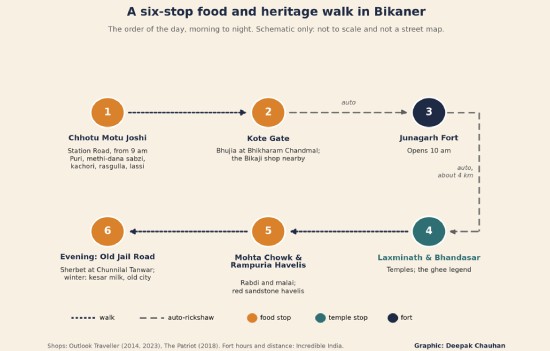 A Six-stop Food and Heritage Walk in Bikaner. By Author. The day in six stops. Not to scale, so ask an auto driver for the shortest way between them.
1. Chhotu Motu Joshi, Station Road: breakfast first
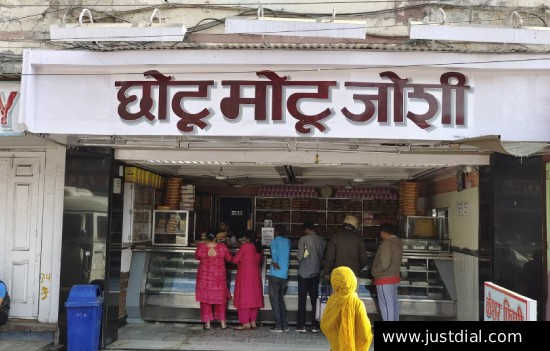
This shop has roots in the royal kitchens. It was started by brothers Chotulal and Motulal Joshi, who cooked for the palace. Chotulal’s grandson Jagmohan Joshi runs it today, with the next generation helping out. The shop opens at 9 am.
What to order
1. Puri
with methi-dana sabzi, with the house dana methi kairi on the side.
2. Kachori
and jalebi, if you want your breakfast fried and sweet.
3. Rasgulla.
The tins stack up along the shelves, and the paneer is made by hand. It is one
of the famous sweets of Bikaner.
4. Lassi.
There are more than ten kinds.
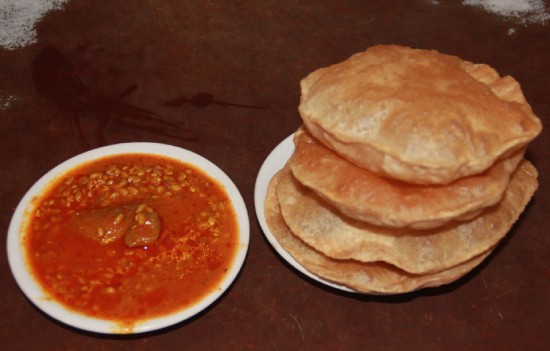 Plate of puri with methi-dana sabzi and dana methi kairi, Chhotu Motu Joshi.
2. Kote Gate: Bikaner street food’s headquarters
Walk on
to Kote Gate, grand enough to have its own India Post stamp (2019). This is
bhujia country. Bikaneri bhujia has been a registered Geographical Indication
since 2010, so the name belongs to this place by law.
Many Bikaneris buy theirs at Bhikharam Chandmal, where the staff will usually offer you a taste before you buy. Nearby, the Bikaji shop is, in Outlook Traveller’s words, “where the legendary Haldiram used to make his bhujia.” Bikaji itself has been run since 1987 by Shivratan Agarwal, Haldiram’s grandson.
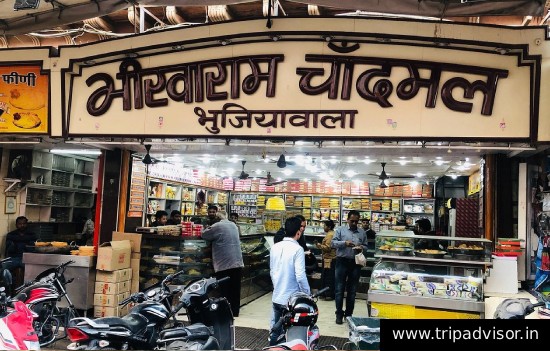
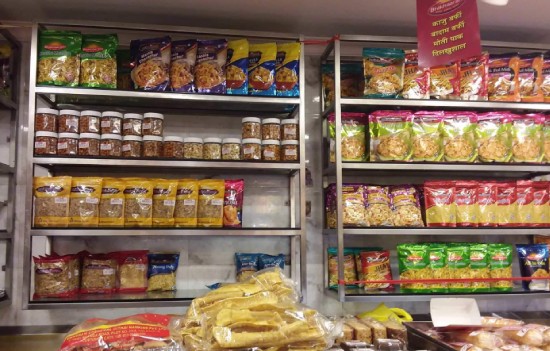 Bhujia
counter at Bhikharam Chandmal, Kote Gate.
3. Junagarh Fort: history after breakfast
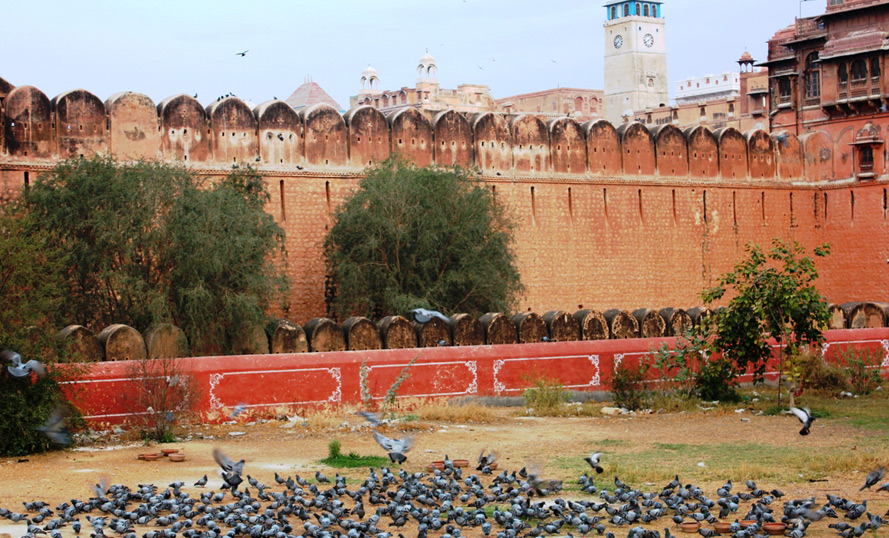 It is a ground level fort with a palace and museum
inside. VG. 2013.
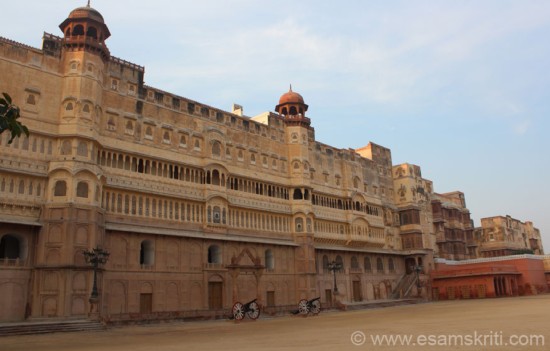 Palace inside. This is where movie Jhansi ki Rani was
partly shot. 2013.
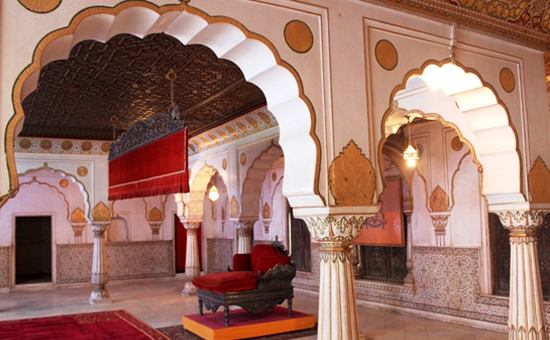 Karan Mahal, is one of the many beautiful rooms, in
the palace. 2013.
Take an
auto to Junagarh, which opens at 10 am. The fort was built under Raja Rai
Singh. Its foundation was laid on 17 February 1589 and it was completed on 17
January 1594. You enter through the Karan Pol and Suraj Pol gates. Har Mandir
is the personal temple of the Maharaja of Bikaner. Rao Bikaji, founded the
state of Bikaner in 1545. Ground floor is Vikram Vikas Durbar Hall. Do see
Zorawar Mahal, Karan Mahal, Phool Mahal, Chander Mahal, Anup Mahal, Badal
Mahal, Gaj Mandir, Arms on display in the Durbar Hall. Album links at end.
Junagarh
opens at 10 am, which leaves time for puri and lassi at Chhotu Motu Joshi
first.
4. Laxminath and Bhandasar temples: ghee in the walls
An auto
ride of about 4 km brings you to the Laxminath temple in the old city. In the
area around it stands the Bhandasar Jain temple, dedicated to Sumatinath and
protected by the Archaeological Survey of India.
Bikaneris
tell a story about it. During a drought, when water was scarce, the builder
Bhandasa Oswal is said to have used some 40,000 kg of ghee in the mortar
instead. On hot days, people say, the walls still seep a little. If this city
would put ghee into a temple, imagine what it puts into its sweets.
5. Mohta Chowk and the Rampuria Havelis: rabdi
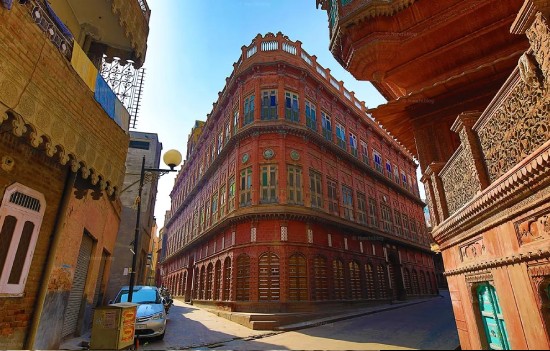 Look up at the jharokhas, then go back for a second
bowl of rabdi. Bipinraju7, via Wikimedia Commons.
Now walk
into Mohta Chowk for rabdi, milk simmered for hours until it thickens and
layers of cream gather. There are four shops run by the descendants of Ojiya
Maharaj, Manka Maharaj and Handa Maharaj that are recommended. It is a dish to
be eaten slowly and enjoyed.
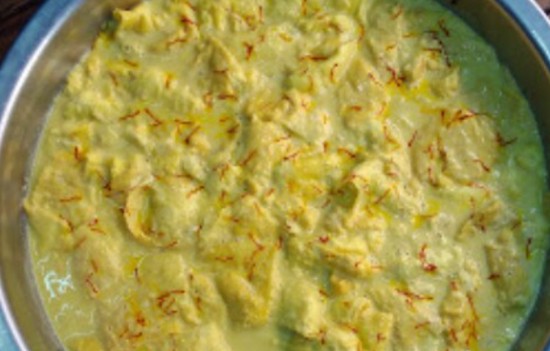 RABDI thickening in a wide kadhai at a Mohta Chowk sweet shop.
Then walk through the to the Rampuria Havelis. They were built for the Rampuria merchant family in Dulmera red sandstone, with Rajput, Mughal and Victorian touches. Look up: the carved jharokhas are the reason to come.
6. Evening: sherbet on Old Jail Road, kesar milk in winter
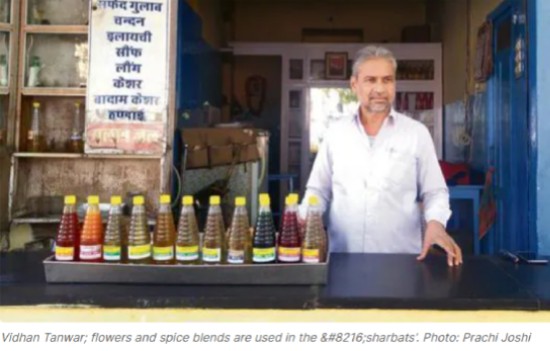 Courtesy The Mint, HT Media.
At the end of the day, walk or take an auto to Old Jail Road. Chunnilal Tanwar’s sherbet shop that opened in 1939. Its founder opened it when he was 17. Bela is the local cooler, and there are Rose, Khus, Kewra, all served in clay kulhads.
In winters, the evening drink changes. Milk with saffron, almonds, pistachio and cardamom is heated for two and a half to three hours in large iron kadhais over coal and wood, then served in clay sakoras late into the night. One shop told Local18 in 2024 that it sells 400–500 kg of it on a single night.
Before you go
1. Time:
a full day, from 9 am breakfast to a late cup of milk. Junagarh is open 10 am
to 4:30 pm.
2. Getting
around: walk between nearby stops and take autos for the longer hops: Kote Gate
to Junagarh, and Junagarh to Laxminath (about 4 km).
3. Season: winter is the time for walking and kesar milk. In the summer month of May, daytime highs can touch 46 °C.
4. Food:
everything on this walk is vegetarian. Shop hours change, so check before you
set out.
Take
home: a packet of bhujia and some papad. More than 4,000 women in the
surrounding villages make fresh papad for Bikaji.
Author Deepak Chauhan is from Nokha,
Bikaner. He is the founder
of PalmSays, where he writes on Indian hand-reading traditions
and explores what
history and modern research say about palmistry
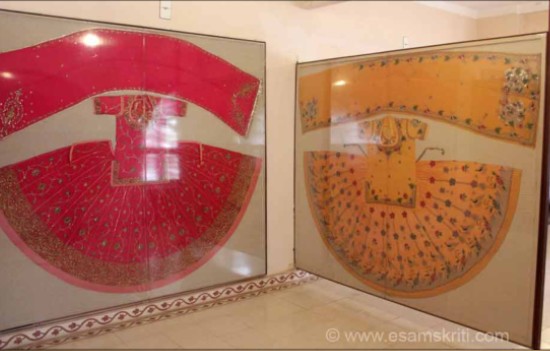 Prachina Museum is part of Lallgarh Palace. There is also a Train of the then Maharaja of Bikaner.
References
Recommendations
and shop details draw on Outlook Traveller (2014; 2023), The Patriot (2 August
2018) and Local18/News18 Hindi (December 2024). Fort, temple and haveli
details: Incredible India (Ministry of Tourism) and The Times of India (2024).
GI registration: Geographical Indications Registry, application no. 142. Stamp:
India Post, 19 October 2019.
Food is
an important part of Indian Culture so sharing -
1. Places to eat in Jaipur, To read all articles in Indian Food section
To
see Bikaner Albums
1. Jungarh Fort
2. Junagarh Fort
album 2
3. Bikaner City
including Camel Park
4. Lallgarh
Palace
5. Prachina
Museum i.e. part of the palace
6. Karni
Mata Mandir where rats worshipped 1 hour away
7. Kolayatiji i.e. about two hour away – sacred place
8. Gajner Palace
i.e. about one hour away