- Who
started Sadhu Vaswani Mission? What are main activities of SVM? How many
schools, colleges and hospitals does it run? Why is headquarters in Pune? This
photo feature cum FAQ provides answers to this and more.
Q1. When was Sadhu Vaswani Mission
founded?
The organisation now known as the Sadhu Vaswani Mission traces its origins to 1929–1930, when Sadhu T.L. Vaswani started Sakhi Satsang for women, in Hyderabad, Sindh, rooted in his conviction that ‘home-building is nation-building’. Sadhu Vaswani recognised the latent strength (shakti)
of women and encouraged their active involvement in educational, social, and
humanitarian work.
After Partition Sadhu Vaswani reached Pune in 1949. Here the organization solely focused on women's upliftment, developed into a broader movement dedicated to value-based education, service, and spiritual upliftment. It was renamed as Brotherhood Association.
After
the passing away of Sadhu Vaswani in 1966, the Brotherhood Association was
formally renamed Sadhu Vaswani Mission after him. Under the leadership of Dada
J.P. Vaswani, the Mission expanded nationally and internationally, while
remaining rooted in its original ideals. Didi Krishna Kumari, a dynamic woman spiritual
leader, heads the Mission now.
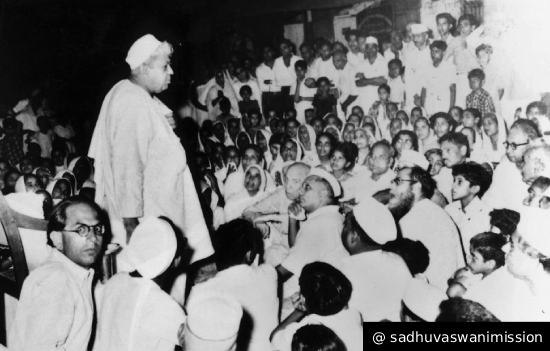 A glimpse of Sadhu Vaswani in his early days. This was in Pune.
 Sadhu Vaswani’s early words for inspiring women.
 Sadhu Vaswani Centre, London.
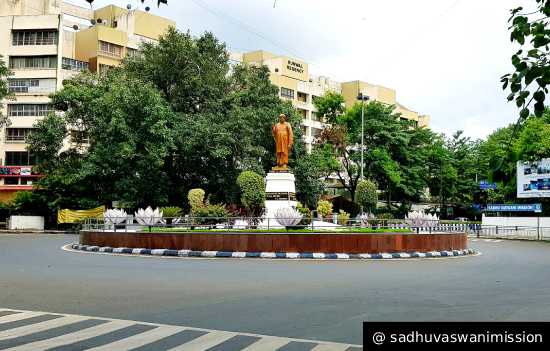 Sadhu Vaswani Chowk, Pune.
 Dada
Vaswani with his Guru, Sadhu Vaswani.
Dada
Vaswani with his Guru, Sadhu Vaswani.
 Dada Vaswani birthday is celebrated as Global Forgiveness Day-2 minute silence is maintained worldwide on August 2.
 Dada Vaswani’s books.
Q2. How were Dada J.P. Vaswani and Sadhu T.L. Vaswani related?
Dada J.P. Vaswani was the nephew of Sadhu T.L. Vaswani. Beyond this familial relationship, the two shared a profound guru–disciple bond. Sadhu Vaswani recognised Dada’s spiritual inclination and intellectual capacity early on. He personally guided his formation, shaping both his inner life and his sense of service.
After his graduation, Dada Vaswani turned away from a conventional professional path and dedicated his life in service of the Guru. Over the years, he assisted Sadhu Vaswani in spiritual, educational, and humanitarian work, immersing himself fully in it. This relationship evolved from kinship into one of spiritual succession. Upon Sadhu Vaswani’s passing in 1966, Dada J.P. Vaswani served as the spiritual Head of the Mission for over 50 years, carrying forward his Guru’s teachings.
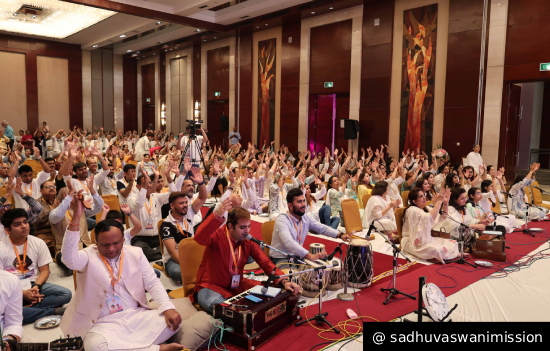 Dada Vaswani devotional camp.
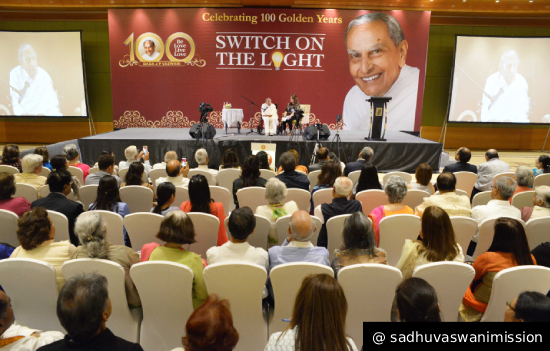 Inspirational talks by Dada Vaswani.
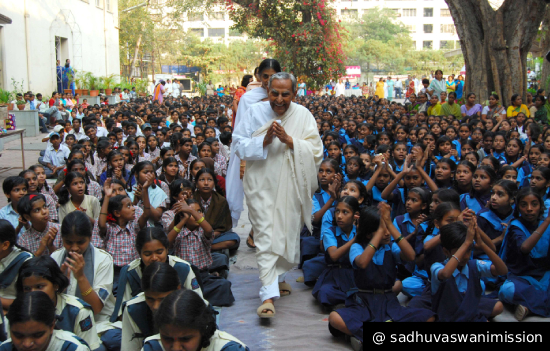 Children cheering Dada Vaswani, the educationist they respect.
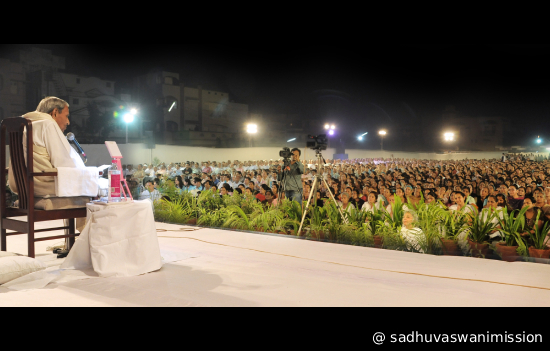 Dada Vaswani addressing a gathering during one of his yatras.
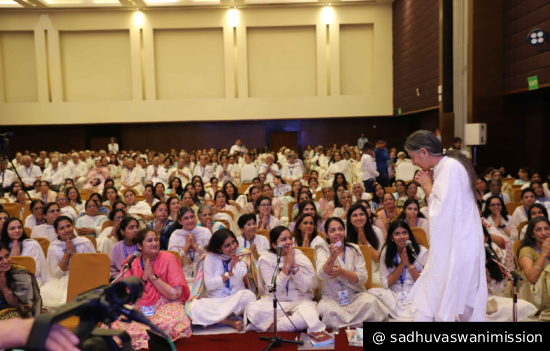 Current head Krishna Didi at meditation camp.
Q3. Why is Sadhu Vaswani Mission
headquartered in Pune?
The
headquarters of Sadhu Vaswani Mission is in Pune primarily for historical
reasons. Till Partition in 1947, Sadhu T.L. Vaswani and Sakhi Satsang were
based in Hyderabad, Sindh (now in Pakistan). Like many, Sadhu Vaswani was
compelled to migrate to India.
Sadhu
Vaswani came to live in Pune, the cultural capital of Maharashtra. Also, the
city offered a conducive environment for education, satsangs, and overall
rebuilding.
Pune had long been associated with saints such as Sant Dnyaneshwar, Sant Tukaram, Sant Eknath, Sant Namdev, and others, scholars, and spiritual movements, and hence the city carried a history of religious and cultural inquiry that resonated with Sadhu Vaswani’s vision. Its intellectual traditions and ethical climate aligned closely with his emphasis on education, character formation, and service.
After relocating in 1949, Sadhu Vaswani re-established St. Mira’s School in Pune and resumed spiritual gatherings, educational initiatives, and service activities from there.
Over time, Pune became the Mission’s principal administrative and spiritual centre. The headquarters later developed into a comprehensive campus housing educational institutions, healthcare facilities, Samadhi shrines, and the Darshan Museum.
Q4. Why is the greeting “Dada Shyam” used at the Mission?
The greeting “Dada Shyam” was given by Sadhu T.L. Vaswani himself as a mantra, meant to be remembered and lived in everyday life.
Shyam
is a traditional name for Lord
Krishna, symbolising love, compassion, and divine consciousness. And the word Dada
means “elder brother”, who in Indian culture is associated with moral support, selfless love, and protection.
The invocation “Dada Shyam” expresses that Krishna is our elder brother-close and ever-present. Dada Shyam thus conveys
a relationship of trust and companionship, gently reminding both the speaker
and the listener of protection by the Divine.
It
reflects the broader ethos encouraged by Dada Vaswani-bringing spiritual
remembrance into ordinary life with simplicity.
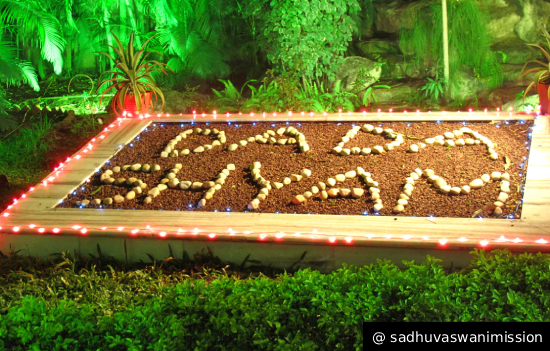 Greeting at
Pune campus. It conveys a relationship of
trust and companionship, gently reminding all of protection by the Divine.
Greeting at
Pune campus. It conveys a relationship of
trust and companionship, gently reminding all of protection by the Divine.
Q5. What are the main activities of Sadhu Vaswani Mission?
Sadhu
Vaswani Mission works in four main areas:
1.
Education,
2.
Healthcare,
3.
Humanitarian Service,
4.
Spiritual Outreach.
It
runs 16+ schools and colleges that emphasise character-building and
values-based education. Through its healthcare institutions, the Mission
provides quality medical care at subsidised costs, reaching out especially to
the underprivileged. Its humanitarian initiatives include social service,
disaster relief, rural upliftment, and village rehabilitation.
Across
multiple slum areas of Pune, the Mission serves 2500+ meals daily,
ensuring that at least one nutritious meal a day reaches those in need.
The
Mission also promotes ethical awareness through two annual campaigns, International Meatless Day and Global
Forgiveness Day, and conducts spiritual
and cultural programmes that encourage forgiveness, world peace, love for all,
silence (inner peace), compassion, reflection, and service.
Q6. Details of schools, colleges, and
hospitals run by Sadhu Vaswani Mission?
SVM runs a broad network of educational institutions, with a strong and sustained emphasis on girls’ education, alongside co-educational learning environments.
A. Schools
and Early Childhood Centres
The
Mission currently runs the following schools and pre-school institutions:
1.
Sadhu Vaswani International School, Sanpada, Mumbai (Co-educational),
2.
Sadhu Vaswani International School, Hyderabad (Co-educational),
3.
Sadhu Vaswani School, Ahmedabad (Co-educational),
4.
Sadhu Vaswani Vidya Mandir, Vadodara (Co-educational),
5.
Sadhu Vaswani School for Girls, Rajkot (Girls only),
6.
Sadhu Vaswani School, Gaikwadi, Rajkot (Co-educational),
7.
Sadhu Vaswani International School for Girls, New Delhi (Girls only),
8. St. Mira’s Primary School, Pune,
9. St. Mira’s Pre-Primary School, Pune,
10. St. Mira’s Secondary School, Pune,
11.
Sadhu Vaswani Gurukul, Manjri, Pune (Co-educational),
12.
Sadhu Vaswani International School, Pradhikaran, Pune (Co-educational),
13.
Shanti Vidya Mandir, Pune,
14. St. Mira’s Play ‘N’ Learn Centre, Pune,
15.
Sadhu Vaswani Gurukul, Pimpri (Co-educational),
16. St. Mira’s Kindergarten, Malad, Mumbai (Co-educational),
17.
Sadhu Vaswani International School, Bangalore (Co-educational),
18. Little Lamps Nursery, London (Co-educational).
In the co-educational institutions, student strength has approximately equal representation of girls and boys. Institutions designated exclusively for girls serve the Mission’s long-standing commitment to girl-child education.
B. Colleges
and Professional Institutions (Pune)
The
Mission also runs the following colleges and higher-education institutions:
1. St. Mira’s College for Girls.
2. Sadhu
Vaswani College of Nursing.
3. Sadhu
Vaswani Institute of Management Studies for Girls.
4. Sadhu Vaswani Institute of Teachers’ Training.
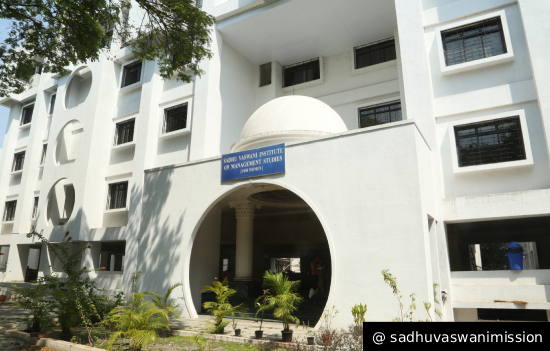 Sadhu Vaswani College of Management Studies.
 St Mira School for girls.
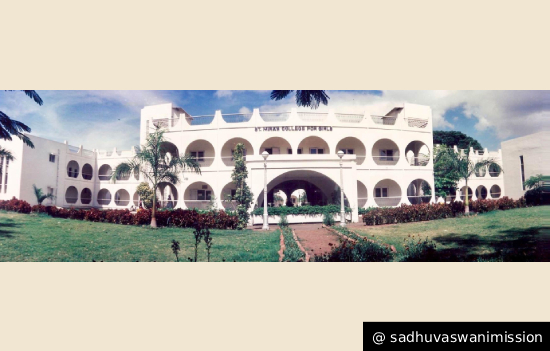 St Mira College for girls.
 Yoga at SVM International School, Pune.
 Students of SVM School observe World Animal Rights Day.
 Free meals and education provided to school at Manjiri, Maharashtra.
C. Hospitals
and Healthcare Institutions
Sadhu
Vaswani Mission operates four charitable hospitals in Pune:
1. Inlaks
and Budhrani Hospital
2. Fabiani
and Budhrani Heart Institute
3. Morbhai
Naraindas Cancer Institute
4.
K.K. Eye Institute
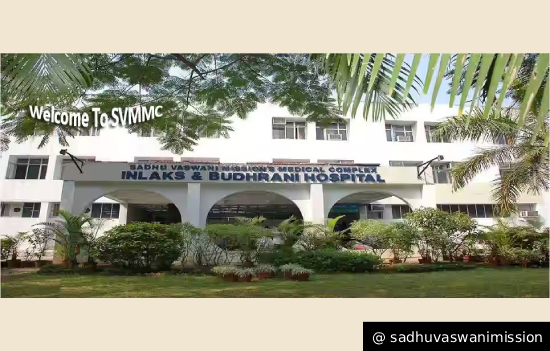 Inlakhs and Budhrani Hospital building, Pune.
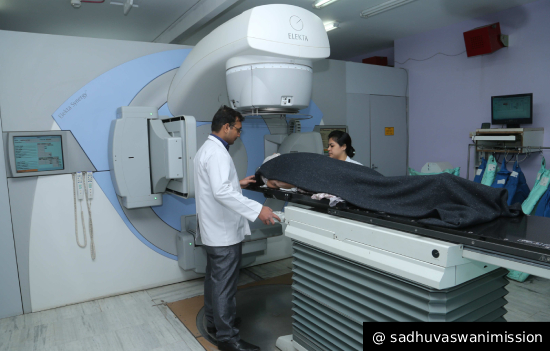 State of the Art Cancer Equipment at the SVM M&B Cancer Institute, Pune.
In
addition, the Mission runs two diagnostic centres, known as Shanti Clinic in
Pune and Pimpri, which provide diagnostic services at concessional rates.
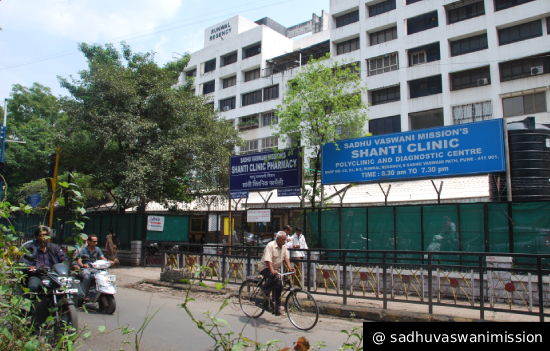 SVM Shanti Clinic, Pune.
The Mission’s healthcare outreach includes:
1.
Regular concessional and free medical camps.
2. Special
initiatives such as Limb for the Limbless, Sight for the Sightless, and free
medicine distribution in remote villages.
3. Two mobile medical clinics operating in the Raigad district (hilly regions of Maharashtra), for rural healthcare. We regularly visit tribal villages providing free medical aid and medicines at the villagers’ doorsteps. The two mobile clinics serve nearly 200 villages.
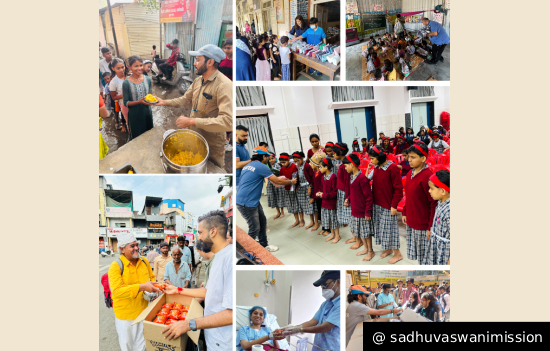 Sevas by Mission.
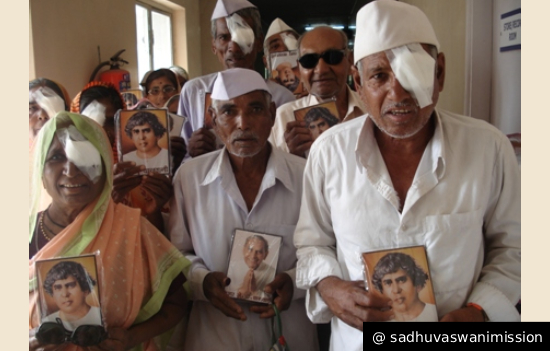 Free Cataract surgeries by Mission.
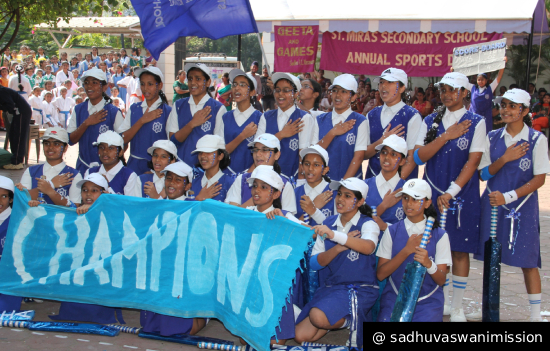 Girl children encouraged in sports with Geeta and Games philosophy.
Q7. Do the schools also teach Bharatiya values, yoga, or meditation?
Mira schools integrate Bharatiya values into daily school life, with a clear focus on character-based education alongside academic learning. Education at St. Mira’s School is shaped by motto ‘Simplicity and Service, Purity and Prayer’.
A
distinctive feature is the Sanctuary
Hour, with which each school day begins. During
this period, students engage in value-based and spiritual education through
readings from sacred texts, recitations, reflective discussions, and themes
drawn from Indian culture and patriotism.
The
intent of these practices is character-building-to cultivate inner discipline,
ethical awareness, and a spirit of service to society. Sadhu Vaswani often
emphasised that the noblest work is to cultivate
the soul, and this principle continues to inform the educational
philosophy of the Mira institutions.
Alongside academic learning, students are encouraged to develop mindfulness, self-restraint, and social responsibility, with the clear aim of preparing individuals to face life by shaping them into well-rounded human beings. Thus, Mira schools blend modern education with India’s cultural and spiritual heritage, including practices aligned with meditation and silence (inner reflection).
Q8. Can I sponsor the education of a
Girl Child? Please give details.
Sadhu Vaswani Mission invites individuals to become partners in shaping young lives by supporting the education of children from economically disadvantaged families, especially girl students. At the heart of this initiative is a thoughtfully designed corpus endowment–based model that ensures lasting impact across generations.
For each child, a corpus of ₹10 lakh created is set aside. Only the interest earned from this endowment is used to meet educational expenses of the child, while the principal remains untouched—allowing the same fund to support the education of many more children in the years to come. In this way, a single act of generosity becomes a perpetual gift of learning, benefiting not just one child but several.
Donors
may contribute the full amount or support the corpus in parts, according to
their capacity.
Such initiatives display the Mission’s long-held view that education is a service.
Q9. How are the activities of Sadhu
Vaswani Mission funded?
The activities of SVM are funded by voluntary donations from individuals, families, and well-wishers. These contributions support the Mission’s educational institutions, healthcare services, humanitarian and social welfare programmes.
Q10. Cities in India and abroad where
Sadhu Vaswani Mission has a presence?
In
India, Sadhu Vaswani Mission has its headquarters in Pune, with a strong
institutional presence through educational, healthcare, and spiritual centres.
It also has active centres and programmes in Mumbai, Delhi, Kolkata, Chennai,
Bangalore, and Hyderabad, with a total of 27 Centers and satsangs
in India.
Abroad,
the Mission has an established presence in parts of North America, Europe, Middle
East, and Southeast Asia. There are 37 International Sadhu Vaswani Centers and
Satsangs. The major overseas centres and active communities are located in New
York, New Jersey, Atlanta, London, Dubai, Singapore, and Hong Kong, among
others.
Across
the world, Sadhu Vaswani Centers regularly perform local community service for
the upliftment of all.
Q11. If I want to contribute to the Sadhu Vaswani Mission how
can I?
Please
click on link https://www.sadhuvaswani.org/donate
Q12. Books by Sadhu Vaswani and Dada
J. P. Vaswani?
Sadhu Vaswani was a prolific writer-author
of several hundreds of books in English and Sindhi. His writings embrace many
subjects, and his collection of songs, the Nuri Granth, is one of the largest books by a single poet-saint, in the literature of the world. The Nuri Granth is revered as a scripture and is available in English too. His works include 'India Arisen', 'India in Chains', 'Life and Teachings of Sri Krishna', Youth and the Nation', 'Tukaram: Poet and Prophet', ‘Creative Revolution’, among others.
Many of his works have deep engagement with
the freedom struggle, where he stood shoulder to
shoulder with luminaries such as Mahatma Gandhi and Rabindranath Tagore. Though rooted in the struggle for independence, his writings transcend time. They continue to remain deeply relevant even after Independence, as they speak timelessly of nation-building, civic responsibility, moral regeneration, and the spiritual well-being of society-themes that are as relevant today as they were during India’s freedom struggle.
A gifted writer, Dada J. P. Vaswani
authored 150+ books. Many were translated into 17+ world languages. From the
sublime to the mundane, important to the practical, from the serious to the
jovial, from religion to human relationships, Dada has shared invaluable
knowledge through his books and writings. His substantial work is the Anjali Sangrah which has hundreds of poems, dedicated to
the divine. His works include Be in the Driver's Seat (Amazon Bestseller), 'The Miracle of Forgiving', and ‘Spirituality in Daily Life’, among others.
Buy books on official link https://www.dadavaswanisbooks.net
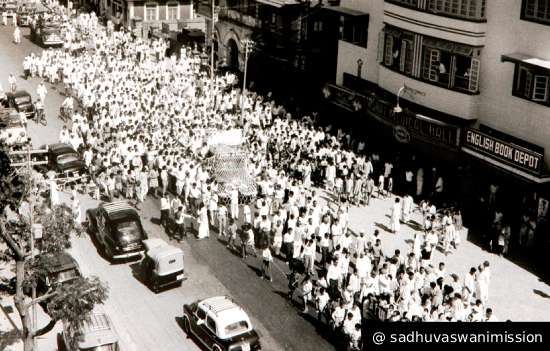 Sadhu Vaswani’s last procession 1966.
Sadhu Vaswani, continues to inspire people across the world.
Dada
Shyam.
Also see
1.
SVM Delhi website
2.
SVM HO, Pune
3.
SVM Panama
4.
SVM
Hinduism Today
5.
Sadhu
Vaswani Centre, USA
6.
SVM Gurukul,
Manjiri, Pune
7.
Didi Krishna explains SVM
Mission 6 minutes