- Know the origins of Yoga, its evolution, contributions
of different Indian traditions and thoughts of learned Yogis. Indian traditions
borrowed and competed with one and another, did not think in water-tight
compartments as the West do.
Historical Background
Note that Hinayana and Mahayana Buddhism were divided into four
speculative schools. The former into Vaibhasikas (Kashmir and
Gandhara) and Sautrantika. The latter into Madhyamika (founder
Nagarjuna who lived about 1st century A.D.) and Yogacharya (founded
by Maitreyanatha, lived in Ayodhya 270-350 A.D.) 5 Pg.
390.
“The earliest and greatest exponent of this school was Asanga. He came from Brahmana family of Peshawar. His brother Vasubandhu was also an exponent of Yogacharya philosophy.” History and Culture of Indian People Vol
2 Pg 389 by Bharatiya Vidya Bhawan
“When the Jnana-marga of the Upanishads prevailed over Karma-marga, external means for achieving the highest object of life, gave place to internal ones, thus meditation took the place of rituals. This gave rise to yoga, which developed to a great extent and was being practiced long before Buddha.” Cultural Heritage of India Vol 1 Pg. 561 by Ramakrishna Mission.
The Stages of Sanctification – “Still it appears that Buddhism and Yoga move in a similar atmosphere of thought, possibly because both had a background of Samkhya philosophy.” Cultural Heritage of India Vol 2 Pg. 74 by Ramakrishna Mission
“As contrasted with Hatha-yoga, the yoga taught in the Yoga-sutras is called Raja Yoga though yoga with external or bodily aids like Asanas and Pranayam anticipates Hatha-yoga practices.” Cultural Heritage
of India Vol 2 Pg. 79 by Ramakrishna Mission
Abstract
The term "Yoga" in ancient India represented a shared technology of spiritual and mental discipline, rather than the intellectual property of a single tradition.
During the 4th and 5th centuries CE, the Indian subcontinent experienced an era of profound intellectual codification. This paper examines the Buddhist Yogācāra school, Patañjali’s Yoga Sūtras, and Umāsvāti’s Jain Tattvārthadhigama Sūtra. By exploring their shared Upaniṣadic and Śramaṇa roots, the linguistic shift to classical Sanskrit, their deeply contrasting metaphysical goals, and the etymological evolution of the word "yoga" itself, we can objectively trace the evolution of ancient India's greatest psychological sciences.
Author is
with Sanchi University of Buddhist-Indic Studies, Bhopal, MP.
The Shared Contemplative Pool and Upaniṣadic Roots
To determine the chronological precedence of these
systems, we must decouple the practices of meditation from the formal
codification of philosophical schools. None of the classical traditions
invented meditation; rather, they drew from a shared ancient pool of
contemplative practices.
The Etymological Duality: Mundane "Addition" vs. Spiritual "Alignment"
Before examining the sophisticated psychology of these schools, it is crucial to understand the mundane etymology of the word Yoga itself. While the later Vedic and classical Sanatani traditions elevated "Yoga" to signify a profound spiritual alignment with a higher reality or the divine, its usage in early Buddhist contexts and colloquial Indic languages often retained a strictly literal, non-spiritual meaning.
Derived from the Sanskrit root yuj (to yoke or join), yoga in the ordinary sense simply meant "addition," "combination," or "total." In the daily life of ancient India, a merchant might use the word yoga to refer to the mathematical "total" of their accounts, or the literal addition and acquisition of material things, such as property or a house. By understanding this literal definition, we see the brilliance of the later philosophical codification: the early Buddhists and Śramaṇas took a commonplace word for material "addition" or mathematical "totaling" and systematically shifted its context. In the Yogācāra framework, it evolved to describe the "total" concentration of the mind, stripping the word of its material, acquisitive attachments entirely.
The roots of this shared spiritual technology lie in both the wandering ascetic (Śramaṇa) culture of the 5th century BCE—which produced early Buddhism and Jainism—and the Sanatani. The earliest explicit definition of "Yoga" in a spiritual context appears in the Kaṭha Upaniṣad (c. 3rd Century BCE) and not in Buddhist or Jain texts.
tāṃ yogam iti manyante sthirām
indriya-dhāraṇām
(They consider Yoga to be this firm holding back of the senses.) Kathopanishad II/3/11 (dvitiya valli, tritiya adhyaya , ekadasha shloka)
This Upaniṣadic baseline provided the initial vocabulary. For centuries, wandering monks and forest sages practiced sensory withdrawal, breath control, and deep concentration (Dhyāna in Sanskrit, Jhāna in Pali). However, it was not until the early Gupta period (c. 300–500 CE) that these disparate practices were weaponized into highly systematized, competing philosophical architectures.
The Sanskrit Cosmopolis and the Arena of Debate
To understand how Patañjali, the Buddhist founders of Yogācāra (Asaṅga and Vasubandhu), and the Jain scholar Umāsvāti came to share such identical terminology, we must look at the linguistic transition of the era.
Historically, early Buddhism and Jainism consciously
rejected Sanskrit in favor of Pali and Prakrit in order to reach the common
people. Yet, by the 4th century CE, the intellectual landscape had shifted dramatically.
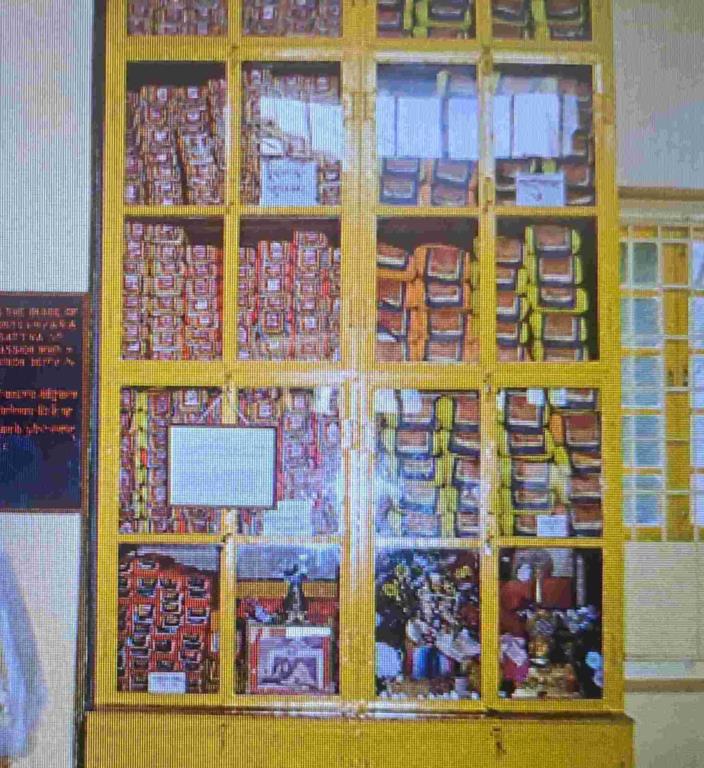 Sanskrit books at the Dalai Lama Temple, Mcleodganj, Himachal. 2001.
Historians refer to this era as the rise of the "Sanskrit Cosmopolis." Under the patronage of powerful empires, formal philosophical debate (Vāda) became a highly formalized institution in royal courts and monastic universities (Vihāras). To defend their doctrines, secure royal patronage, and win debates, Buddhist and Jain scholars translated their ancient texts into classical Sanskrit.
This linguistic convergence created a shared
philosophical vocabulary. Terms like Nirodha (cessation), Kleśa (mental
affliction), and Samādhi (concentration) became the standard currency of
debate. These scholars were not operating in isolated silos; they were
contemporaries breathing the same intellectual air, actively reading, debating,
and refining their texts in direct response to one another.
Ontological Warfare — Using the Same Tools for Different Goals
While these three traditions shared the same linguistic vocabulary and the same foundational technology (Yoga), their ultimate understanding of reality—their metaphysics—were diametrically opposed. They engaged in a competitive synthesis, using the empirical tool of meditation to prove entirely different truths.
1. Patañjali’s Classical Yoga: The Path of Radical Dualism
Compiled around 400 CE, Patañjali’s Yoga Sūtras organized the floating ascetic traditions into a brilliant, logically watertight Sanatani framework based on Sāṃkhya philosophy.
The Metaphysics: Sāṃkhya-Yoga is fiercely dualistic.
It argues that physical matter/nature (Prakṛti) and pure consciousness (Puruṣa)
are both absolutely real, but tragically entangled. Read Samkhya
and Buddhism
The Use of Yoga: Patañjali defines Yoga as Yogas-citta-vṛtti-nirodhaḥ (the cessation of mental fluctuations). The goal is not non-duality, but rather the complete isolation (Kaivalya) of pure consciousness from the machinery of the mind and body. Read Vedic Roots of
Vipassana
2. Buddhist Yogācāra: The Path of
Idealism
Founded by Asaṅga and Vasubandhu (c. 4th Century CE), Yogācāra literally translates to "practitioners of yoga." Also known as Cittamātra (Mind-Only), this school asserts absolute idealism.
The Metaphysics: External reality is an illusion constructed by the "storehouse consciousness" (Ālaya-vijñāna).
The Use of Yoga: Yoga is the rigorous analytical
meditation used to deconstruct the illusion of the subject-object duality,
proving that the ego and the external world are entirely empty of inherent
existence, leading to non-dual awakening.
3. Classical Jainism: The Path of
Absolute Stillness
Codified by Umāsvāti in the Tattvārtha Sūtra (c. 2nd–5th Century CE), Jainism provides the most radical interpretation of Yoga.
The Metaphysics: Jainism asserts a pluralistic
universe filled with infinite, luminous souls (Jīva) that are weighed down by
actual, microscopic physical particles of Karma.
The Use of Yoga: In a fascinating linguistic inversion, Umāsvāti defines Yoga not as the cure, but as the disease. Yoga is the physical, vocal, or mental action that attracts karmic dirt (Āsrava) to the soul. Thus, the Jain spiritual goal is to become an Ayogi—a liberated being who has achieved absolute, uncompromising physical and mental stillness, stopping the influx of karma entirely.
Conclusion: The Crucible of Classical Indian
Psychology
When asking "who is older," the answer lies not in a linear timeline of borrowing, but in the recognition of a shared, explosive era of intellectual codification. The early Buddhists, Jains, and Upaniṣhadic sages had been meditating for nearly a millennium before Patañjali, Vasubandhu, or Umāsvāti put pen to palm leaf.
However, during the linguistic transition to the Sanskrit Cosmopolis in the 4th and 5th centuries CE, these ancient practices were forged into permanent philosophical structures. Jainism provided the foundational ethical architecture of non-violence (Ahiṃsā) and the extremes of physical austerity. Buddhism provided the microscopic, highly analytical deconstruction of consciousness and the illusion of the ego. Patañjali acted as the great synthesizer, creating an accessible, systematic manual for achieving liberation.
Together, competing fiercely yet borrowing heavily
from one another, they mapped the deepest layers of the human psyche, leaving
behind a legacy that continues to define global contemplative practices today.
Author - Vijay Dubey is Assistant Director, Sanchi University of Buddhist-Indic Studies, Sanchi, Madhya Pradesh.
Also read and
References
1. Mysore
Yoga Traditions
2. Yoga Sutras of Patanjali
3. Relation
of Yoga to Buddhism
4. History of Yoga
5.
History and Culture of Indian People Volume 3.
6. How MAHARAJA of Mysore support to T
Krishnamacharya led to the REVIVAL of Modern Day YOGA – “Here (Mysore Palace Yogashala) Krishnamacharya made several experiments and revived many asanas (yogic postures) consulting ‘Sritatvanidhi’ and other ancient texts.
His experiments went a
long way in reviving many asanas which form the part of yoga syllabus of modern
times. Krishnamacharya’s other celebrated students were K. Pattabhi Jois, B. K. S. Iyengar, Srivatsa Ramaswamy, A. G. Mohan and his son T. K. V. Desikachar.”
7. Samkhya and Buddhism
8. Vedic Roots of
Vipassana
9. Seven Interesting Facts about Krishnamacharya – the Father of Modern Day Yoga – “Krishnamacharya walked for about two and a half months to find Sri Yogeshwara Ramamohana Brahmachari's ashram at the foothills of Mount Kailash. He studied the Yoga Sutras of Patanjali, learnt asanas and pranayama, and studied the therapeutic aspects of yoga for over seven years.”
10. About T
Krishnamacharya Yoga tradition
11. T Krishnamacharya – Father of Contemporary Yoga
12. Yogic Tradition – Bihar School of Yoga
13. The MAHAVRATAS of
Patanjalayogasastra has parallels with Jaina Darsana
14. 118 Asanas in the mid 17th century
Editor Notes
1. Search – “While modern, popular Hatha yoga focuses on physical health and flexibility, the original Buddhist Hatha yoga (such as in the Amṛtasiddhi 11th
century) was designed as a precursor to advanced meditation, specifically aimed at manipulating internal energy to reach enlightenment.”
“The oldest use of the term hatha does
not originate from Vedic texts but from Vajrayāna Buddhist texts from the 8th
century AD. The term hatha yoga is first defined in a commentary on Kalacakratantra from the 11th century AD, in the context of a tantric sexual ritual.” Source The origin and essence of Yoga and
relation to Buddhism
Read
Vedic Roots of Vipassna
On Vajrayana (Tantric
Buddhism) Buddhist Scholar Amit Narvade wrote, “Our main knowledge of Buddhist Tantra
comes from Tibet, where it was well preserved, especially in the Gelugpa
tradition.”
Padmasambhava established Vajrayana form of Buddhism
in Tibet in the 8th century. The primitive religion of Tibet,
before introduction of Buddhism was Bon (Phon). Cultural Heritage of India Vol 1 Pg. 501 by Ramakrishna Mission. Dr Subhasis wrote that Vajrayana Buddhism core tenets based
on SAIVA SAKTA Philosophy
2. Exploring hatha yoga, Buddhist Tantra and the Nath Tradition – “Terms such as pratyahara, dhrana and samadhi are common to both Patanjali’s Ashtanga Yoga and the six-limbed yoga in Vajrayana Buddhism. However, the interpretations differ.” Life Positive
magazine
3. Respected Guruji S.N.
Goenka said on the Vipassana
Research Institute site, “Vipassana is a technique of India. Laudable references to Vipassana are given in the Ṛg Veda. The most ancient literature of this country is full of words of praise for Vipassana:”
4. Swami Satyananda Saraswati wrote in
Yoga Magazine The True Spirit of Hatha Yoga, “In yogic
literature, we have a few reliable texts on hatha yoga. One is by yogi Gorakhnath which is known as the Gorakhsha Samhita.
Another text is Gheranda Samhita by the great sage Gheranda. Besides these two, there is another very well known text on hatha yoga
i.e. Hatha Yoga Pradipika by Yogi Swatmarama. There is a 4th text on hatha yoga known as Hatha Yoga Ratnavali. All of these texts were supposed to have been written from 6-9th century A.D.”
“In the raja yoga of Patanjali, you have eight steps: yama and niyama are the first two, asana and pranayama make it four, pratyahara and dharana six and dhyana and samadhi make it eight. The contention of Patanjali is that you have to perfect yama and niyama first. Without the perfection of yama and niyama, asana and pranayama etc. will not give the desired results.”
5. Swami Muktibodhananda
wrote in Hatha Yoga Pradipika, “All the processes of hatha and
laya yoga are but the means to attain raja yoga (samadhi). One who attains raja
yoga is victorious over time (death). Raja yoga means realization of, or being,
Shiva, Brahman, Atma, the Self, cosmic consciousness. Hatha yoga is the same
experience but from the reflection on the primordial Shakti i.e. before nirvana samadhi. In the highest state of raja yoga there is
no reflection in Shakti; Shiva and Shakti are in equanimity. Hatha yoga is the
means to experience this; shakti or tattwa is the tool.” Pg. 590 Published by Bihar School of
Yoga, Munger
6. Yoga and Buddhism – Similarities and Differences by Vamadeva Shashtri –“The Mahayana tradition, particularly in its Tantric forms, uses breathing exercises, mantras, visualizations and deities much like the Yoga tradition. The Theravadin tradition has less in common with Yoga, though does use similar meditation and concentration methods.”
“In the two hundred Sutras in the Yoga Sutras, only three deal with asana. Most of the Yoga System of Patanjali is concerned with the science of meditation as concentration, meditation and Samadhi (Dharana, Dhyana, Samadhi). In the beginning of the Yoga Sutras, Yoga is defined as Samadhi or spiritual absorption.”
“Relative to Yoga and Buddhism one of the most interesting interactions was between Ishvara Krishna (not Krishna of the Bhagavad Gita) and the Buddhist guru of Vasubandhu, the founder of the Vijnanavada school. The debate was said to be won by Ishvara Krishna and the record of his arguments, the Samkhya Karika was produced, which has become the main text on Samkhya. Vijnanavada, also called Yogachara, is perhaps the closest Buddhist school to classical Yoga, but curiously was the Buddhist system most in conflict with it in philosophical debates.” GOOD READ.
7. Yoga and Buddhism – Are they the same
8. Hinduism, Buddhism and Hatha Yoga – a Review – “The
first view recognizes the common shared tradition, while the second insists
that the text belongs to a purely Buddhist
tradition: but, ironically, the second view of the text even more sharply
underlines and emphasizes the truth that actually even the purest Buddhist
traditions are inevitably common shared traditions.”
9. Whilst looking at current day Yoga we must know the contributions of T Krishnamacharya – considered to be Father of Contemporary Yoga and changes
brought about by him. India Today
10. Senior Journalist Sandhya Jain wrote, “A third century AD Prakrit inscription of the 14th regnal year of king Virapurushardatta of the Ikshvaku house of Vijayapuri in Nagarjunakonda valley, hails Buddha as “born in the family that produced hundreds of great royal sages such as Ikshvaku” (Iksvaku-raja-pravararsi-sata-prabhava-vamsa-sambhava).”
11. Vedic deity Lord Indra in Buddhism
Well-known author Devdutt
Patnaik wrote in Mumbai Mirror, “In Buddhist lore, he is present when the Buddha is born and when the Buddha becomes the Buddha, i.e. attains enlightenment and he encourages Buddha to spread his wisdom to humanity.” To read full article
Noted art historian Benoy K Behl said, “The earliest-known representation of Lord Indra is of the 2nd century BCE in the Buddhist caves of Bhaja in Maharashtra. Indra continues to be in worship in every Buddhist temple of Japan.” Source
Conclusion
It is only in India
that Hinduism and Buddhism are treated as different religions (perhaps colonial
plan). Read How Hindu Buddhist strains are
intertwined in Thailand, Cambodia and Japan
Let us maximise the
benefits of Hatha Yoga and Meditation rather than debating dates.