- This includes early
life of Buddha, four Buddhist Councils, different schools in Buddhism. This briefly
covers Mahayana, Hinayana and Vajrayana schools. Tried to make it simple and highlighted
key parts.
Background
about Buddha
The ancient name of India, Jambudvipa, has
been confirmed based on numerous inscriptions and records uncovered through
archaeological excavations over a long period, as well as the early Pali
canonical 1 and classical Sanskrit
texts. 2 In Jambudvipa, in 623 BCE, Siddhartha Gautama was born in the Śītōṣṇa (sub-Himalayan) region near present-day Lumbini, Nepal, in North India, to King Śuddhodana and Queen Mahāmāyā. Siddhartha’s father, Śuddhodana, belonged to the Śākya clan.
Author Amit Narwade is a PHD scholar, Somaiya
Vidyavihar University, Mumbai.
After attaining youth, Siddhartha became
deeply troubled by social conflicts, oppression, suffering generated by
exploitation, and the growing hostility among human beings. In order to discover the true causes of human
suffering and to seek a path for the welfare of humanity, Siddhartha renounced
household life at the age of twenty-nine. This event is known in history as the
Mahābhiniṣkramaṇa (Great Renunciation).
Siddhartha studied the philosophies and
teachings of many contemporary thinkers and prominent teachers from various
schools of thought. 3 These include Pūraṇa Kassapa’s Akiriyāvāda (which denies moral action and its consequences), Makkhali Gosāla’s Ājīvika sect taught Niyativāda, or strict determinism, Ajita Kesakambali’s Ucchedavāda is a form of materialism that denies rebirth and karma, Pakudha Kaccāyana’s atomistic eternalism holds that elements are unchanging, Sañjaya Belaṭṭhiputta’s Ajñānavāda advocates complete philosophical scepticism and Nigaṇṭha Nātaputta (Mahāvīra) founder of Jainism, emphasising asceticism and non-violence.
However, even after engaging with these intellectual traditions, he did not find a complete solution to the problem of human suffering and liberation. Realising that the search for truth must be undertaken through personal experience, Siddhartha began intense meditation on the banks of the Nirañjanā River, seated beneath a banyan tree.
Years of rigorous meditation, ascetic
practices, and extreme fasting reduced his body to a mere skeleton. At that
point, he understood that without preserving the body, the quest for truth
could not continue. With this realisation, he accepted milk-rice (kheer)
offered by Sujātā and then proceeded to Gaya (Uruvelā). At Gaya, Siddhartha
seated himself beneath a peepal tree and entered deep meditation.
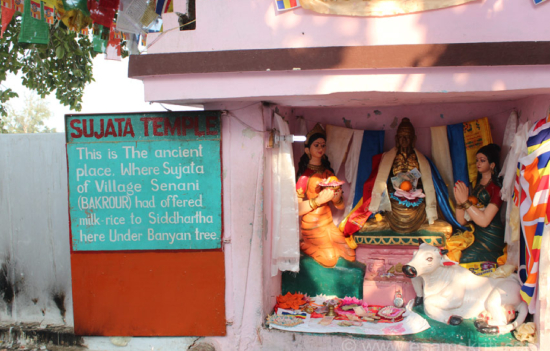 Sujata Temple, Bodh Gaya. 2012.
Through profound contemplation, he discovered
the path to human liberation and freedom from suffering. With this realisation,
Siddhartha Gautama attained Buddhahood and became the Buddha.
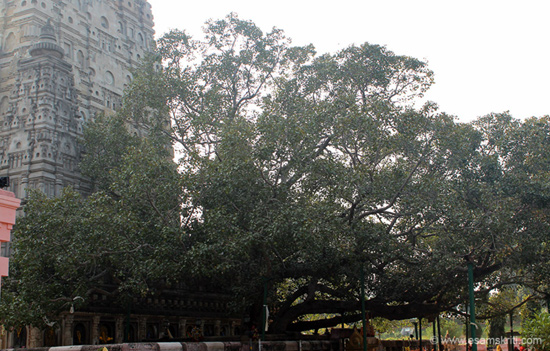 Bodhi Tree at Bodh Gaya under which Gautama attained Buddhahood.
The path he discovered is known as Bodhi or Enlightenment. The peepal tree under which he attained enlightenment later came to be known as the Bodhi Tree, gaining lasting historical and spiritual significance. After attaining enlightenment, the Buddha began the task of transmitting the knowledge he had realised to society. He initiated this mission by approaching his former companions—the five ascetics (Pañcavargika) with whom he had previously practised austerities.
The Buddha delivered his first sermon at the
Deer Park (Mṛgadāvaṇa) in Sarnath, in the presence of Bhaddiya and the other
ascetics. This inaugural discourse is known as the Dhammacakkappavattana Sutta
(The Turning of the Wheel of Dhamma).
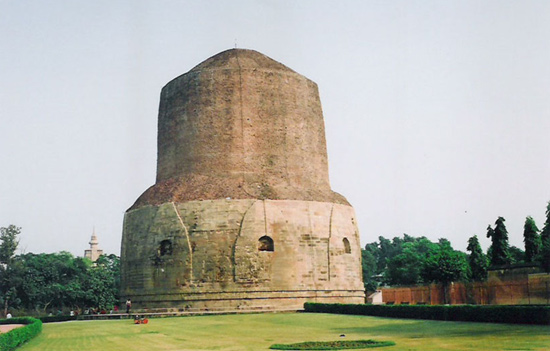 Stupa at Sarnath
Through this sermon and his subsequent teachings, the Buddha presented profound doctrines such as the Four Noble Truths (Cattāri Ariyasaccāni), the Five Precepts (Pañca Śīla), the Noble Eightfold Path (Ariya Aṭṭhaṅgika Magga), and the principle of Dependent Origination (Paṭiccasamuppāda). The Buddha taught that by understanding and practising these principles, human beings could free themselves from suffering. Read Samkhya
and Buddhism
In due course, people from various sections of society were inspired by Buddha’s teachings. They accepted him as their teacher and entered the Saṅgha, adopting the life of bhikkhus. What began with the ordination of the first five disciples gradually expanded into a Saṅgha consisting of thousands of monks.
Early
Buddhism and Buddhist Council Meetings
As the Saṅgha continued to grow in size, the
diversity of temperament, behaviour, and conduct among its members made it
necessary to establish a structured system of discipline. To maintain harmony,
moral conduct, and organisational stability within the monastic community, a
set of disciplinary rules became essential. This necessity led to the
formulation of the Vinaya, the monastic code
of discipline.
However, differing interpretations and
applications of the Vinaya eventually became a source of internal divisions
within the Saṅgha. These disagreements resulted in factions and splits, a phenomenon
historically referred to as Saṅghabheda
(schism within the monastic community).
From these schisms within the Saṅgha, several distinct schools and divisions emerged. Although there were differences of opinion among these groups primarily concerning matters of Vinaya (monastic discipline), there was no fundamental disagreement regarding the core principles and teachings of the Buddha. The essential elements of the Buddha’s doctrine continued to serve as the central foundation of all these traditions.
The term “Yāna” literally means a “vehicle” or “path”, signifying a means through which beings are carried toward liberation. Throughout his life, the Buddha devoted himself to the propagation and dissemination of the Dhamma (Pali
word for the Sanskrit word Dharma), and he instructed his followers to
continue this mission. He exhorted the monks with the famous injunction:
“Caratha Bhikkhave
cārikaṃ, Bahujana hitāya Bahujana sukhāya” (VP, MVG I.11) 4 “Go forth, O monks, for the welfare of the many, for the happiness of the many.”
The Buddha directed the bhikkhus to travel and teach the path of Dhamma, which leads to the welfare and happiness of humanity. At the age of eighty, the Tathāgata took leave of this world. The Buddha’s passing away from worldly existence, traditionally dated to 545 BCE, is known in Buddhist tradition as the Mahāparinirvāṇa.
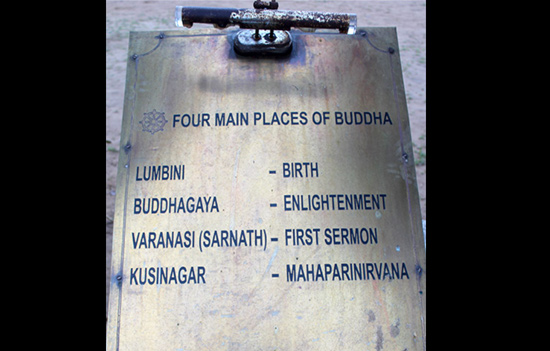 Four important places in Buddha Life. Bodhgaya Temple. 2012.
At the time of the Buddha’s Mahāparinirvāṇa, Buddhism was largely confined to central India. In the Mahāparinibbāna Sutta, 5, the Buddha advised devotees to visit four places connected with his life: Lumbinī, where he was born; Bodhgayā, where he attained enlightenment; Sārnāth, where he delivered his first sermon; and Kusinārā, where he attained Mahāparinirvāṇa. Geographically, these sites lay in or around the region known in early Buddhist texts as Madhya-deśa, or the “central country.”
Soon after the Buddha’s passing, these four places became important pilgrimage centers (caityas), serving as living memorials of his life and teachings. Pilgrimage to these sacred sites helped preserve the memory of the Buddha, strengthen devotion among lay followers, and played a key role in spreading Buddhism beyond its original heartland.
First
Buddhist Council
Soon after the Mahāparinirvāṇa of the Buddha,
the Bhikkhu Saṅgha felt an urgent need to maintain unity, discipline, and
doctrinal clarity within the monastic community. With this objective, the First Buddhist
Council was convened within one hundred days of the Mahāparinirvāṇa, during the
5th century BCE, at Rājagṛha (Rajgir), under the patronage of King Ajātaśatru. The
council was led by senior monk Mahākassapa and attended by 500 Arhat bhikkhus.
Several important resolutions were adopted at this council to preserve the Buddha’s teachings. Bhante Ānanda was entrusted with the responsibility of compiling and reciting the Suttas (discourses of the Buddha), while Bhante Upāli was assigned the task of compiling and reciting the Vinaya, the monastic code of discipline.
This council laid the foundation for the systematic preservation of the Dhamma–Vinaya through oral tradition.
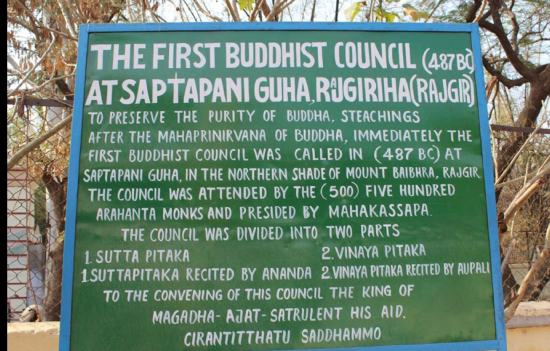 Board at Rajgir.
Second
Buddhist Council
Approximately one hundred years later, in the
4th century BCE, the Second Buddhist Council was held at Vaiśālī under the patronage
of king Kalasoka. The primary purpose of this council was to resolve disputes
concerning ten controversial monastic practices, most of which were related to
the interpretation and observance of the Vinaya.
This council was resulted in the first major
schism within the Saṅgha, leading to the division between the Sthaviras
(Elders) and the Mahāsaṅghikas. The monks who deviated from the rules were
later called the Mahasanghikas, while the orthodox
monks were distinguished as the Theravadins (Sthaviravadins). It was
rather a division between the conservative and the liberal. The hierarchic and
the democratic. There is no room for doubt that the Council marked the
evolution of new schools of thought.
From this initial split, several Buddhist
schools later emerged. The Theravada and
Mahasanghikas then divided into several sects and groups.
After the Buddha’s mahaprinirvana (death), Buddhist missionaries spread Buddhism from central India toward the southwest along the Southern Route. Buddhism also reached western India, where it flourished in Mathura (Madhura), a city on the banks of the Yamuna River, southeast of present-day Delhi. Although Mathura was later known as a sacred center of Krishna worship, Buddhism once thrived there (Baruah, 2000, p.5). The city became an important center of the Sarvastivadin (Theravadins) school of Buddhism. Sarvastivadin (Theravadins) became popular all-over North India and made its way to Central Asia, China. Mahāsaṅghika sect (those who deviated from the rules) became popular in Andhra Pradesh
at Amaravati and Nagarjunikonda.
Third
Buddhist Council
In the 3rd century BCE, the Third Buddhist
Council was convened at Pāṭaliputra under the patronage of Emperor Aśoka. The
principal objective of this council was to purify the Saṅgha by eliminating
false monks and resolving doctrinal confusion.
This council played a decisive role in shaping
and consolidating Theravāda Buddhism, and also marked the beginning of
large-scale missionary activities, through which Buddhism spread beyond the
Indian subcontinent.
Early Buddhist traditions from Northern and
Southern India differ in several ways, though they also share important
similarities. By the time of King Ashoka, the Sangha had already passed through
four or five generations of leadership. Buddhism had spread to Kashmir in the
north and to the Deccan plateau in the south.
Sri Lankan sources state that Ashoka sent missionaries across India, but such a large effort could not have been carried out by the Theravāda school alone. The Dipavamsa records that many schisms occurred within two centuries after the Buddha’s death, leading to the formation of eighteen Nikāya schools.
Fourth
Buddhist Council
The Fourth Buddhist Council held in Kashmir,
was organised by Kanishka, is understood differently within various Buddhist
traditions. The session synchronises with the emergence of Mahayanism. In the centuries after the Christian era the erection and
worship of Buddha images came into vogue. This paved the way for the
advent of Mahayanism. The earliest writer on Mahayana philosophy was Nagarjuna who lived in Andhra Pradesh.
Thus, the
Buddhist Councils were pivotal historical events that ensured the preservation,
transmission, and diversification of Buddhism, enabling it to spread and
flourish across vast regions of Asia.
Different
schools of Buddhism
The first major split occurred at the Second Buddhist Council, about 100 years after the Buddha’s Mahāparinirvāṇa. This division led to the formation of two main groups: the Mahāsāṅghikas (liberals) and the Sthaviravādins (orthodox).
The Mahāsāṅghikas, who held more liberal and
progressive views, were often in conflict with the Sthaviras, the conservative
group that closely followed the original teachings of the Buddha. In a certain sense, the Mahāsāṅghikas were
the forerunners of Mahāyāna Buddhism.
They were the first to introduce the terms
Mahayana and Hinayana, using Hinayana to refer to the Sthaviras, while
identifying their own outlook as Mahayana. The terms Mahayana and Hinayana
refer to two different sets of Buddhist doctrines.
In terms of time, the teachings
called Hinayana were taught by Buddha himself, while the teachings known
as Mahayana developed later, after his death, through the reflections and
interpretations of his disciples. In terms of approach, Hinayana emphasizes the Buddha’s practical and experiential
(phenomenological) teachings, whereas Mahayana expresses the deeper,
introspective understanding of reality attributed to the Buddha.
Thus, it is clear that the terms Mahayana and
Hinayana were coined later, when differences and a sense of superiority
developed between early Buddhism and later, developed schools. The followers of
developed Buddhism called their own tradition Mahayana (Great Vehicle) and labelled
earlier traditions as Hinayana (Small Vehicle). These
terms do not appear in the Pali Nikāyas or the Chinese Āgamas, but are
frequently found in Mahayana sūtras and treatises. According to Baruah, although
some scholars consider Nāgārjuna the founder of Mahayana Buddhism, this view is
mistaken.
Theravāda
(simply said orthodox school, Hinayana, teachings taught by Buddha)
Theravāda, literally meaning the “Teaching of the Elders” (Jain, 2012, p. 395), is the Buddhist tradition that strictly preserves the Buddha’s original teachings and monastic discipline as they existed before his Mahāparinirvāṇa, without later doctrinal modifications. It upholds the arhat as the highest spiritual ideal, emphasizing individual liberation from saṃsāra through insight
into suffering and non-self rather than universal salvation.
Liberation is attained by following the Four Noble Truths and the Noble Eightfold Path, grounded in ethical conduct (śīla), mental discipline (samādhi), and wisdom (paññā). The tradition relies exclusively on the Pāli Tipiṭaka, comprising the Vinaya Piṭaka (monastic discipline and the formation of the Saṅgha), Sutta Piṭaka (the Buddha’s discourses), and Abhidhamma Piṭaka (systematic analysis of mind and reality).
All the Buddha’s teachings are summarized as Dhamma, meaning truth, law, and righteousness, which governs both human conduct and the natural order. Living in accordance with Dhamma leads to Nibbāna, the final liberation from suffering, achieved not through prayer or divine intervention but through self-effort, mental training, and compassion. Philosophically, Theravāda emphasizes the Three Marks of Existence—impermanence (anicca), suffering (dukkha), and non-self (anattā)—and dependent origination (paṭiccasamuppāda), firmly rejecting any permanent soul.
Strong emphasis is placed on
monastic life, meditation practices such as Vipassanā and Samatha, and careful preservation of the earliest
teachings.
Important scholars such as Mahākassapa, Ānanda, Upāli, Moggaliputta Tissa, Buddhaghosa,
Dhammapāla, and Mahānāma played key roles in preserving and explaining the tradition.
Today, Theravāda Buddhism is practiced mainly
in Sri Lanka, Myanmar, Thailand, Cambodia, Laos, and parts of India and
Bangladesh.
Read How
Hindu, Buddhist strains are intertwined in Thailand, Japan and Cambodia and
Ramayana in
Cambodia
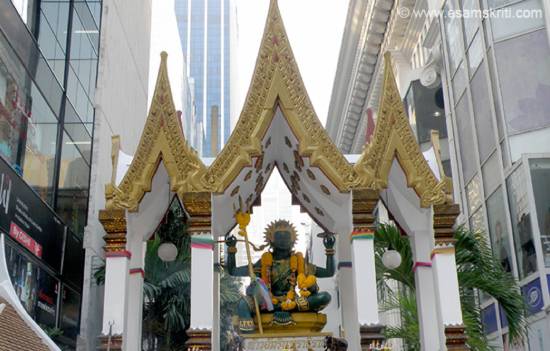 Lord Indra Temple, Bangkok. 2009.
Mahāyāna
Mahāyāna Buddhism emerged about five centuries after the Buddha’s death and marked a major turning point in the history of Buddhism. It played a decisive role in the spread of Buddhism to East Asia—particularly China, Korea, Japan, and later Taiwan—without which Buddhism might not have survived or flourished in these regions.
Early Theravāda Buddhism was largely monastic,
inward looking, and focused on individual liberation (arhat ideal). Its highly
technical and philosophical orientation had limited appeal for the socially and
practically oriented cultures of East Asia. In contrast, Mahāyāna re-presented Buddhism as a compassionate,
socially engaged, and accessible tradition that welcomed lay participation.
According to B. Baruah,7 after the decline
of Buddhism in India following Aśoka’s reign and the resurgence of Brahmanism, Mahāyāna arose as a reform movement. It sought to overcome sectarian divisions, revive Buddhism, oppose Brahmanical dominance, and reconnect the Dharma with society by engaging actively with social and political realities.
Around the beginning
of the Common Era, this new movement came to be known as Mahāyāna (“Great Vehicle”), distinguishing itself from earlier traditions that it labelled Hīnayāna (“Lesser Vehicle”). Although sometimes presented as a sharp break, Mahāyāna was in fact a creative expansion of ideas already presents in the Buddha’s teachings. It likely originated in South India, with Northwest India also serving as an important center due to interactions with Indian, Mediterranean, and Iranian cultural influences.
A Mahāyāna historical account from the early
Common Era even claimed that earlier forms of Buddhism were preliminary stages
leading toward Mahāyāna (Jain, 2012, p. 173), highlighting its
self-understanding as a higher and more inclusive path.
A defining feature of Mahāyāna is the introduction of a new spiritual ideal—the Bodhisattva. A Bodhisattva is an “Awakening Being,” one who is committed to completing the Ten Perfections (daśa pāramitā) in order to attain Buddhahood (Coomaraswamy, 1954, p. 337). Unlike the arhat or pratyekabuddha, who seek personal liberation, the Bodhisattva renounces final release and vows to achieve enlightenment for the
benefit of all beings.
This compassionate intention, known as
bodhicitta, leads the Bodhisattva towillingly remain within saṃsāra to relieve
the suffering of others. The development of celestial Bodhisattvas such as
Avalokiteśvara and transcendent Buddhas like Amitābha further encouraged
devotional practices, including prayer and worship, making
Buddhism emotionally and spiritually accessible to the masses.
Philosophically, Mahāyāna is centered on the
doctrine of śūnyatā (emptiness), which
teaches that all phenomena lack inherent, independent existence and arise only
through interdependence. Emptiness does not imply nihilism but points beyond
fixed and absolute concepts. Closely related is the idea of tathatā (suchness),
the true nature of reality as it is, beyond conceptual thought.
Another influential doctrine is Tathāgata-garbha
(Buddha-nature), which holds that all beings possess the potential for
Buddhahood. Although this idea appears close to the notion of an inner essence,
Mahāyāna interprets it within the broader framework of non-self and emptiness.
Several influential scholars and texts shaped
early Mahāyāna thought. Nāgārjuna (2nd
century CE) founded the Mādhyamika school, elaborating the philosophy of
emptiness, which was further developed by his disciple Āryadeva (3rd century CE). Aśvaghoṣa (1st–2nd century CE) was a pioneering poet and philosopher who helped popularize Mahāyāna ideas.
Key Mahāyāna texts include the Prajñāpāramitā Sūtras, Aṣṭasāhasrikā Prajñāpāramitā, Lotus Sūtra (Saddharmapuṇḍarīka), Vimalakīrti Nirdeśa, Buddhacarita, and the Mahāyānaśraddhotpāda-śāstra.
Together, these developments established
Mahāyāna as a dynamic, compassionate, and philosophically profound tradition
that reshaped Buddhism and ensured its survival and expansion across Asia.
Read Hindu deities worshipped
in Japan
And How Hindu,
Buddhist strains are intertwined in Thailand, Japan and Cambodia And Shiv Temples in
Vietnam
The ideas of the Maitreya Buddha and the Jātaka tradition developed
slowly within Buddhism as part of its natural historical and doctrinal growth.
The belief in a future Buddha came from the early Buddhist idea that Buddhahood
continues over time and is not limited to one historical Buddha. It reflects
hope during times of moral decline and promises the future renewal of the
Dhamma. Maitreya was not a later or foreign idea but grew naturally from
teachings already found in the Nikāyas.
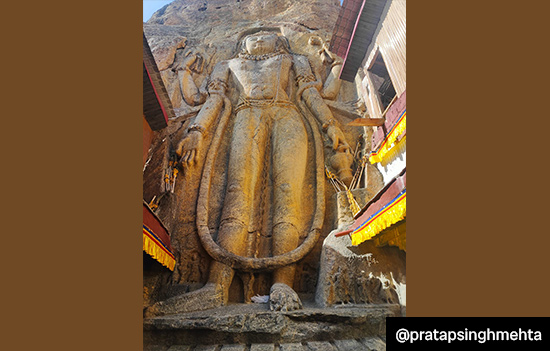 Maitreya Buddha, road from Leh to Kargil. Also found in Thiksey Monastery near Leh.
In the same way, Jātaka stories, which describe the Buddha’s past lives, developed to explain the long moral
and spiritual training needed to become a Buddha. At first, these stories were
meant to teach values like generosity, compassion, and self-sacrifice. Later,
they became more detailed and popular narratives. The Jātakas helped spread
Buddhism among ordinary people and strengthened the Bodhisattva ideal, which
later became central to Mahāyāna Buddhism.
Vajrayāna
From the Buddha’s Parinirvāṇa until the sack of Nalanda in 1197 A.D.—about seventeen centuries—Indian Buddhism went through three main phases: Hinayāna, Mahāyāna, and Vajrayāna (Esoteric or Tantric Buddhism). These phases were not completely separate; earlier forms continued alongside and influenced later ones.
Vajrayāna Buddhism is a unique blend of
mysticism and ritual, combining mantras (sacred sounds), yantras (magical
diagrams), mandalas (ritual circles), mudras (symbolic gestures), maithuna
(sexual rituals), yoga, a complex pantheon, elaborate worship, magic,
astrology, alchemy, symbolic practices, emphasis on the female principle, and a
monastic philosophy.
Mahayana was not the last major development in
Indian Buddhism. Between the 3rd and 7th centuries CE, new ideas emerged within
Mahayana that formed a new phase of Buddhism, often described as the third
turning of the Wheel of Dharma.
This tradition came to be known as Tantra,
also called Mantrayana (the Secret Mantra Vehicle) or Vajrayana (the Diamond
Vehicle). Although these terms are often used together, scholars note that they
are not exactly the same.
Traditionally, it is believed that Tantric
teachings were given by Buddha himself, but because they were highly
specialised, they were meant only for select practitioners. For this reason,
Tantra is often referred to as Esoteric Buddhism.
The word tantra also refers to a type of
scripture that explains these specialised teachings. Tantric
texts are considered a later addition to Buddhist literature, coming after the three original collections—the Vinaya, Sutta, and Abhidhamma Pitakas.
Tantric Buddhism, like all Buddhist
traditions, aims at Buddhahood. Tantric Buddhism is sometimes described as
presenting a shortcut to enlightenment (Tilawka Thera, Sakhare A, 2023). The
Vajrayāna technique adds skilled means to advanced Mahāyāna teachings for
advanced students (Sakhare, 2017,19). It is based on early Buddhist doctrine
and is philosophically rooted in Mahayana, especially the Madhyamaka idea of
emptiness (śūnyatā). Its distinctive feature lies
in its special methods of practice, which require guidance from a guru.
While the ideal figures of earlier traditions
are the arhat (Hīnayāna) and the bodhisattva (Mahayana), Tantra upholds the siddha, or accomplished adept, as its spiritual
ideal.
The origin of Buddhist Tantra is debated, but
it is best understood as part of the wider religious creativity of ancient
India, rather than as borrowed from Hindu Tantra. It developed in India for
several centuries before Buddhism declined there. Our
main knowledge of Buddhist Tantra comes from Tibet, where it was well
preserved, especially in the Gelugpa tradition. From Tibet, it spread across
the Himalayas, Mongolia, and Siberia. A smaller transmission went through China
to Japan, where it survives in the Shingon school.
KARMA has different meaning in
different schools
The Sarvāstivādins tried to explain karma by arguing that past, present, and future karmas all “exist”, so that actions (deeds) could be directly linked to their results.
This view, however, met with strong resistance from other Buddhist schools.
From the Mahāyāna perspective, karma is
explained through dependent origination and
emptiness (śūnyatā). Actions and their results are real at the conventional
level, but they do not exist as permanent entities. Karma functions through
causal relations without requiring the real existence of past and future karmas.
In Vajrayāna, karma is accepted as binding,
but it is seen as something that can be transformed
or purified through advanced methods such as mantra, ritual, meditation,
and yogic practices. Vajrayāna emphasizes the rapid transformation of karmic
tendencies rather than their denial, integrating karma with skillfull means on
the path to enlightenment.
Conclusion
Buddhism began with the Buddha’s quest to understand and end human suffering and developed into a rich and diverse tradition over many centuries. Through the Buddhist Councils, the Dhamma–Vinaya was preserved, clarified, and transmitted, even as differences in discipline and interpretation led to the formation of various schools.
Theravāda preserved the earliest teachings and
emphasized individual liberation through discipline, meditation, and wisdom.
Mahāyāna emerged as a reformist and socially engaged movement, expanding the
ideal of liberation through the Bodhisattva path, compassion, and profound
philosophical insights such as emptiness and Buddha-nature. Vajrayāna developed
later as an esoteric extension of Mahāyāna, introducing powerful ritual and
meditative methods aimed at rapid enlightenment.
Despite their differences, all three traditions share the same foundational goal: the eradication of suffering and the attainment of liberation, demonstrating Buddhism’s ability to adapt while remaining rooted in the Buddha’s original vision.
Author Amit Narwade is a PHD scholar, Somaiya
Vidyavihar University, Mumbai.
Source (numbers in article
refer to Source)
1.“Imasmiṁ kho, bhikkhave, Jambudīpe Tathāgato loke uppajjati…”- Aṅguttara Nikāya (AN 8.29 / AN 4.36). Meaning, Monks, it is in this Jambudīpa that a Tathāgata arises in the world... “Jambudīpe manussā dīghāyukā honti…”- Dīgha Nikāya – Mahāpadāna Sua (DN 14). Meaning “In Jambudīpa, humans are long-lived…”
2. “Jambudvīpe manuṣyaloke bodhisattvo jāyate”(Lalaitvistara). Meaning “In Jambudvīpa, in the human world, the Bodhisattva is born.”
3. According to the Brahma Jala sutta of Digha
Nikaya I, there were 62 philosophical views: Eternalism, annihilationism,
chance theories.
4. VP- Vinaya Pitaka, Mahavagga part I.
5. Mahāparinibbāna
Sutta, Dīgha Nikāya 16 (DN 16)
6. Bahuah
B, Buddhist sects and sectarianism, 2000, p.79, 80.
7.
Bahuah B, Buddhist sects and sectarianism, 2000, p. 78
References
1. Bapat P V, 2500
years of Buddhism, Ministry of Information and Broadcasting of India, 1956
2. Tilawka Thera,
Sakhare A, ETHICAL TEACHINGS IN BUDDHIST SCHOOLS, JETIR November 2023, Volume
10, Issue 11.
3. Dr. Jain Bhagchandra ‘Bhaskar’, Pali bhasha aur sahitya ka Itihaas, Alok Prakshan, Nagpur, 2012.
4. Dr. Sakhare Malti,
Understanding Dhamma, Sanket Prakashan, Nagpur, 2017 Coomaraswamy, Ananda K.,
Arts and Crafts of India and Ceylon, Farrar, Straus & Co., N.Y., 1964. 6.
Online Tripitaka. https://suttacetral.net
5. Bibhuti Baruah,
Buddhism sects and sectarianism, Sarup and sons, 2000
6.
Tipitaka.org
7. Nilinaksha Datta,
Buddhist sects in India, Narendra Prakash jain publication, 1998.
8.Suttacentral.net
Also read on eSamskriti (suggestions
by Editor)
1.
Author, spiritualist and British Council scholar Dr Satish Kapoor wrote in Introduction
to Buddhism-“On leaving home Buddha reached Vesali where he became a disciple of Alara Kalama (also known
as Arada Kalama) a scholar of the Sankhya school of philosophy. Alara
introduced him to the philosophy of the Upanishads and taught him the
techniques of meditation. But his quest for the ultimate Reality could not be
fulfilled, and he left him with five Brahmin ascetics.”
2.
Respected Guruji S.N. Goenka said
on the Vipassana Research
Institute site, “Vipassana is a technique of India. Laudable references to Vipassana are given in the Ṛg Veda. The most ancient literature of this country is full of words of praise for Vipassana:”
3. The
4 Noble Truths of Buddhism were echoes of Rishi Kapila’s original wisdom
according to former scholar President Dr. Radhakrishnan writings in Indian
Philosophy (1923). “The profound four-fold framework that Sage Kapila had already crystallized in the Samkhyapravacanabhasya – from the recognition of suffering, to the path of liberation, through the subtle understanding of prakrti and purusha, to the supreme discriminating wisdom – would later find a simplified reflection in Buddhist teachings.”
4.
Why
did Buddhism vanish from India
5.
Hindu deities
worshipped in Japan
6.
Harmonious blend
of Hinduism, Buddhism, Shinto strains in Japan
7.
How Hindu,
Buddhist strains are intertwined in Thailand, Japan and Cambodia
8.
Ramayana
performances in South-east Asian countries and Sri Lanka
9.
Samkhya and
Buddhism
10.
Vajrayana Buddhism
core tenets based on SAIVA SAKTA Philosophy
11.
Theravada Buddhism
as an Iteration of Classical Hindu Ascetic Praxis
12.
Lord INDRA in
Buddhism
13.
Dalai Lama
explaining Tantra in Buddhism – “His Holiness clarified that while the First Turning of the Wheel of Dharma dealt with the Four Noble Truths, teachings given in public, for which there is a historical record, the Second Turning deals with the Perfection of Wisdom teachings. The Third Turning deals with Buddha nature and the clear light nature of the mind and how to use it. This is the basis of the practice of secret mantra. He explained that the Second and Third Turnings did not take place in public but before a more select gathering of disciples.”
14.
What is common to
the Dhammapada and Bhagavad Gita
Photo credits - Cover by Benoy K Behl. All other, except Maitreyi Buddha by Sanjeev Nayyar.