- Over 24 points, this essay briefly covers the various stages of the evolution of Buddhism in India starting from Buddha to about 12th century A.D. Triend to provide answers to commonly asked questions.
We earlier shared Different Schools
of Buddhism
that included briefly early life of Buddha, four Buddhist Councils and different
schools in Buddhism.
An AI search
indicated stages of evolution. Briefly they were Origin (5-6th
century BCE), Expansion (3rd BCE), Rise of Schools (1st
BCE-8th CE), Monastic Centres (750-1200 CE) and Decline (post 12th
century CE).
This compilation
presents its evolution, marking key developments and putting dates where available.
To do so, referred to the History and
Culture of Indian People volumes 2, 3, 4, 5 published by Bharatiya Vidya
Bhavan. Read on.
1. Birth of Buddha – around 563 BCE at Lumbini.
2. Attaining
Enlightenment at Bodh Gaya at 598 or 623 BCE.
3. First Sermon at Sarnath – known today as Dhamek Stupa, its original name according to a 1029 A.D. inscription was ‘Dharma Chakra Stupa’.
4. Buddha gave up his body – around 483 BCE at Kushinagar.
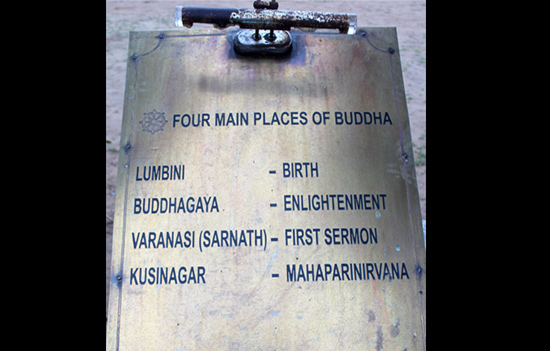 Major places associated with Buddha. Bodh Gaya 2012.
5. Noble Truths and Samkhya
The
4 Noble Truths of Buddhism were echoes of Rishi Kapila’s original wisdom according to
former scholar President Dr. Radhakrishnan writings in Indian
Philosophy (1923). “The profound four-fold framework that Sage Kapila had already crystallized in the Samkhyapravacanabhasya – from the recognition of suffering, to the path of liberation, through the subtle understanding of prakrti and purusha, to the supreme discriminating wisdom – would later find a simplified reflection in Buddhist teachings.” Read Samkhya and
Buddhism
6. First Buddhist Council,
Rajgir, 487 BCE
“Several important resolutions were adopted at this council to preserve Buddha’s teachings.” 2
7. Second Buddhist Council,
Vaishali, App 4th century BCE
PhD Scholar Amit Narwade wrote, “The primary purpose of this council was to resolve disputes concerning ten controversial monastic practices, most of which were related to the interpretation and observance of the Vinaya.” 2
It was for the first time that one knew of the division
between two monk groups known as the easterners and westerners. The former
lived at Vaishali/Pataliputra and the latter at Kausambi/Patheyya and Avanti
(Ujjain). 1 Pg 378
After this initial split, several Buddhist
schools later emerged. The Theravada got divided into eleven sects and the
Achariyavada into seven, all Hinayanists. The oldest
and most orthodox sect was Thervada (=Sans. Sthaviravada),
with its founder from Ujjain adopted Pali as the language of its Pitaka.
It was propagated in Ceylon. The other important branch of Thervada was the Sarvastivada, the language of its Pitaka was
Sanskrit. It became popular all over North India and made its way to Central
Asia, China. Mahasanghika sect became popular in Andhra Pradesh at Amaravati
and Nagarjunikonda. 1 Pg. 379-80
Buddhism was not a single monastic organization two centuries after Buddha’s death. Instead, it had numerous sects growing independently in India.
8. Third Buddhist Council,
Pataliputra, 3rd century BCE under Ashoka
“The principal objective of this council was to purify the Saṅgha by eliminating false monks and resolving doctrinal confusion.” 2 By purification Ashoka meant removal from the Sangha of non-Theravadins. 1 Pg. 382.
9. Fourth Buddhist Council,
Kashmir
“Is understood differently within various Buddhist traditions. The session synchronises with the emergence of Mahayanism.” 2
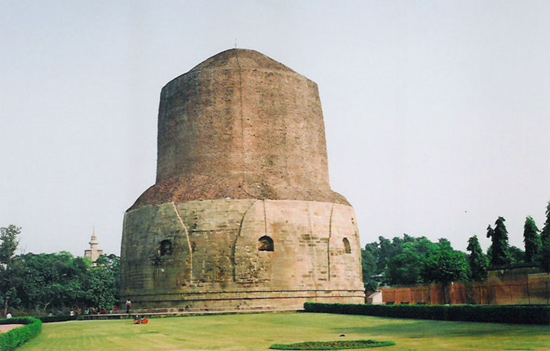 Dhameka Stupa, Sarnath. Original name ‘Dharma Chakra Stupa’.
10. Teachings called Hinayana were taught by Buddha, while the teachings known
as Mahayana developed later, after his death, through the reflections and
interpretations by his disciples.
Hinayana emphasizes Buddha’s practical and experiential (phenomenological)
teachings, whereas Mahayana expresses the deeper, introspective
understanding of reality attributed to the Buddha.
11. Theravada, also referred by its critics as Hinayana
(HIN-small vehicle); 3rd century BCE. Mahāyāna
(MAH-large vehicle) started around 1st century A.D.
HIN goal self-realization of individual. They
were semi-realists. The Hinayanists at first conceived of Buddha as an omniscient
human being and later as superior to all beings. A Hinayist is called a
Sravaka, aims for Arhathood and a
Mahayanist is a Bodhisattva, aims for
Buddhahood. In Hinayana, there were no deities. 5 Pg. 374-379
MAH goal is self-realization of all beings. Mahayanist
were negativists or idealists. They regarded Buddha as eternal without origin
and decay. 5 Pg. 375-378. Unlike Hinayana, MAH did not insist on a
person becoming a monk or nun.
The first condition that a Mahayanist had to fulfil was to take the vow of dedicating one’s own self to the service of others i.e. development of Bodhi-Chitta. His next duty was to commence fulfilling the six paramitas
(perfections in virtues) across many lives.
Mahayana stressed on Karuna
or compassion unlike Hinayana. In Hinayana, the final goal was attainment of Arhathood, dedication to personal liberation. The object of Karuna is to stimulate one to make use of one’s perfect knowledge in missionary activities for the benefit of the suffering world. 6A Pg. 405
The most popular Bodhisattvas were
Avalokitesvara, Manjusri, Vajrapani and Maitreya. In Mahayana a large number of
deities were included.
12. Tantrayāna 3rd to 7th
centuries BCE.
In the 5-6th century A.D. with the
gradual decline of Buddhist philosophical scholarship, the mantraic literature and ritualistic worship revived
with the appearance of a number of distinguished Tantric sadhakas.
In Vajrayana, the pantheon became large with
deities of every description. Within the fold of Vajrayana there arose, about the 10th
century A.D., a school known as Kalachakra-yana. The supreme deity is called
Lord Sri-Kalachakra. 6A Pg. 412 Its sphere of influence was limited to Bengal, South Bihar and Kashmir.
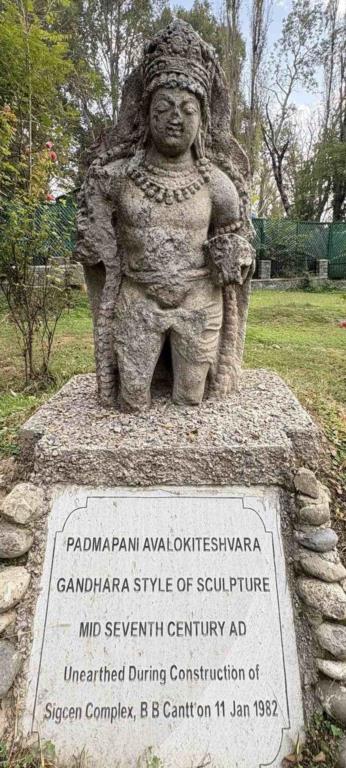 Padmapani Avalokitesvara. Gandhara School. Mid-7th century. By
Namrata Wakhloo.
Padmapani Avalokitesvara. Gandhara School. Mid-7th century. By
Namrata Wakhloo.
13. The Four Philosophical Schools of Buddhism
Hinayana and Mahayana Buddhism were divided into four speculative
schools. The former into Vaibhasikas
(Kashmir and Gandhara) and Sautrantika.
The latter into Madhyamika (founder
Nagarjuna who lived about 1st century A.D.) and Yogacharya (founded by Maitreyanatha, lived in Ayodhya 270-350
A.D.) 5 Pg. 390. Kumarajiva followed Madhyamika school and propagated this system of thought in China in 5th
century A.D.).
14. Introduction of Murty of Buddha - around 1st century A.D.
 Pranams. Sukhothai Historical Park, Thailand. Pic by Benoy K Behl.
Earlier devotees
worshipped symbols.1 Pg. 387 This paved the way for the advent of Mahayanism.
15. Mahayana Buddhism
emerged around 5 centuries after Buddha death
Mahayana Buddhism originated around the 1st
century B.C. in undivided Andhra Pradesh. It spread across India 1-2nd
century A.D. 1 Pg. 388 Nagarjuna (Brahmin by birth) was one of the key thinkers who shaped Mahayana thought.
For simplicity Hinayana relates to Thervada that preserves Buddha’s original teachings. “Mahāyāna Buddhism emerged about five centuries after the Buddha’s death. It represented Buddhism as
a compassionate, socially engaged, and accessible tradition that welcomed lay participation.”
“A defining feature of Mahāyāna is the introduction of a new spiritual ideal—the Bodhisattva. A Bodhisattva is an “Awakening Being”. The Bodhisattva aims to achieve liberation for the benefit of all human beings. “The development of celestial Bodhisattvas such as Avalokiteśvara further encouraged devotional practices, including prayer and worship.”
16. Doctrinal Changes-Emergence of Tantrikism 320 to 750 A.D.
This part is verbatim from History and Culture of Indian
People Volume 4.
During this period original philosophical principles were
superimposed by an esoteric Yogic system, combined with endless rituals and
forms of worship, that it could hardly be called Buddhism any longer. The
religion lost itself in the maze of mysticism and was engulfed by a host of mudras, mandalas, kriyas and charyas. The mission of Buddha was to
wean away the Indian mind from the blind faith in the efficacy of worship and
rituals passed into oblivion, and the learning of the mind towards worship of
divinities and veneration for rituals and mystical utterances. 6 Pg. 259-260
The earliest literature which may be called a precursor of
Tantra was known as the Dharanas and
formed a part of the Mahayana-sutras- about
4th century A.D. It is
text devoted to Avalokitesvara who with TARA formed the chief deities of
worship in the early Tantra literature. The utterance of the Dharanas or
Mantrapadas was preceded and followed by an elaborate ritualistic worship of
Buddhas, Bodhisattvas and other deities. 6 Pg. 261
In the Karandvyuha
(4th century A.D.) we come across for the first time the well- known mantra ‘Om madipadme hum’. Repetition of these words led to attainment of the truth.
Up to 4th century A.D., Bodhisattva Avalokitesvara
was the chief object of worship and goddess
Tara not yet included in the Buddhist pantheon. 6 Pg. 262
It is from the 7th century A.D. that we find
exuberance of Tara-sotras and goddess
Tara raised to the mothership of all Buddhas and a companion of Avalokitesvara.
This is almost like Siva Sakti in concept. 6 Pg.
263
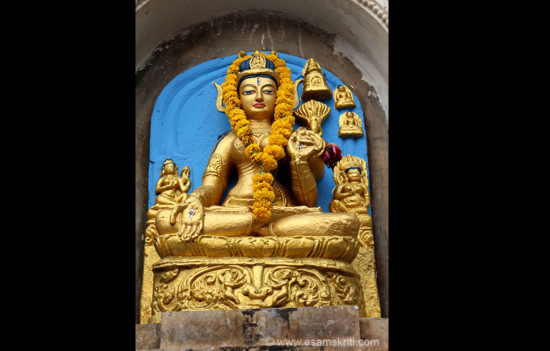 Tara in Bodh Gaya Temple. 2012.
The earliest texts dealing with Tantrik Buddhism are Manjusrimulakalpa and Guhyasamaja. The latter deals with yoga
and mandalas, gives exposition of the truth which is the Vajra or oneness of the Universe. The former gives an exposition of
mudras, mandalas, mantras, kriyas and charyas. There is a section devoted to directions for drawing pictures
of different Buddhas, Bodhisattvas, Taras etc.
Difference between
Tantrikism and Mahayanism (Madhyamika-Yogacharya
systems) was in the ways and methods of realizing the highest truth. The former
takes the aid of mudras, mandalas and mantras and even takes recourse to
hatha-yoga.
17. Tibetan Buddhism - Vajrayana
“While the ideal figures of earlier traditions are the arhat (Hīnayāna)
and the bodhisattva (Mahayana), Tantra
upholds the siddha, or accomplished
adept, as its spiritual ideal. 2
“Our main knowledge of Buddhist Tantra comes from Tibet, where it was well preserved, especially in the Gelugpa tradition.” 2 The
universities of eastern India and Kashmir began genial centre of the cultivation of Tibetan.
Tibetan Buddhist literature was due to contribution of both Indian scholars and
Tibetans.
Padmasambhava established Vajrayana form
of Buddhism in Tibet in the 8th century. The primitive religion of
Tibet, before introduction of Buddhism was Bon (Phon). RKM Cultural Heritage of India Vol 1 Pg. 501. Guru Padmasambhava
said to have taken a giant leap from Rewalsar Lake (Himachal) to Tibet.
Atisa Dipankara (11th
century) of Bengal is considered possibly the most outstanding personality in
the Buddhist world after Nagarjuna. He spent 13 years in Tibet. 6A Pg 416-18 The Gelugpa sect is the dominant sect in Tibet, was founded in the 14th century,
in known as the School of the Virtuous.
Its followers wear yellow caps. RKM
Kashmir was another vigorous centre of
Buddhism. When Buddhism was persecuted in Tibet by Glan-dar-ma, it was revived
mostly by Kashmiri sramanas. Also, a
number of sramanas who went over to
China in the 10-11th centuries belonged to Kashmir. 6A Pg 419
Buddhism found a last refuge in Nepal. “Japan received Buddhism from China through Korea in 552 A.D.” RKM Vol 1 Pg. 498
18. Who built Sanchi Stupa?
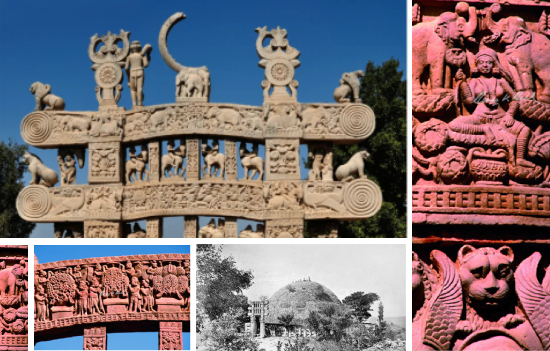 Pic by Benoy K Behl.
Ashoka built Stupa 1 or Great Stupa. It was enlarged
by Sungas (Hindus-185 BC-73 AD). Gateway built in first century BC by
Satvahanas (Hindus). During Gupta period, several temples were built/sculptures
added. Construction continued up to 12th century. Read Who
built Sanchi Stupa
19. Bodh Gaya Mandir was completed by the Gupta Kings around 7th century. Temple destroyed by Turkish
invaders in early 13th century. Senior journalist wrote Sandhya Jain
wrote, “Around 1590 a Saivite saint took charge of the Mahavira. In 1883, Sir Alexander Cunningham, J.D.M. Beglar and Dr Rajendra Lal Mitra renovated the temple on scientific lines.”
20. Pala rulers of modern day Bengal and Bihar were Buddhist. During their four century rule Buddhist found a safe refuge after it ceased to have any footing in other parts of India barring Kashmir etc.
First Pala ruler
Gopala revived Nalanda. During his rule Odantapuri monastery was built. The
great philosopher Santarakshita lived during his reign and went to Tibet,
stayed there up to 762 A.D. There he was called Pandita Bodhisattva. The next
king Dharmapala founded the Vikramasila monastery in Bihar where several
Sanskrit texts were translated into Tibetan.
Ganapati is
present in the Mahayana pantheon. He is generally depicted as being trampled
down under the feet of such goddesses as Aparnajita and Parnasavari.
21. The ideas of the Maitreya Buddha and
the Jataka tradition developed slowly within Buddhism as part of its natural
historical and doctrinal growth.
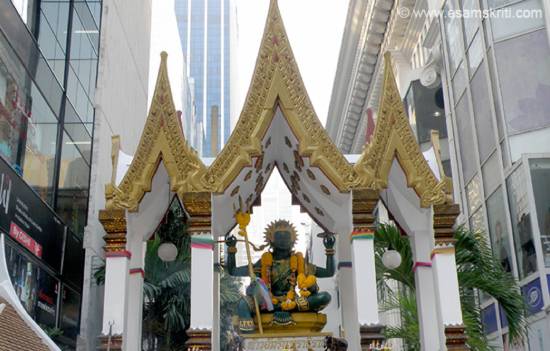 Lord Indra Temple in Sukumwit Street, Bangkok. 2009.
22. Lord Indra in Buddhism
Prof Shashi Bala, Dean, K M Munshi Centre of Indology, Bharatiya Vidya Bhavan, New Delhi wrote, “Why Lord Indra, a Vedic deity was taken into the fold of Buddhism, was never a question in the minds of the Buddhists all over Asia. It was the philosophy of transcendence in life that lays behind it.”
“Indra is present in Buddhist art in several forms in Asian countries. He has been worshipped in Nepal, China, Manchuria, Japan, Korea, Mongolia, Tibet and even in Central Asia by the Uighurs. He has been painted, sculpted, and drawn for over more than a millennium. His statues and paintings can be found in the Yunkang caves, the Guge thangkas, Japanese scrolls, Mongolian and Tibetan xylographs.”
23. Who are Dhyani Buddhas?
“It
is in the Guhyasamaja that we find
the idea of Buddhist pantheon properly crystallised. We find the description of
five Dhyani Buddhas, their mantras,
their mandalas (circle of deities)
and their Saktis of female counterparts.
These Dhyani Buddhas represent the five skandhas
or elements of which the world is composed.” RKM Vol 1 Pg. 525
24. Why did Buddhism vanish
from India?
There were nine
reasons why Buddhism vanished from India the key ones being destruction of
monasteries in Bengal and Bihar by foreign invaders. Dr B R Ambedkar addressed delegates of Young Men’s Buddhist Association in May 1950 at Colombo on ‘Rise & fall of Buddhism in India’ and said (excerpts), “Buddhism in its material form had disappeared. I agree. But as a spiritual force it still exists.” To read full article
At the 1893 Parliament of Religions Chicago Swami Vivekananda said, “The relation between Hinduism (by Hinduism, I mean the religion of the Vedas) and what is called Buddhism at the present day is nearly the same between Judaism & Christianity. Jesus Christ was a Jew, and Shakya Muni as a Hindu, The Jews rejected Jesus Christ, nay, crucified him, and the Hindus have accepted Shakya Muni as God and worship him. But the real difference that we Hindus want to show between modern Buddhism and what we should understand as teachings of Lord Buddha lies principally in this: Shakya Muni came to preach nothing new.”
Prof Padmanabh Jaini in his Collected Papers on Buddhist Studies has made an excellent study on
the reasons for Survival of Jainism and Disappearance of Buddhism in India.
Read page 140.
Notwithstanding the above Buddhist Caves at Ellora stood side by side alongside the Hindu and Jain ones for centuries and to this day. “In modern Balinese theology Buddha is regarded as a younger brother of Siva.” 6A Pg. 402
Between 750-1000 A.D. Buddha was declared as an incarnation
of Lord Vishnu. His painting is found in Brihadesvara Temple, Thanjavur and sculpture
in Rani-ki-vav, Patan, Gujarat.
Errors if any are
unintentional. As always, I am happy to stand corrected. Love.
To read all articles
on Buddha Vakhya
References and Also read
1. History and
Culture of Indian People Volume 2.
2. Introduction to
Buddhism
by Amit Narwade, a PHD
scholar, Somaiya Vidyavihar University, Mumbai.
3. Album
Sarnath
4. Album
Bodh Gaya
5. History and
Culture of Indian People Volume 3.
6. History and
Culture of Indian People Volume 4.
6A. History and
Culture of Indian People Volume 5.
7. Who built Sanchi
Stupa
8. Atishi journey
from Bengal to Tibet via Sumatra
8. Kumarajiva a great
Buddhist Master – from Kashmir lived 5th century A.D.
9. Lord Indra in
Buddhism
10. Are Ambedkarites
Buddhist
11. Why did Buddhism
vanish from India
12.
Hindu deities
worshipped in Japan
13.
Harmonious blend
of Hinduism, Buddhism, Shinto strains in Japan
14.
How Hindu,
Buddhist strains are intertwined in Thailand, Japan and Cambodia
15.
Samkhya and
Buddhism
16.
Vajrayana Buddhism
core tenets based on SAIVA SAKTA Philosophy
17.
Theravada Buddhism
as an Iteration of Classical Hindu Ascetic Praxis
18.
Lord INDRA in
Buddhism
19.
Dalai Lama explaining
Tantra in Buddhism – “His Holiness clarified that while the First Turning of the Wheel of Dharma dealt with the Four Noble Truths, teachings given in public, for which there is a historical record, the Second Turning deals with the Perfection of Wisdom teachings. The Third Turning deals with Buddha nature and the clear light nature of the mind and how to use it. This is the basis of the practice of secret mantra. He explained that the Second and Third Turnings did not take place in public but before a more select gathering of disciples.”
20.
What is common to
the Dhammapada and Bhagavad Gita