- This photo feature has some outstanding pictures of the Brihadeshwara Temple along with a good write-up on the temple.
Introduction
My visit to Thanjavur in February 2023 was a profound journey into the heart of Chola excellence. The Brihadeshwara Temple, also known as the "Big Temple" or Peruvudaiyar Kovil, is a spiritual and engineering marvel that has anchored the Kaveri delta for over a millennium.
Commissioned by
Raja Raja Chola I and consecrated in 1010 CE, it stands as a testament to a
dynasty that combined administrative precision with divine artistic vision.
Walking into the
complex, one is immediately struck by the sheer scale. Unlike other South
Indian temples where the entrance Gopurams are the tallest features, here, the Vimana
(shrine tower) reigns supreme, asserting the central importance of the deity
within.
A Journey in Pictures
1. The Keralantakan
Tiruvasal
The approach begins at this outer gateway, named to commemorate Raja Raja I’s victory over the Chera king. Its towering presence against the sky establishes the monumental scale of the "Big Temple" before one even enters the main courtyard.
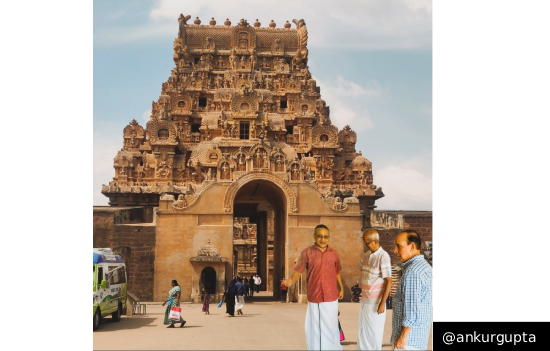 Outer Keralantakan Tiruvasal gopuram.
2. The Gateway of the Great King
The journey
continues through the Rajarajan Tiruvasal. A close study of this second gateway
reveals the transition from pure structural strength to artistic finesse, with
intricate Vimana-like carvings and massive monolithic Dvarapalas (guardian
deities) flanking the entrance.
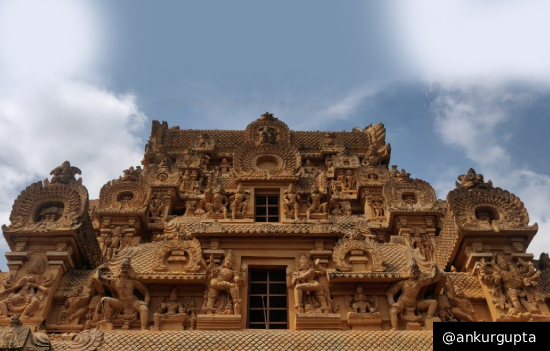 Inner Rajarajan Tiruvasal entrance. Close-up of
gateway facade and sculptures.
Inner Rajarajan Tiruvasal entrance. Close-up of
gateway facade and sculptures.
3. The Chronicles in
Granite
One of the most significant aspects of this temple is its role as a historical archive. The base of the main shrine is covered in meticulous Tamil inscriptions. These 1,000-year-old records detail land grants, the names of 400 temple dancers, and administrative wages—proving the temple was the socio-economic hub of the empire.
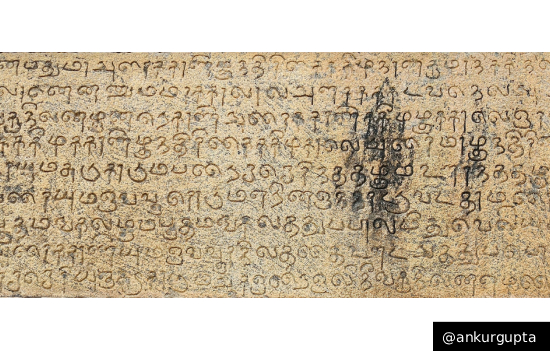 Detail of granite wall inscriptions.
4. Alignment of the Sacred
Axis
Standing by the
soaring Dwajasthambam (Flag Post), one can appreciate the precise spatial
planning of the Chola architects. The vertical alignment of the pillar against
the distant 216-foot Vimana illustrates a symbolic bridge between the earth and
the heavens.
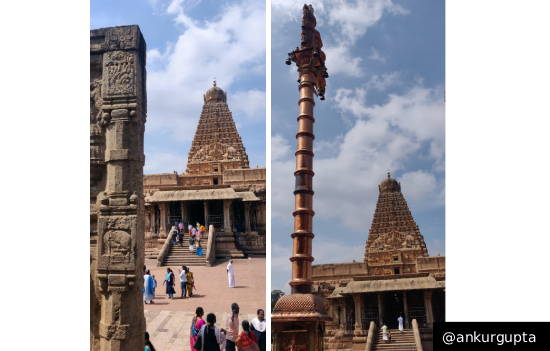 Spatial view of pillars and Vimana. Dwajasthambam
(Flag Post).
Spatial view of pillars and Vimana. Dwajasthambam
(Flag Post).
5. The Monolithic Guardian
The Nandi Mandapa
houses a colossal monolithic Nandi, one of the largest in Bharat. Carved from a
single stone, the bull sits in eternal gaze toward the Lord. The wide-angle
perspective captures the Nandi under its ornate pavilion with the towering
shrine rising behind it.
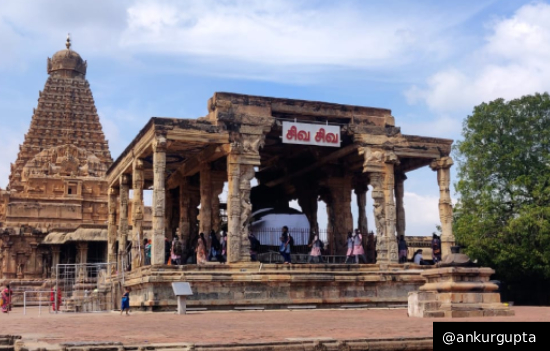 The monolithic Nandi bull. Wide-angle courtyard view
with Nandi Mandapa.
The monolithic Nandi bull. Wide-angle courtyard view
with Nandi Mandapa.
6. The Engineering Marvel
The Sri Vimana
rises to a height of 216 feet. It is built entirely of interlocking granite
blocks without the use of mortar. At its apex sits the Kumbam, a monolithic capstone weighing approximately 80 tons,
lifted to this height via a legendary 6km long ramp.
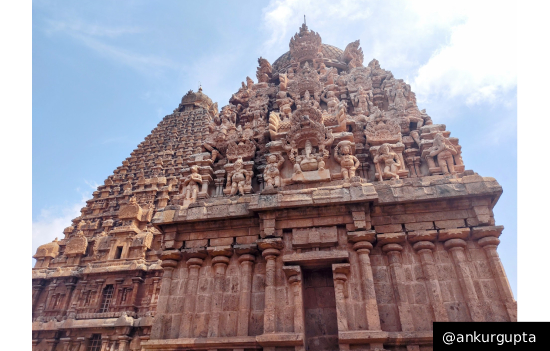 Full profile of the 216-foot Sri Vimana.
7. Divine Artistry in Stone
The exterior walls
are a gallery of Dev-Koshtas (niche deities). These sculptures, such as
Dakshinamurti and Durga, show case the fluid anatomy and serene expressions
unique to Chola art, where hard granite appears to have the softness of silk.
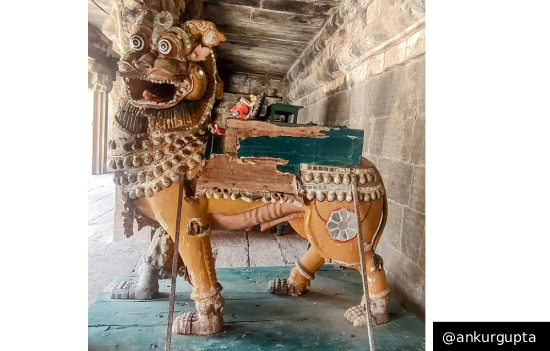 Sculptural detail from a temple niche.
8. The Cloistered Walkways
and Framed Vistas
The courtyard is
enclosed by a pillared Prakara. Using these internal corridors to frame the outer gateways highlights the "city within a city" feel of the complex, emphasizing the rhythmic geometry that defines the space.
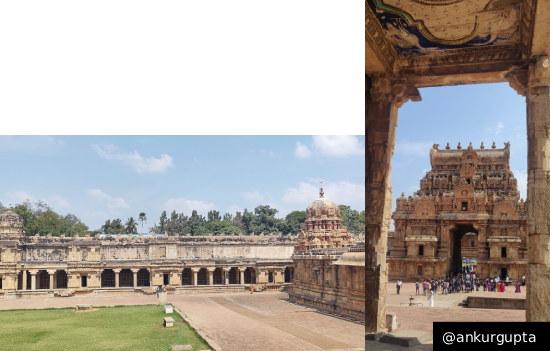 Long corridors of the Prakara. Gateway framed through interior pillars.
9. Hidden Soul
The Chola Murals-Beyond the stone, the temple preserves rare Chola Frescoes in the inner sanctum’s corridor. These vibrant paintings, rediscovered in the 1930s, depict scenes of Shiva as Tripurantaka and represent a peak in Indian mural tradition.
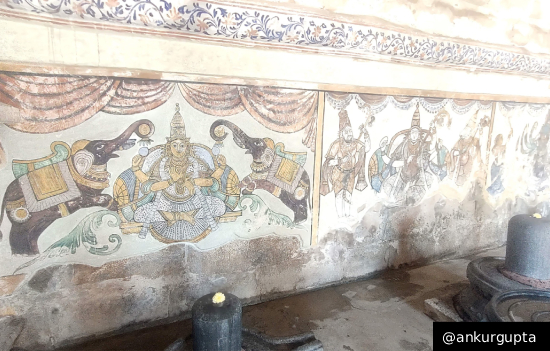 Chola-era mural painting.
10. A Living Legacy at Sunset
As the sun sets,
the granite reflects a warm, golden hue. Despite being a UNESCO World Heritage
site, Brihadeshwara remains a living temple. The vibrant colors of devotees
against the ancient stone ground this millennium of history in a continuous
pulse of worship.
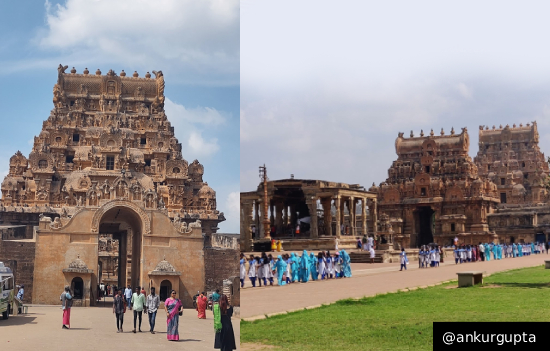 Panorama of the temple at sunset. Current-day
devotees in the courtyard.
Panorama of the temple at sunset. Current-day
devotees in the courtyard.
Tourist Information
a. Best Time to
Visit: The ideal time to visit is during the cooler months (October to March).
b. Temple Timings:
6:00 AM to 12:30 PM and 4:00 PM to 8:30 PM.
c. Location:
Thanjavur is well-connected by rail and road; the nearest airport is
Tiruchirappalli (TRZ), approximately 60 km away.
d. Photography:
Allowed in the outer courtyards and Prakara; strictly prohibited inside the
main sanctum.
e. Nearby Attractions: The Maratha Palace complex, the Saraswathi Mahal Library, and the nearby "Great Living Chola Temples" at Gangaikonda Cholapuram and Darasuram.
To see albums of
1. Big
Temple in detail
2. Maratha
Palace
3. Art
Gallery in Maratha Palace
4. Gangaikonda
Cholapuram Temple
5. Darasuram
Temple
Travelogue
in Hindi
To read all articles
by author