- This
photo feature, being part five in the series on Khajuraho, tells you about the Varaha
Temple.
Text and Images by Ankur Gupta
This is the fifth in a series of photo
features on Khajuraho Temples. First was Introduction to
Khajuraho.
Second was Kandariya
Mahadev and Lakshmana Temples. Third was Chaturbhuj
Temple. Fourth was Dulhadeo
Temple.
Padavali Temple
Morena,
near Gwalior) is widely considered the
stylistic inspiration for the grandeur seen here.
The Cosmic Protector:
Exploring the Varaha Temple
While the towering shikharas of the Western Group, such as the Lakshmana
Temple, dominate the Khajuraho skyline, one of the most intellectually and
spiritually dense monuments is a modest, open-air pavilion located just steps
away from the main entrance.
The Varaha Temple, dating back to roughly 900–925 AD, serves as a grand theological introduction for visitors entering the UNESCO World Heritage site. It is not a temple in the traditional sense of a sprawling sanctuary; rather, it is a dedicated architectural "jewel box" designed to protect and display one of the most extraordinary monolithic sculptures in India.
Architectural Simplicity and Sacred Geometry
As seen in the wide view of the temple, the structure is a simple,
oblong pavilion built on a high stone platform (jagati). Unlike its
larger neighbours that feature dark, enclosed sanctums, the Varaha shrine is
entirely open to the elements, consisting of a pyramidal roof supported by
fourteen plain, sturdy pillars. This intentional design ensures that the
masterpiece within is bathed in natural light throughout the day, allowing the
intricate details of the sandstone to be visible from every angle.
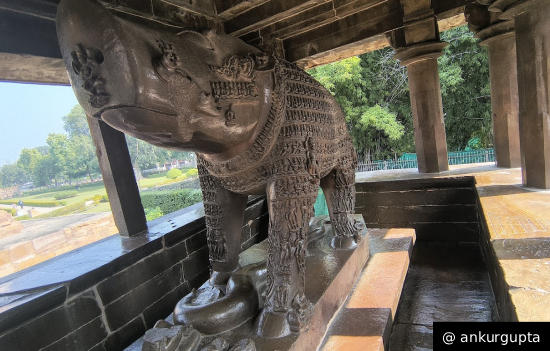 Wide view of the open-air
pavilion and the fourteen pillars.
Wide view of the open-air
pavilion and the fourteen pillars.
The Monolithic Masterpiece: The Boar of
Khajuraho
The heart of this shrine is a massive, highly polished sandstone
sculpture of Varaha, the
boar incarnation of Lord Vishnu. Measuring over 2.5 meters in length and
standing nearly 2 meters tall, the sculpture is carved from a single block of
yellow sandstone. As captured in the first pic, the sculpture's scale is
immediately imposing, commanding the space within the pavilion.
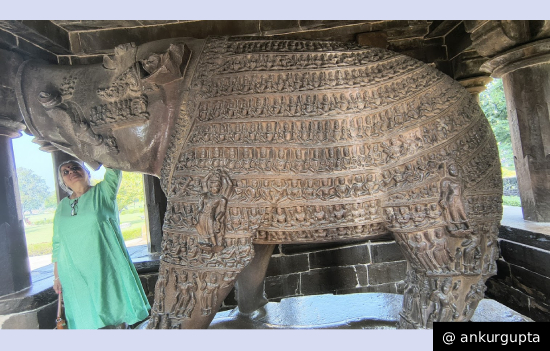 Side profile highlighting the high-polish finish and the scale of the monolith.
The boar is not merely a representation of an animal; it is a cosmic map.
As seen in the macro-detail, every square inch of its body is intricately
carved with hundreds of miniature figures representing the entire Hindu
pantheon. These include gods, goddesses, celestial beings, and the Saptarishis (seven
sages). The sheer density of the carving suggests that the entire universe and
all its divine inhabitants reside within the skin of the protector.
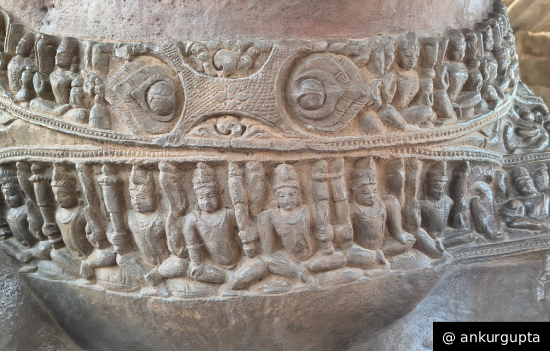 Close-up detail of the hundreds of miniature deities carved across the boar's body.
The Tradition of the Cosmic Ocean
The sculpture depicts a pivotal moment in Hindu tradition: the rescue of
the Earth. According to the Puranas, a powerful demon named Hiranyaksha had
stolen the Earth (represented as the goddess Bhudevi) and carried her to the
bottom of the cosmic ocean. Vishnu assumed the form of a gargantuan boar to
dive into the depths and rescue her.
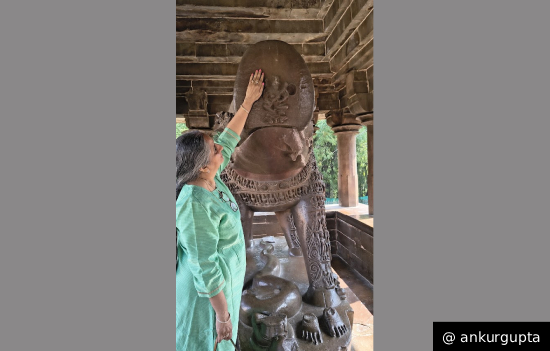 The monolithic Varaha sculpture
showing the intricate snout and the figure of Bhudevi.
The monolithic Varaha sculpture
showing the intricate snout and the figure of Bhudevi.
After a battle that lasted a thousand years, Varaha slew the demon and
lifted the Earth out of the water between his tusks. While the original figure
of Bhudevi between the tusks has weathered over time, the sculpture still
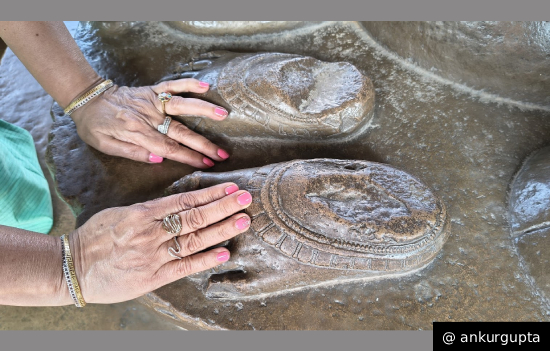
conveys the raw power of this restorative act. This profound connection between
the devotee and the divine remains alive today; pic below captures a lady
devotee in a moment of deep prayer, touching the feet of the deity, bridging a
thousand years of history with a single gesture of faith.
Artistic Refinement and Symbolism
The polish on the sandstone, visible in the side profile pic above, is so refined that it gives the stone a metallic, almost jade-like sheen—a testament to the advanced lapidary skills of the Chandela craftsmen. Beneath the boar lies the coiled serpent Sesha, representing eternity. The figures are arranged in rhythmic rows, including the Dikpalas (guardians
of directions), ensuring that every angle of the monolith tells a different
story of the heavens.
Traveller’s Tips
1. Location: Located just opposite the Lakshmi Temple and south of the Lakshmana
Temple.
2. Photography: Walk around the sculpture 360 degrees. The most intricate carvings are
often on the side facing away from the main walkway.
3. Symbolic Sequence: Most guides recommend visiting this shrine first.
It provides the context for Vishnu's role before you explore his more
human-like forms in the larger temples nearby.
The Varaha Temple may be small in stature, but its monolithic resident
serves as a powerful reminder of the artistic and spiritual heights reached by
the Chandela dynasty over a millennium ago.
To read all
articles by author And To read all
articles on India Travels and Yatras
Also read/see
1. Meaning behind
Erotic Sculptures in Khajuraho
2. Pics of Vishwanatha temple
3.
Pics of Western Group
temples
4.
Pics of Kandariya Mahadeva
Temple
5.
Pics of Vamana Temple and
Dulhadeo/Chaturbhuj Temples.
6.
Pics of Jain temples
7. All about
Khajuraho Temples
8. Khajuraho Temples
a Journey from Real to Surreal
9. MP Tourism site on
Khajuraho
10. Pics of Lakshmana
Temple
and Matangeshwara Temple
11. Khajuraho Dance
Festival
12. Padavali Temple
Morena,
near Gwalior) is supposed to be the inspiration for Khajuraho
13.
Travelogue
Khajuraho, Chitrakoot and Prayagraj
14.
UNESCO site
15.
For a 30 page PDF
on the Temples of Khajuraho