- Photo feature is of a app 2150 years old pillar made by a Greek follower of Sri Krishna, Heliodorus. What is the importance of this pillar?
Whilst
researching Who made Sanchi
Stupa
did I start reading more about Vidisha. I got to know about the Heliodorus
Pillar when art historian and photographer Benoy K Behl wrote, “The
city of Vidisha, present-day Besnagar in Madhya Pradesh, was on the trade route
which connected the plains of the Ganga to the Western Coast. It was also a
great market place, at the centre of the vast and fertile plains of Central
India. Among the earliest objects to be
found here is a large stone pillar with an inscription, dated between 120–100 BCE. It was set up by a Greek devotee named Heliodorus, in honour of Vasudeva, another name of Lord Vishnu.”
A
month so later, an old friend Dilip forwarded me a video by noted historian Dr Meenakshi Jain. She spoke about the Heliodorus Pillar in more detail in Sangam Talks video. That goaded me to compile this piece.
Vidisha
based guide Ranjit Singh, whom I know, was nice enough to send me pictures of
the pillar, adjoining areas and board by ASI Bhopal. A couple of Professors
helped too by sharing.
It
is called Heliodorus/Garuda Pillar or Khamba Baba and app 2150 years old. Dr
Jain says that Vidisha was a place of pilgrimage then which is why Heliodorus
came there meaning he did not create a sacred site.
Format
is pic of ASI Bhopal board, matter as written on board, insights esp.
importance of Heliodorus Pillar and our understanding of that period.
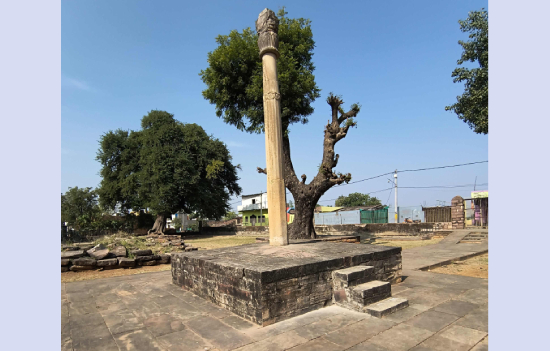 Heliodorus Pillar. Inscriptions on lower part of pillar. Pic by Ranjit Singh Guide.
 Close-up of inscription on pillar. Pic by Ranjit Singh Guide.
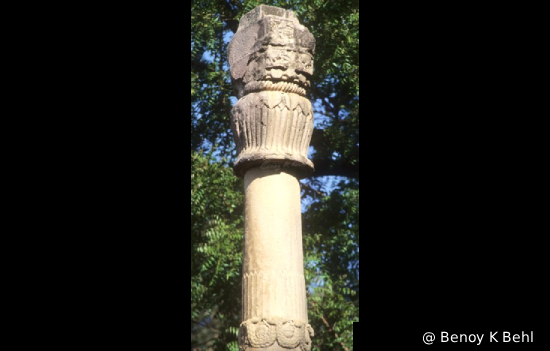 Close-up of top part of pillar. Pic by Benoy K Behl.
Picture 4
 Pic
by Ranjit Singh Guide.
Pic
by Ranjit Singh Guide.
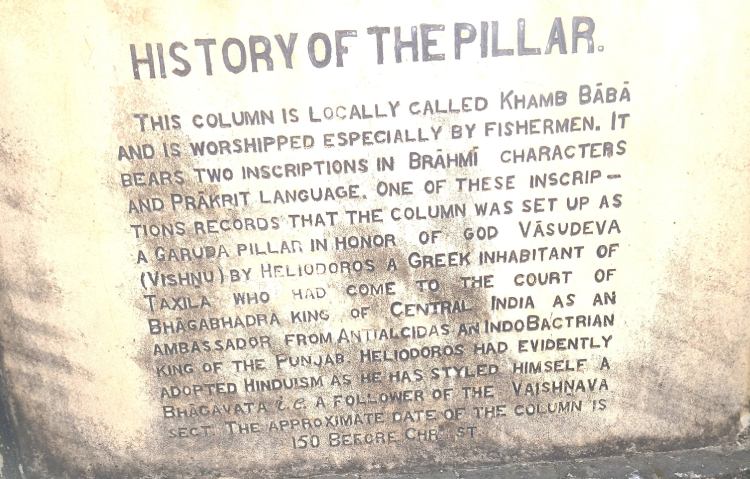
“KHAMBA BABA. It is worshipped esp. by Fisherman. It has two inscriptions in Brahmi script and Prakrit language. One of these inscriptions states that this column was set up as a GARUDA pillar in honour of God Vasudeva (Vishnu) by Heliodorus, a Greek inhabitant of Taxila who had come to the
court of a Bhagabhadra King of Central India as an Ambassador from Antialcidas,
an Indo Bactrian King of Punjab. Heliodorus had adopted Hinduism as he styled
himself as a Bhagavata i.e. follower of the Vaishnava sect. The app date of the Khamba is 150 years before Christ.”
Picture 5
 Pic
by Ranjit Singh Guide.
Pic
by Ranjit Singh Guide.
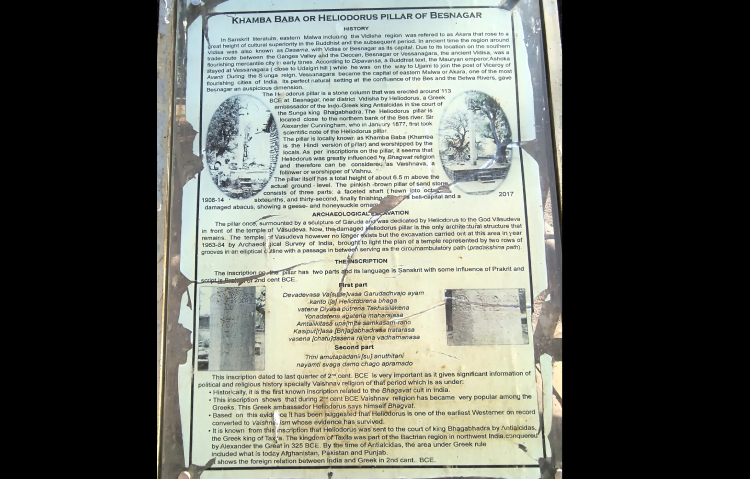
History: “The pillar was constructed around 113 BCE. The pillar has a total height of 6.5 metres. The pinkish brown pillar in sandstone consists of three parts – a faceted shaft, finally finishing with a bell capital and a damaged abacus showing a geese and honey suckle ornament.
The pillar, once surmounted by a sculpture of Garuda was dedicated by Heliodorus to Vasudeva in front of the temple of Vasudeva. The temple no longer remains but excavations by the ASI in 1963-64 brought to line the plans of the temple represented by two rows of grooves in an elliptical outline with a passage in between serving as the circumambulatory path (pradikshana path).”
Inscription has 2 parts is
in Sanskrit with a little bit of Prakrit with the script being Brahmi dated to
2nd century BCE.
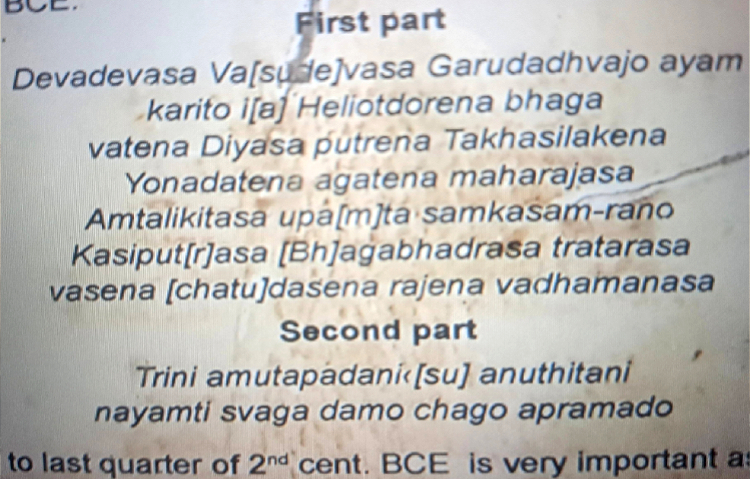 Inscription. Pic by Ranjit Singh Guide.
Professor 1 views – “The first part identifies the pillar as a "Garuda-standard" for the "God of Gods" Vāsudeva (Krishna). The second part lists three virtues: self-restraint (dama),
charity (chaga), and
conscientiousness (apramada), which lead to heaven. The inscription is a crucial historical and religious artefact documenting the presence of Indo-Greeks who adopted Vaishnavism.”
 Garuda in a Bangkok, Thailand Hotel. 2009
Professor
1 views in Hindi
पहला भाग:
देवदेवास वासुदेवास गरुड़ध्वजो अयं
देवताओं के देवता वासुदेव के लिए, यह गरुड़-स्तंभ।
कारितो इअ हेलिओदोरेना भगवातेना दियासा पुत्रेना तकखसिलाकेना योनदातेना आगतेना महाराजसा अमतालिखितसा उपं[त] संकासम-रानो कासीपुत्रसा भगभद्रसा त्रातारसा वसेना चतुदसेना राजेन वधमानसा
इसे तक्षशिला के निवासी, दिय के पुत्र, भागवत हेलिओडोरस ने बनवाया था, जो महाराजा अंतलिखित (अंतियालकीदास) के पास से आए थे, जो काशीपुत्र भागभद्र, उद्धारकर्ता राजा के चौदहवें शासनकाल के दौरान (यहाँ) आए थे।
दूसरा भाग:
त्रीणि अमुतापदानि [सु] अनुथित्तानि नयंति स्वगा दमो छागो अप्रमादो
तीन अमर पद (सिद्धांत), जब अच्छी तरह से अभ्यास किए जाते हैं, स्वर्ग ले जाते हैं: संयम (दम), त्याग (छाग), और सावधानी (अप्रमाद)।
Professor 2 shares from Ref 1
“Garuddhvaj /Pillar inscription by Helidoros, Besnagar,Vidisha, c.2nd cent CE
Language- Central-western epigraphic Prakrit,
with a few Sanskritised words. Svript-Brahmi of Shunga period
Inscribed Text part I
Line 1 Text - devadevasa vasudejsva garuddhvaje ayam
Translation - This Garud-standard (Dhvaj/pillar)
of Vasudeva, the god of gods
Line 2 Text - karito i (a) Helidorena bhag
Trans- was constructed by Helidora (Heliodoros),
the Bhagavata,
Line 3 Text - vatena Diyasa putrena Takhkhasilakena
Trans - son of Dion,a man of
Takhkhasila(Taxila),
Line 4 Text - yonadatena agatena maharajasa
Trans - the Greek ambassador who came from the
great king
Line 5 Text - Amtalikitasa upa(m)ta samkasam ranon
Trans - Amtalikita(Antialkidas) to kingnormal'
Line 6 Text - Kasiput(r)asa (Bh)agabhadrasa tratarasa
Trans - Kasiputra Bhagabhadra,the Savior,
Line 7 vatena
(chatu)dasemna rajena vadhamanasa
Trans - prospering in (his) fourteenth regnal
year.
Inscribed Text part II quotes from the Mahabharat verbatim
Line 1 Text - Trini amit-- padani (i me) (su) anuthitani
(These?) three steps to immortality, when
correctly followed
Line 2 Text - neyami sva(gam) dama caga apramadan
Trans leads to heaven: control, generosity, attention.” 1 (see Prof 1 for Indic
view)
eSamskriti
author
Dr Subhasis Chattopadhyay says, “This
opening invocation-devadevasā vāsudevasā
garuḍadhvajo ayaṁ is a direct allusion to the Mahābhārata, Book 12 (Śānti
Parva), where Kṛṣṇa is called Deva-deva (“God of gods”) and Vāsudeva (“son of
Vasudeva”). Specifically, the phrase “Deva-devas
Vāsudevas” occurs in: Mahābhārata Śānti Parva 349.65 (critical edition), where
Bhīṣma describes Kṛṣṇa to Yudhiṣṭhira as: Eṣa
devo devānāṁ Vāsudevo Janārdanaḥ. “This god of gods is Vāsudeva,
Janārdana.”
This inscription important for the following reasons (partly
taken from board) -
1. Greeks inhabited
Taxila in the 2nd century BCE.
2. Greeks worshipped Krishna then–first inscription of the Bhagavat cult in India.
3. It confirms the
existence of Krishna worship.
4. Vaishnav sect
had become popular with Greeks with Heliodorus himself being a Vaishnav.
5. Heliodorus, a
Greek inhabitant of Taxila had come to the court of a Bhagabhadra King of
Central India as an Ambassador from Antialcidas, an Indo Bactrian King of
Punjab. By the time of Antialcidas, the area under Greek rule included modern
day Afghanistan, Pakistan and Punjab.
6. Existence of a Krishna Temple near the pillar. Dr Jain says that similar pillars probably made for other members of Krishna’s family.
7. Dr Jain says
that inscription 2 is verbatim from the Mahabharat. Authors of the Mahabharat
said that it should be first recited in Taxila. Since Heliodorus was from
Taxila, he had heard the Mahabharat.
8. Heliodorus did
not create a sacred site at Vidisha. It must have already existed which is why
he came there.
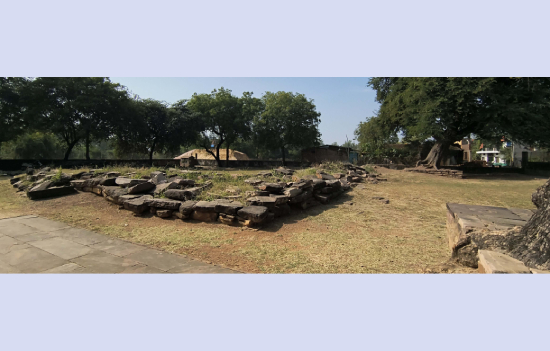 Ruins of pillars of temple close to Heliodorus Pillar.
Dhanayavad
and thanks to Ranjit Singh Guide Vidisha 91 81097 29894 and to the two Professors for guiding me not to forget Dr M Jain video.
References and Also read1.
Richard Salomon (1998) Indian Epigraphy:A
guide to the study of Inscriptions in Sanskrit,Prakrit and the other Indo-Aryan
Languages, Oxford University Press.
2. Dr
Meenakshi Jain Video 8 minutes
3. Ranjit Singh Guide Vidisha 91 81097 29894.
Good and Helpful.