- A
simple listing of 16 key Buddhist monuments in India with brief details and
album links. Some of the finest Ajanta Caves and paintings owe their origin to
the officials and feudatories of the Vakatakas (Hindu rulers), contemporaries
of the Guptas. Period - 2nd half of 5th century to 1st half of the 6th
century A.D.
Based
on my all India Travels, am presenting this photo feature. Album links at end
of article. In case missed out any key monument please write back.
1.
Bodh Gaya Temple and Around
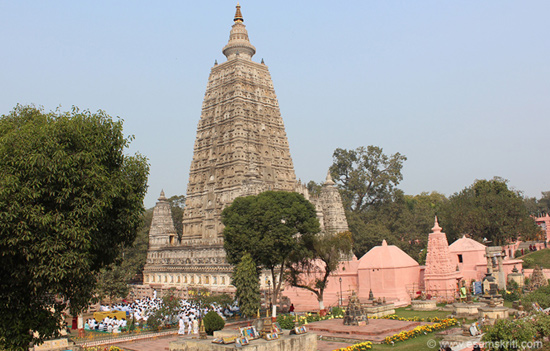
Bodh Gaya Mandir was completed by the Gupta Kings
around 7th century. Temple destroyed by Turkish invaders in
early 13th century. Senior journalist wrote Sandhya Jain wrote, “Around 1590 a Saivite saint took charge of the Mahavira. In 1883, Sir Alexander Cunningham, J.D.M. Beglar and Dr Rajendra Lal Mitra renovated the temple on scientific lines.”
Buddha meditated at Pragbodhi Caves i.e. close to temple. In Vaishali, Bihar is a Stupa that has part of Buddha’s ashes.
At
Bodh Gaya, Ashoka made a stupa that lasted till about 2nd century
A.D. and set up the Diamond Throne where Siddhartha became Buddha.
There
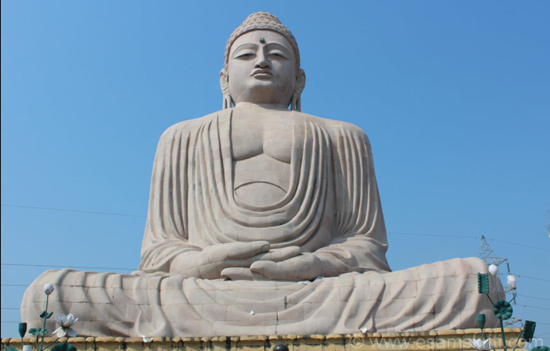
is also Great Buddha Statue at Bodh Gaya, a symbol of India Japanese
cooperation inaugurated in 1989 and Nalanda University ruins.
2.
Sarnath (where Buddha gave his first sermon)
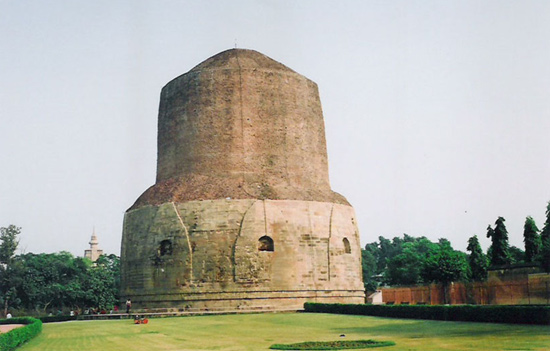 Dharma Chakra Stupa or Dhamekh Stupa.
After achieving
enlightenment at Bodhgaya he gave his first sermon to five companions at
Sarnath. In Buddhist literature this is known as Dharma-Chakra-Pravartana i.e.
the turning of the wheel of law.
Stone inscription of Dhamekh Stupa reads ‘‘According to the inscription dated 1029 A.D. recovered from the site its old name was Dharma Chakra Stupa. It perhaps commemorates the spot where Lord Buddha preached his first sermon. In search of the relic casket Alexander Cunnigham bored vertical shaft through its center down to the foundation level and at a depth of 91.4 cms he found a slab with an inscription ‘Ye Dharma Hetu Prabhava Hetu’. Written in the Bramhi script of 6-7th century ad. Further, he traced out a stupa of Mauryan bricks. However, the present diameter of this sold cylindrical tower is 28.5 mtrs at the base and 33.35 mtrs in height. Its total height is 42.60 mtrs including the foundation structure consisting of a circular stone drum up to the height of 11.20 mtrs from the ground above which rises the cylindrical mass of brick work about 6 metres above the base. Eight niches are provided in eight directions which must have contained images of Buddha. Below them runs a broad course of beautifully carved stones having geometrical designs, swastika, leaf and floral patterns with birds and human figures.”
3.
Kushinagar is where Buddha gave up his body.
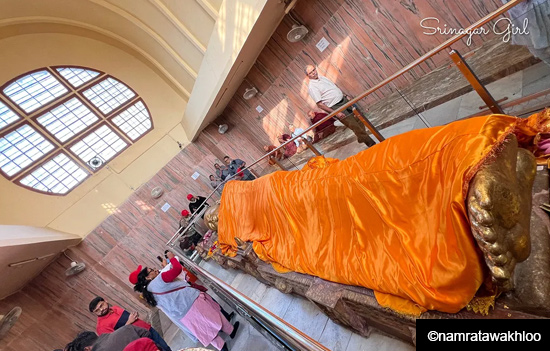 Pic by Namrata Wakhloo.
Namrata
Wakhloo wrote, “The Mahaparinirvana Temple houses an eighteen-foot long statue of reclining Buddha, positioned exactly as he lay when he passed, with his head to the north, on top of a couch. The statue dates back 1500 years to the Gupta period, and was sculpted from a red sandstone monolith, now gilted and wrapped in a saffron robe.”
4.
Shravasti (Uttar Pradesh)
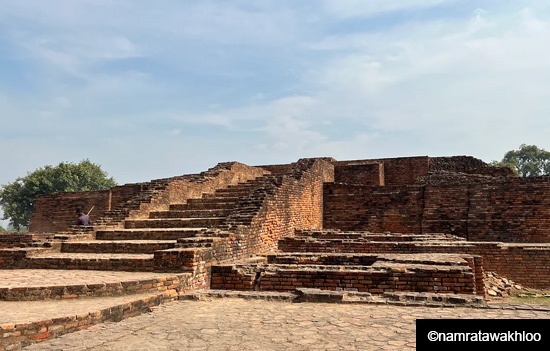 Kachi Kuti (made from
sun-dried bricks) or Anantpindika Stupa.
Kachi Kuti (made from
sun-dried bricks) or Anantpindika Stupa.
Namrata W wrote, “Shravasti is where the Buddha gave most of his sermons. He spent twenty five Varsha Vaas or rainy seasons in this region preaching.”
5.
Rajgir, Bihar
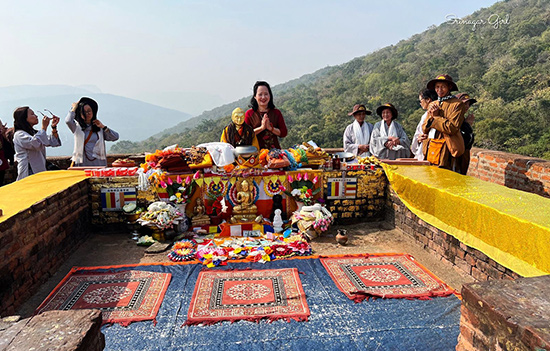 Vulture Peak. Pic by Namrata Wakhloo.
Namrata wrote, “Gautama
Buddha spent several months meditating and preaching at Griddhakuta or the Vulture Peak. The peak is called so because the rock is in the shape of a vulture.” The first Buddhist Council was held at Rajgir in 487 B.C. In Rajgir,
see the Vishwa Shanti Stupa, a symbol of India-Japanese co-operation.
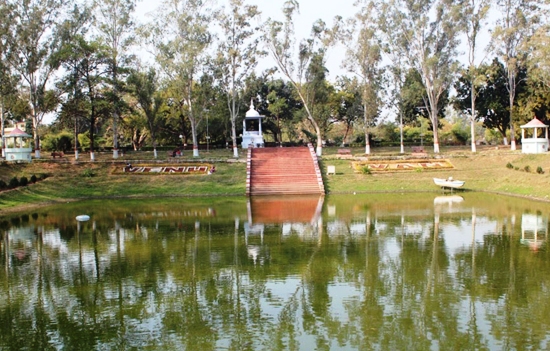 This is the Karandak Nivap tank inside the Venuvana or the forest of Bamboos.
6. Sanchi (near Bhopal)
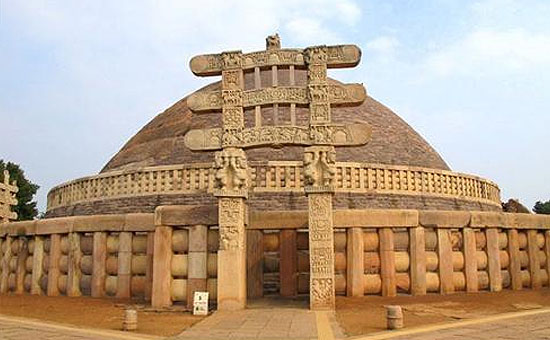
Ashoka built Stupa 1 or
Great Stupa and later enlarged by Hindu kings i.e. Sungas (185 BC-73 AD).
Gateway built in first century BC by Satvahanas. During Gupta period, several
temples were built/sculptures added. Construction continued up to 12th century.
Read Who built Sanchi Stupa
7.
Ellora Caves, Maharashtra
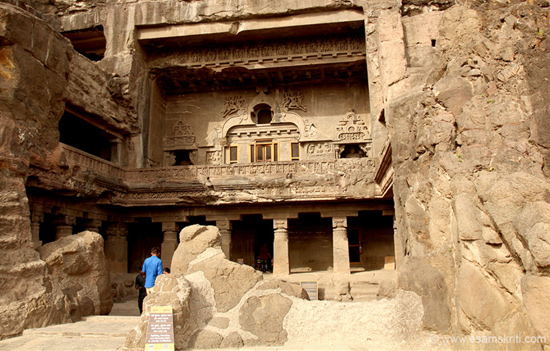 Cave 10 external view.
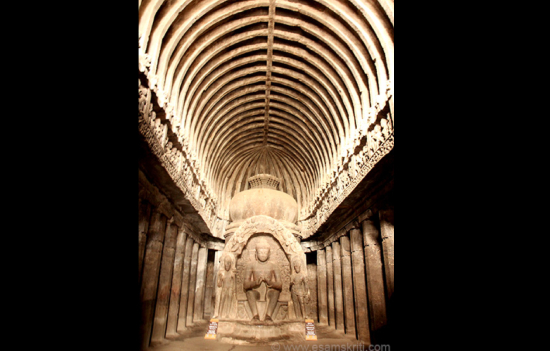 Cave 10 inside.
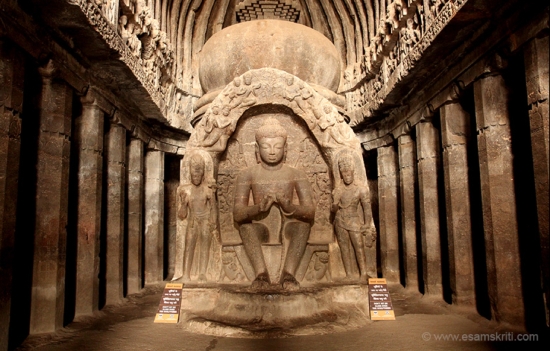 Cave 10.
Ellora
has Saivite, Buddhist and Jain caves. Buddhist cave numbers are 2, 4, 5, 6, 10
and 12. Of these caves 10 and 12 are must see.
Cave
10 - Datable to 7th century.
Cave
12 - Datable to 8th century.
8.
Ajanta Caves, Maharashtra
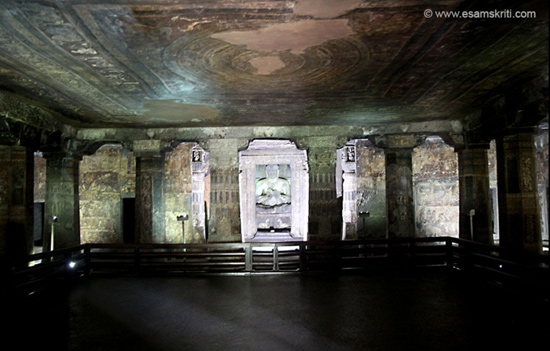 Cave number 17.
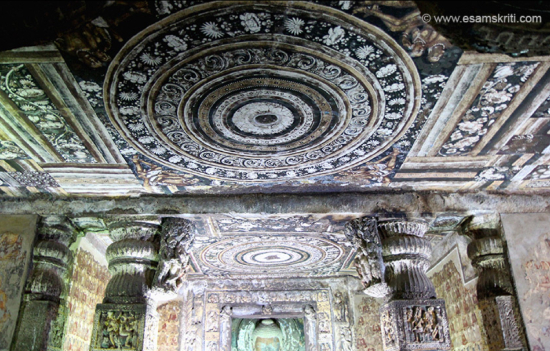 Cave number 2.
Ajanta is 103 kms from Aurangabad. There are four album links by cave nos. “Caves are 30 including the unfinished ones, of which 9,10,19,26 and 29 are Chaitya-grihas (sanctuary) and the rest
are Viharas (monastery). Of the six early caves, 9 and 10 are chaitya-grihas and 8,12,13,15A are monasteries.” 1
“Caves consist of two distinct phased of making separated by an interval of about four centuries. The earliest caves of the same movement when other caves were produced in the Deccan like Bhaja, Kondane, Nasik etc.” 1
“The most prolific part of the second movement was during the supremacy of the Vakatakas, contemporaries of the Guptas,
the two being related by matrimony. Some of the finest caves and paintings owe
their origin to the officials and feudatories of the Vakatakas (modern Washim,
Akola). The most vigorous part of the architectural and artistic activity was
during the second half of the 5th century a.d. and the first half of
the 6th century a.d. There was a considerable decline in creative
impulse from the 7th century.” 1
Vakatakas,
Creators of Ajanta
3-6th century A.D. “Vakataka kings were Hindu Saivites and yet endowed the most magnificent Buddhist caves complex ever built in India.” Guptas ruled from 320 to about 500 A.D. Read more Here
The
earlier paintings, scanty specimens of which survived on walls of Caves 9 and
10 go back to 2-1st centuries BC. The second period of paintings started
in about the 4-5th century and continued for two centuries.” 1
Details by Cave Numbers.
1
One of the finest monastery with lovely paintings.
2
Belongs to 6-7th century A.D.
3
Incomplete monastery. 1
4
Belongs to 6th century A.D.
5
Cave is incomplete.
6
Date not available on ASI Board. Has Buddha images so post 1st
century a.d.
7
Date not available on ASI Board. Has Buddha images so post 1st
century a.d.
8
Major part of monastery swept away by a landslide. 1
9
Belongs to 1st century B.C. Hinayana sect.
10
Belongs to 2nd century B.C. Hinayana sect. Paintings belong to 2nd
century B.C. and 4th century A.D.
11
Belongs to 5th century a.d. or even earlier.
12, 13, 14, 15 – caves are small or in bad shape.
16
Belongs to 475-500 A.D.
17
Belongs to 475-500 A.D.
18
This is merely a rectangular excavation with two pillars, mostly collapsed. 1
19
Made end of 5th century.
20
Belongs to 450-525 A.D.
21
Belongs to 6th century A.D.
22
Seven Manushi Buddhas painted. Date not known.
23
Date not known.
24
Assigned to 7th century A.D.
25
Small unfinished monastery.
26 450-525 a.d. 1
27
Since it has a Buddha image, must be post 1st century A.D.
28
Almost inaccessible.
29
Almost inaccessible.
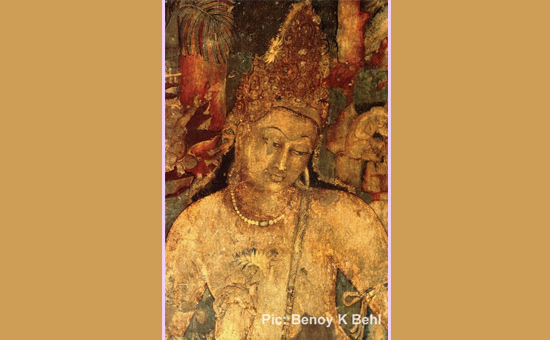 Bodhisatva Painting. Pic by Benoy K Behl.
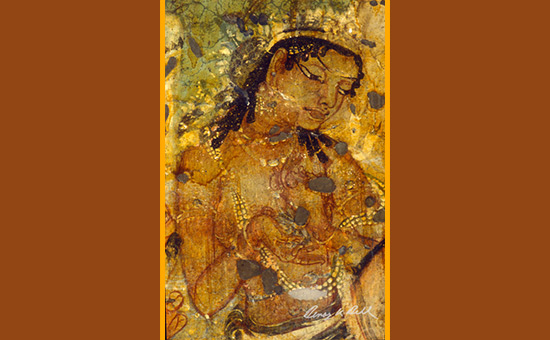 Cave 1. King Mahajanaka
riding out from his palace. Pic by Benoy K Behl.
Cave 1. King Mahajanaka
riding out from his palace. Pic by Benoy K Behl.
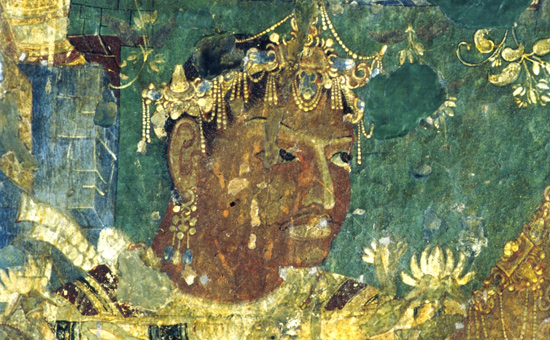 A prince bringing offerings to Vajrapani, the Bearer of Thunderbolt, Cave 1.
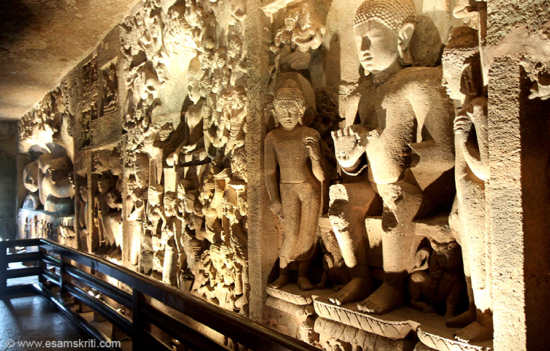 Sleeping Buddha, cave 24.
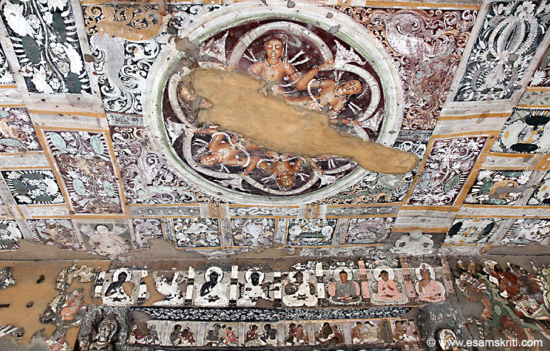 Cave 17.
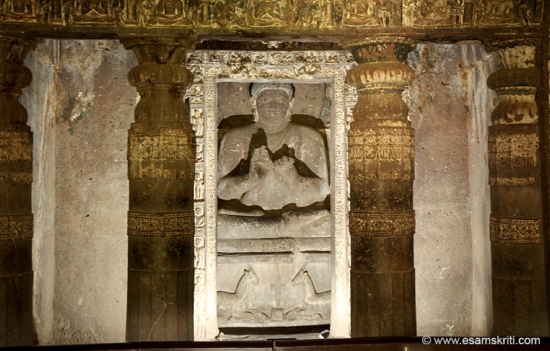 Cave 20.
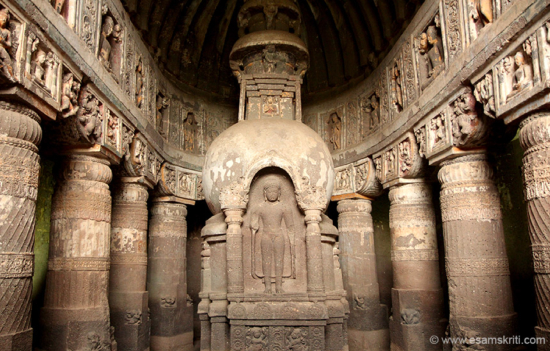 Cave 19.
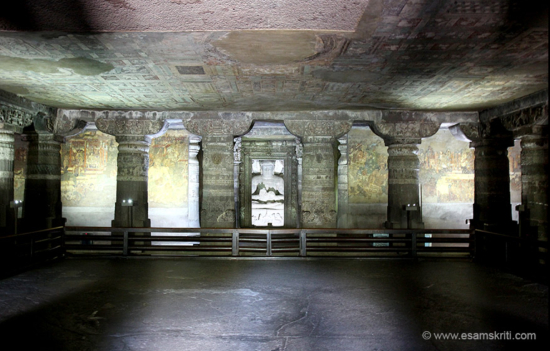 Cave 1.
Read Indian Roots of Asia’s Buddhist Art by Benoy Behl
Other Buddhist
Caves in Maharashtra are Karla, Kondane, Bedse, Bhaja, Ghoravadi. To see pictures
9.
Bojjanna Konda, Andhra Pradesh
Established
4-9th century a.d.
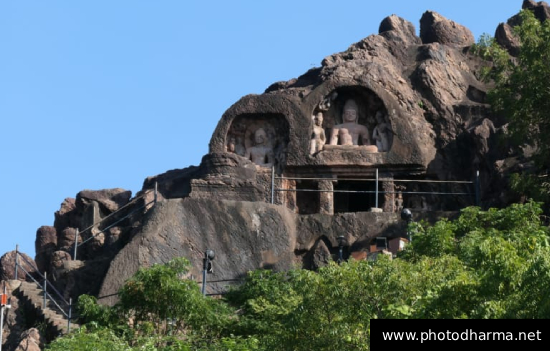
10.
Undavalli Caves, Andhra Pradesh
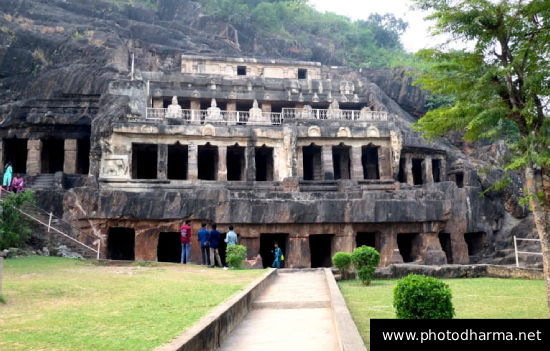
11.
Amaravati Stupa and Museum, Andhra Pradesh
“The Amaravati Stupa, located in the Guntur District of modern-day Andhra Pradesh, is a monumental relic of ancient Indian Buddhism and a testament to the region’s rich cultural and artistic heritage. Built around the 3rd century BCE during the Mauryan period and expanded significantly during the Satavahana dynasty (1st century BCE to 3rd century CE), the stupa served as a major center of Buddhist worship and pilgrimage. It housed sacred relics of the Buddha and became a focal point for devotional activities, attracting monks, artists, and patrons from across the region.” Source and to see
photos
To see pictures of all sites in
Andhra Pradesh
12.
Ratnagiri Monastery, Odisha
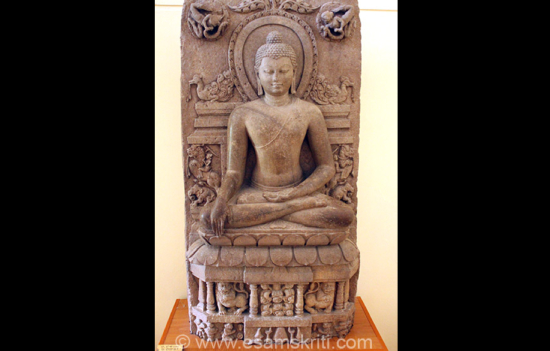 Ratnagiri Museum.
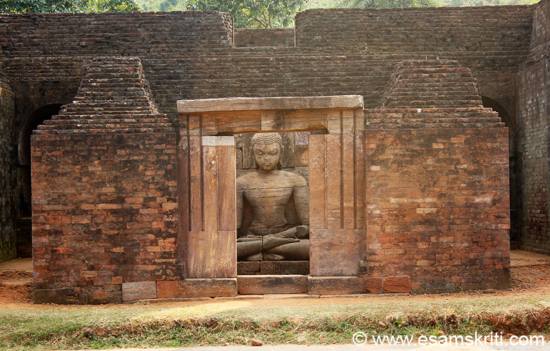 Udaygiri.
About 100 kms from
Bhubaneswar are Ratnagiri, Udaygiri and Lalitgiri monasteries which comprise
the Diamond Triangle. Monastery witnessed growth between 5-13th
century a.d. Ratnagiri was a centre of Tantric Buddhism. Udaygiri has a
rock-cut step-well 9-10th century. Next is Lalitgiri – very well maintained.
13.
Tawang Monastery, Arunachal Pradesh
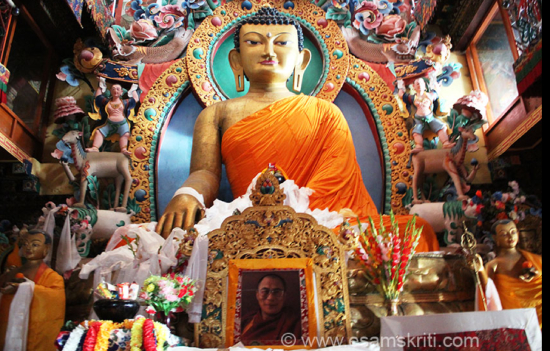
It is said to be the biggest Buddhist Monastery
in the world besides Lhasa, Tibet, is a major holy site for Tibetan Buddhists,
as was the birthplace of 6th Dalai Lama.
It
is an important site of Mahayana Buddhism. This Gelukpa sect monastery was
founded in the 17th century by Mera Lama Lodre Gyaltso, who is considered as a
contemporary of the fifth Dalai Lama.
The
highlights of this monastery are the imposing three-storied assembly hall and
the 28 feet high golden statue of Lord Buddha. It has a library that has an
impressive collection of ancient books and manuscripts. Buddhist gold inscribed
scriptures Kangyur and Tangyur are preserved here.
Taktsang Monastery i.e. 45 kms from Tawang known as Tiger’s Den. Guru Padmasambhava is supposed to have visited there in the 8th century.
14.
Thiksey Monastery, Ladakh UT
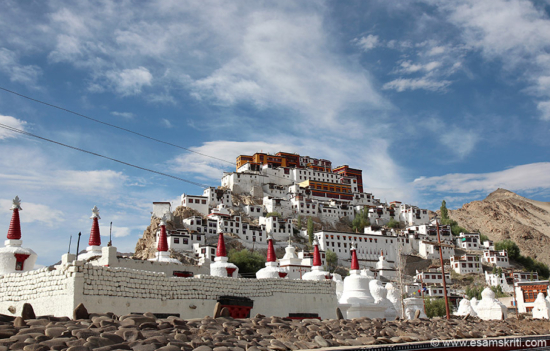 External view.
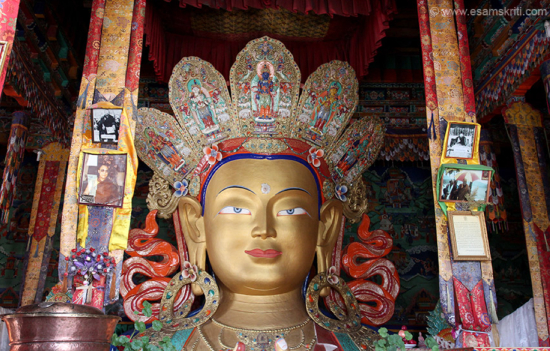 Maitreya (Future Buddha)
It is about 45 kms from Leh. Of all the monasteries I visited in Ladakh, inner connect with this was instant – I wish to go again.
15.
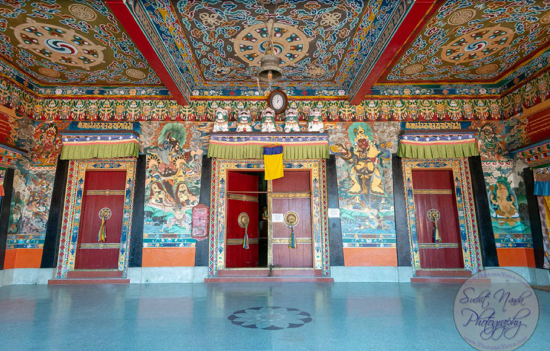
Rumtek Monastery, Sikkim
16.
Mahamuni Pagoda, Tripura
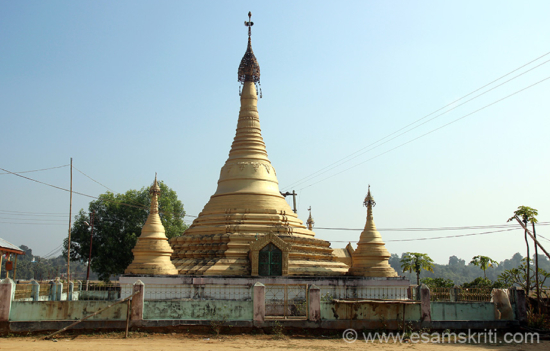
It
is 134 kms from capital Agartala. In 2007, a Buddhist from Thailand donated for
the temple there. The complex has a school.
India
is the Land of DHARMA. (Dhamma in Pali).
As
always, am happy to stand corrected. Love.
References
1.
Booklets published by the Archaeological Survey of India and Board outside
monuments.
To
see excellent photos
without detailed captions of Buddhist sites in India
Albums with captions
1.
Bodh Gaya Temple
2.
Bodh Gaya Temple
covers walk around temple and Buddha images on walls including Tara,
Saraswati
3.
Bodh Gaya Temple
covers pics of foreign devotees, Country-wise monasteries
4.
Great Buddha
Statue
includes Pragbodhi Caves
5.
Nalanda University
ruins
6.
Nalanda University
Rajgir new
7.
Vaishali has a Stupa that has a part of Buddha’s ashes
8.
Sarnath
9.
Rajgir
10.
Buddhist Caves,
Ellora
11.
Ajanta Caves 1 and
2
12.
Ajanta Caves
4,6,7,9,11,19
13.
Ajanta Caves 16
and 17
14.
Ajanta Caves 20,
21, 24, 26
15.
Indian Roots of Asia’s Buddhist Art by Benoy Behl
16.
Exploring
Nagarjunakonda, Andhra Pradesh
17.
Cave Architecture
in India
18.
Thiksey Monastery,
Ladakh
19.
Mahamuni Pagoda,
Tripura