- This photo feature
is about the grandeur of Adalaj ni Vav, step-well near Amdavad in the state of
Gujarat.
Introduction
In the arid
landscapes of Gujarat, architecture traditionally looked not just toward the
heavens but deep into the earth.
My visit to Adalaj Ni Vav in January 2026—situated just 18km from Ahmedabad—revealed a structure that is as much a spiritual sanctuary as it is a functional reservoir. Built in 1499 CE, this five-storey stepwell is a masterpiece of the Solanki (Māru-Gurjara) style, representing a rare and harmonious fusion of Hindu, Jain, and Indo-Islamic aesthetics.
Text and Images by author Ankur Gupta.
The
Narrative in Stone
1. The Triple Entrance: A Unique Welcome
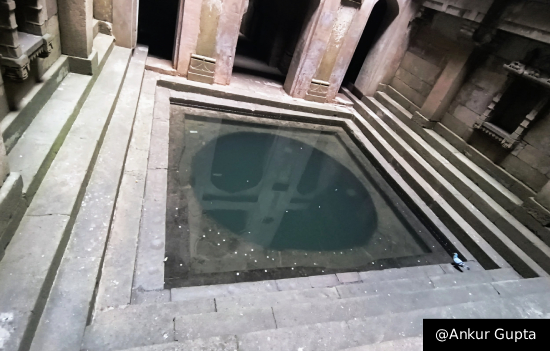
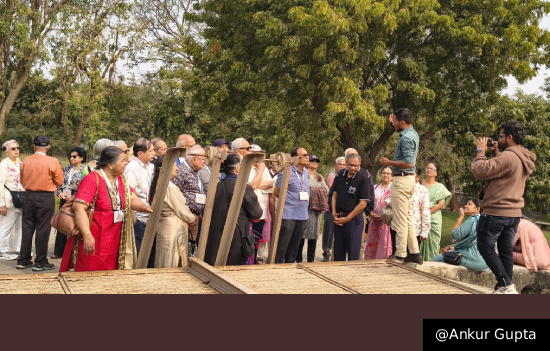 The convergence of the triple entrance stairs at the subterranean platform.
Unlike most stepwells in Gujarat, Adalaj is unique for its three entrance stairs-from the South, West, and East—that converge at a massive square platform underground. These entrances were designed to accommodate large groups of travellers and local villagers who gathered here for both water and social respite.
2. The Legend of Queen Rudabai
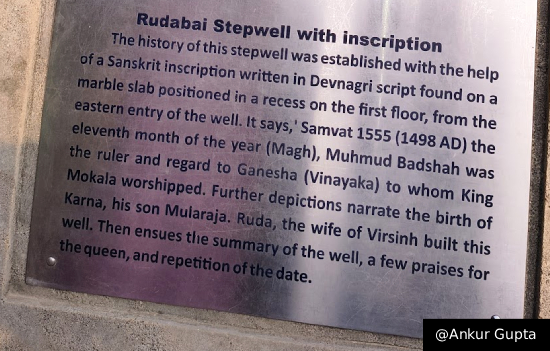 The historical inscription plate detailing the 1499 CE completion.
The history of
Adalaj is etched in tragedy and devotion. Construction was initiated by Rana
Veer Singh of the Vaghela dynasty but was interrupted when he was killed in
battle by Sultan Mahmud Begada. The Sultan, enamored by the beauty of the
widowed Queen Rudabai, proposed marriage. She agreed on one condition: that he
complete the stepwell started by her husband.
Upon its
completion, she circumambulated the well and jumped into its depths, choosing
to join her husband in the afterlife rather than marry the Sultan.
3. Architectural Ingenuity: The Octagonal Shaft
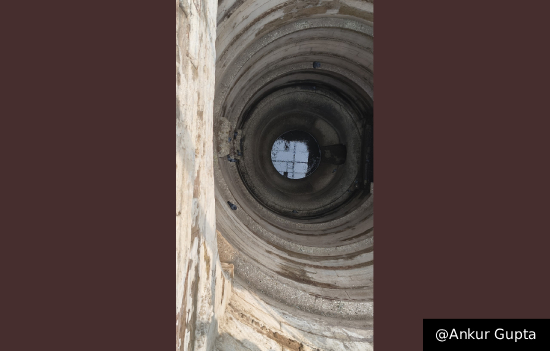 Views looking down the central octagonal shaft toward the water.
The core of the structure is a vertical octagonal shaft. The design allows air and light to permeate the lower levels while ensuring that direct sunlight rarely touches the water, keeping the interior a refreshing 6 to 8 degrees cooler than the outside world. It serves as a medieval form of "natural air conditioning."
4. The Pillars of Solanki Grace
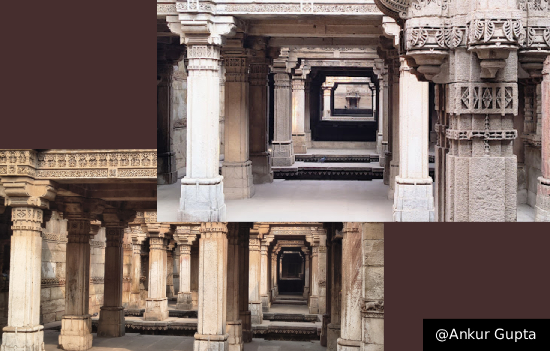 Detailed shots of the carved sandstone pillars and subterranean galleries.
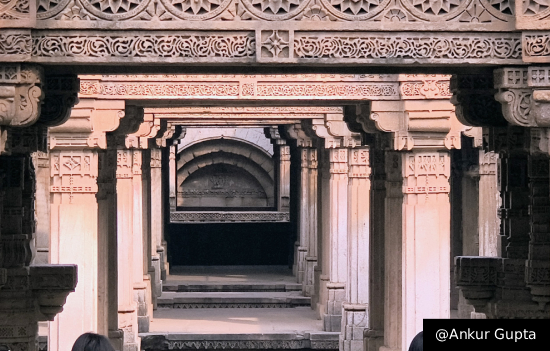
The stepwell is supported by a forest of intricately carved sandstone pillars. Each floor is a gallery of exquisite motifs—ranging from floral spirals and geometric patterns to scenes of daily life, such as women churning buttermilk or dancers performing.
5. Divine Symbology
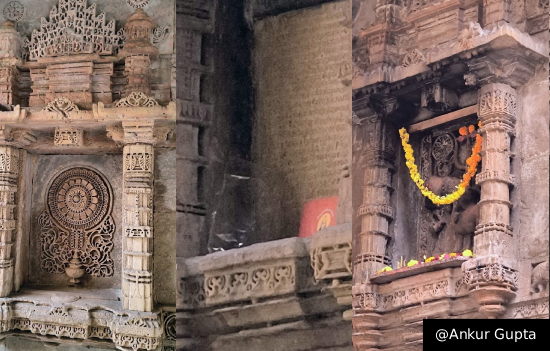 Close-up of divine icons and floral motifs (Ami Khumbor/Kalp Vriksha).
Deep within the
walls, one finds the Ami Khumbor (the
pot of the water of life) and the Kalp
Vriksha (the tree of life). A small frieze of the Navagraha (nine planets)
is also present, believed to protect the monument from evil omens. These
carvings reflect the spiritual sanctity of water in Indian culture, treating
the well as an inverted temple. The spiritual heart of the stepwell is revealed
in the profound symbolism of its deeper niches.
In above pic extreme left, we see the "Wall of Eternal Motifs," where rhythmic floral and geometric friezes transition from sturdy Solanki pillars to delicate, ornate lintels. Above pic highlights the Ami Khumbor—the sacred pot of the water of life—often flanked by the Kalp Vriksha (tree of life), symbolizing fertility and divine sustenance.
6. Indo-Islamic Fusion
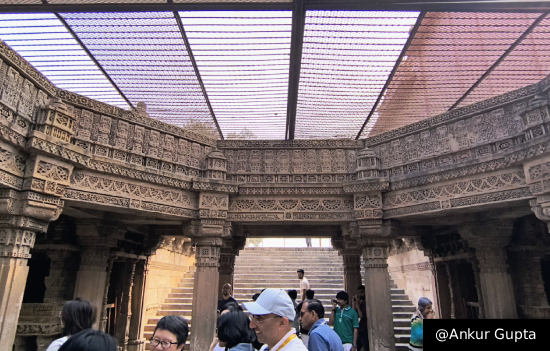 The overhead trellis and the fusion of Indo-Islamic geometric patterns.
The completion of
the well under Mahmud Begada introduced Islamic artistic elements. You will
notice that while the deities and mythological scenes are Hindu/Jain, the
delicate floral graphics and geometric ornaments on the upper brackets are
distinctly Islamic.
Tourist Information
1. Best Time to
Visit: September to March, during the cooler months.
2. Timings: 8:00
AM to 6:00 PM daily.
3. Photography: Allowed and encouraged; the play of light through the octagonal openings is a photographer's delight.
4. Proximity:
Easily accessible from Ahmedabad (18 km) or Gandhinagar (5 km).
5. Nearby Stops:
The Trimandir (4 km away), which houses Hindu, Jain, and Buddhist deities under
one roof.
To see album of
Adalaj Vav
To read all
articles by author
To see album of
Rani-ki-vav Step well, Patan
To
read about Step Wells of Maharashtra
To
read about Abhaneri Step-well near Jaipur, wonder of the world
To see album
of Bundi Step well