- This
photo features captures day wise details of our eight-day driving trip to
Western Rajasthan that includes important Jain Tirths at Osian, Phalodi, Nakoda,
Jirawala, Taranga and
Kumbharia, Mira Bai Museum Merta, feeding cranes at Khichan, Pokhran Fort,
Khimsar Sand Dunes. Yeah Dil Mange More.
We started from Gurgaon on day 1 and reached late night on Day 8. We drove in January 2026. Weather was great, good time to be in Western Rajasthan. Format is day wise, places seen, where spent night, pictures and album links.
Day 1 covered Loharu and Ladnam. Night stay Tal Chappar.
It
took about 3 hours from Gurgaon to Loharu from where Ladnam was app a 4 hour
drive.
See
Fort and other monuments in Loharu… Nawabi capital. Enroute to Ladnum we
stopped at Rani Satiji Mandir, Jhunjhunu, Shekhawati district.
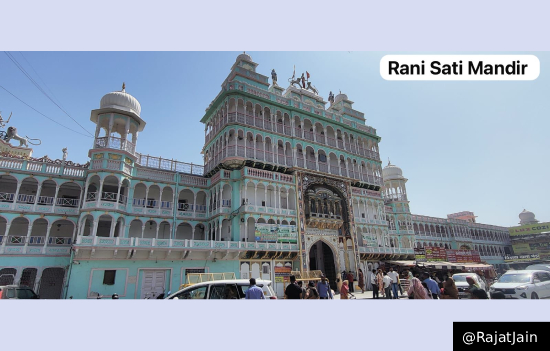 Entrance to Sati Mandir.
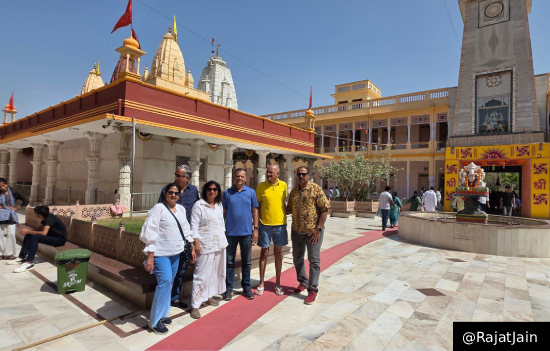 Sati Mandir.
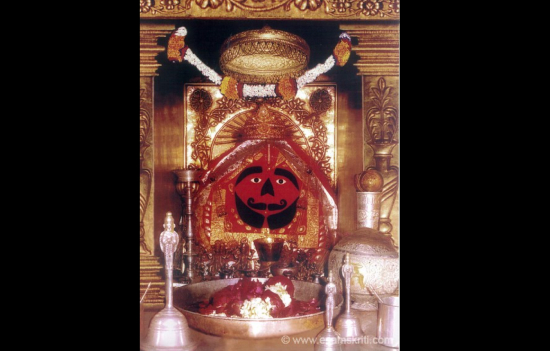 We also visited Salasar, famous for Hanuman ji Mandir. It is located in Churu district.
To
read about Shekhawati Havelis
that are an Open Air Art Gallery
Ladnun is a big Jain centre - University, Jain History, old havelis, Blackbuck sanctuary. Also visited havelis and temples of Ladnun.
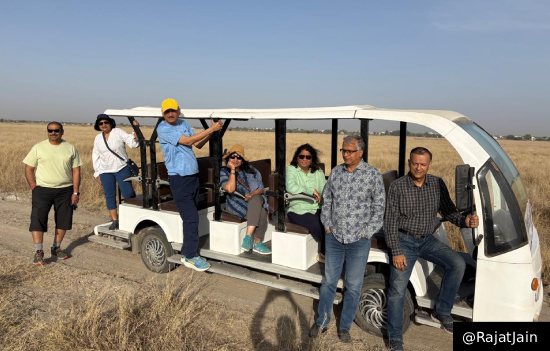 Early morning drive to Black Buck sanctuary.
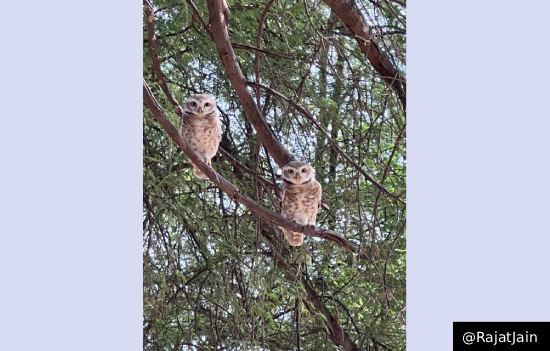 Owls during the day, a rare sight.
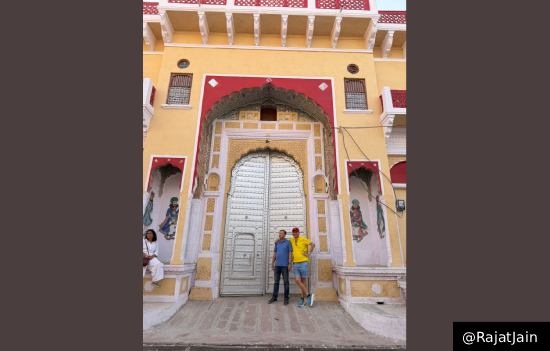 Entrance to a private haveli in Ladnum.
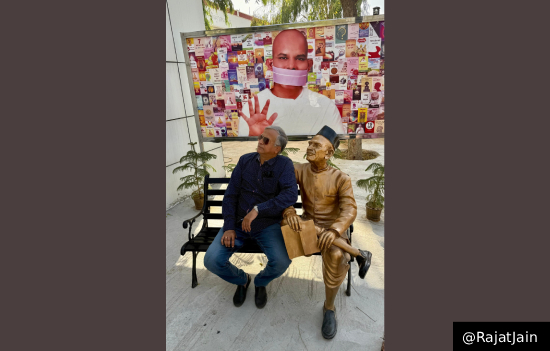 Me at Jain Vishwa Bharati, Ladnum.
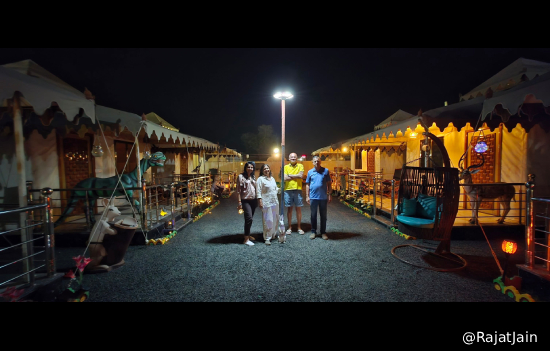 At Tal Chappar Desert Resort, Ladnum.
Founded in 1970 at Ladnun, Rajasthan, Jain
Vishva Bharati (JVB) was envisioned under the inspirational guidance of
Ganadhipati Gurudev Shri Tulsi and nurtured by the spiritual leadership of
Acharya Shri Mahapragya. Over the decades, JVB has evolved into a globally
respected center for value-based education, Jain Studies, and holistic
learning, promoting Ahimsa, Jeevan Vigyan, and Preksha Dhyan as pathways for
individual and social transformation.
Day 2 covered Nagaur Fort and Sand Dunes. Night stay Phalodi.
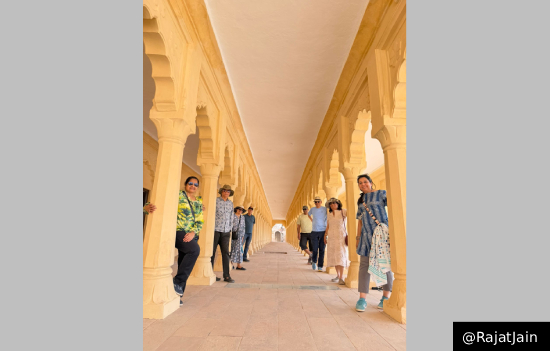 This area is called Rectangular Baradari, has 108 pillars. Fort made with stone in 1119 A.D. Fort has a Sri Krishna mandir.
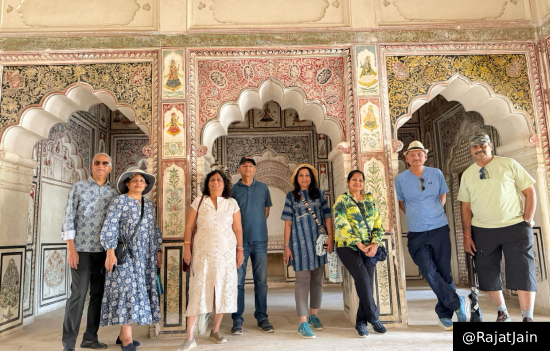 Travel group in Abha Mahal with paintings. Someshwar Chauhan, father of Prithviraj took over fort in 1192.
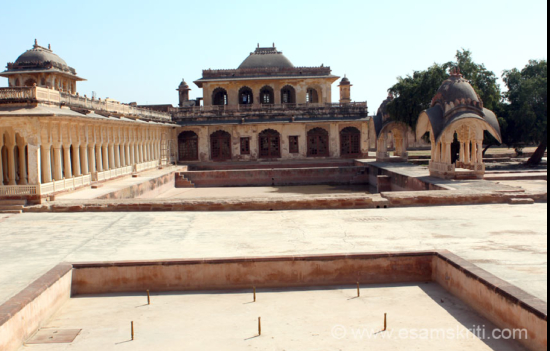 Nagaur Fort
Ahhichatragarh Fort literally translates into
‘fort of the hooded cobra’ is situated in Nagaur. Spread over 36 acres, the
fort was in a state of neglect till the 1980s. In 1985, the fort was handed
over to the Mehrangarh Museum Trust. The fort was gradually restored to its
former glory with the support of various foundations.
To
see album Nagaur Fort and Cattle Fair Nagaur ie held in
February every year.
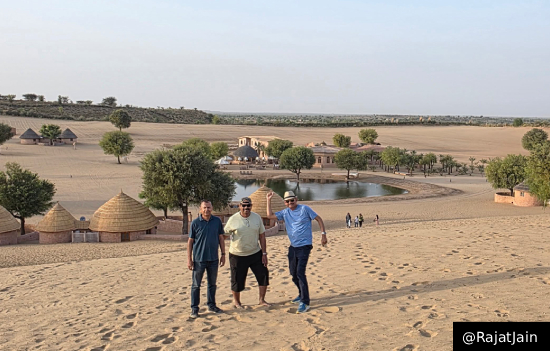 At Khimsar Resort. Khimsar is app 95 kms from Jodhpur. Lovely sand dunes.
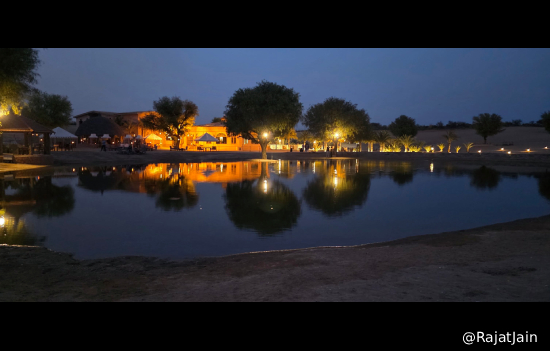 At Khimsar Resort. Relaxed.
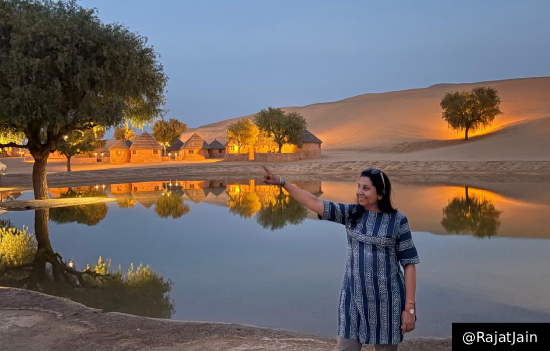 At Khimsar Resort. About 15 kms away is Khimsar Fort.
Day 3 covered Phalodi and Khichan. Night Phalodi.
Start
early in the morning so have time to visit temples and havelis in Phalodi, 3
temples in main market, and one temple with wonderful glasswork. Morning or
Evening visit Khichan, to see cranes and havelis, to feed cranes.
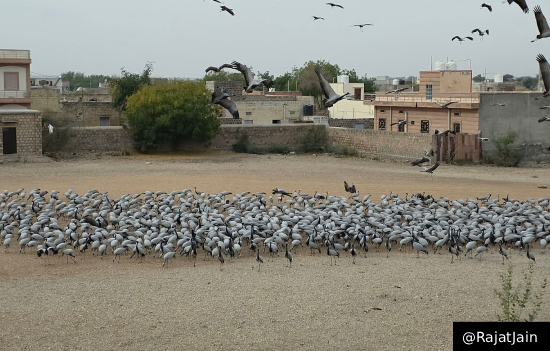 Feeding cranes at Khichan.
Had the experience of a lifetime. Khichan, is a
small nondescript village some 10 kms from Phalodi. But some may know that it
is a famous site for seeing Demoiselle cranes called Kurja in the local
language. I am using the word seeing and not sighting usually used for birds,
because seeing it was. They were present there in thousands.
At 7.15 am, we presented ourselves at a feeding
centre, called Pakshi Chugga Ghar,
and at 8.45 we saw the first lot of cranes appear again from a distance. What
followed was a procession, the likes of which we have not seen and after
circling and stopping at some places around the village, they all gathered at
the feeding centre. We were there up to 10 am, seeing them pick the grains of
bajra. Special mention for Sevaram Mali, who has dedicated his entire life to
the wellbeing on the cranes and birds, and to the Jain Trusts that run and fund
this feeding centre. It is no mean feat. We are talking about hundreds of Kgs
of grain feeding thousands of cranes daily from October to March every year.
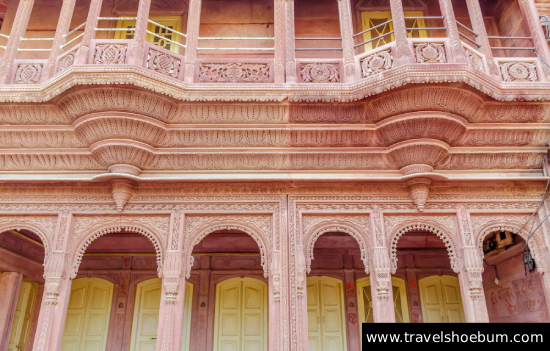 Haveli Khichan.
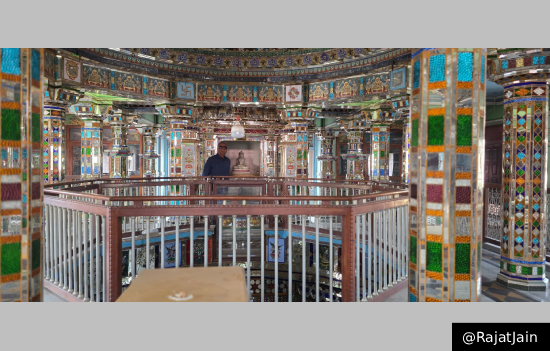 This is a Kaanch ka Mandir- Jain Temple which is more than 250 year old. Glass came from Belgium.
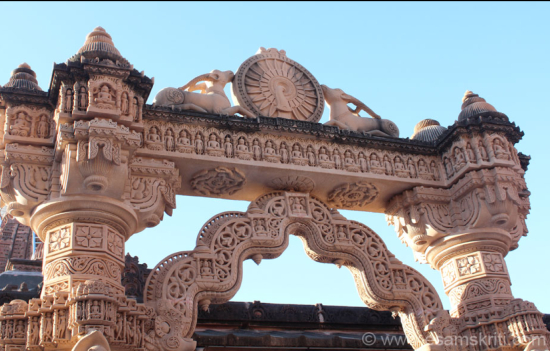 Osian Jain Mandir. Pratihara
King Vatsaraja Raja built this temple around 783 A.D. The temple is an important pilgrimage for
Oswal Jains. This temple is the oldest surviving Jain temple in Western India.
It is famous for its TORANA.
Osian Jain Mandir. Pratihara
King Vatsaraja Raja built this temple around 783 A.D. The temple is an important pilgrimage for
Oswal Jains. This temple is the oldest surviving Jain temple in Western India.
It is famous for its TORANA.
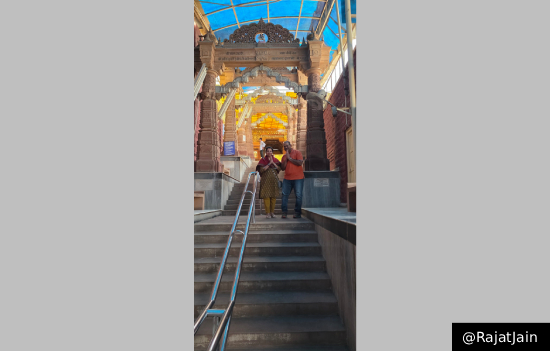 Entrance to Mata Mandir, Osian.
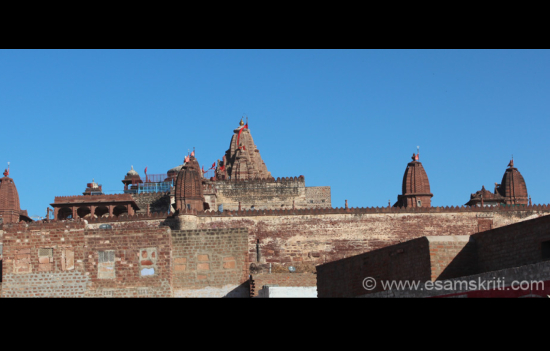 View of Mata Mandir.
To
see albums Osian Jain Mandir and Osian Sachiya Mata
Mandir.
Osian is about 60 kms from Jodhpur. Album Mehrangarh Fort,
Jodhpur
Day 4 covered Ramdevra, Pokran Fort, Barmer city. Night stay Barmer.
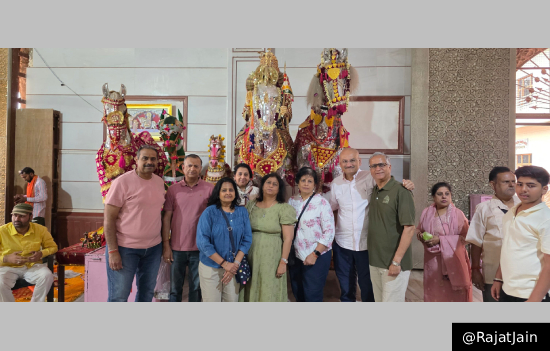 Our group at Baba Ramdev Temple in Ramdevra. App 125 kms from Jaisalmer.
“It is believed that Baba Ramdevji took samadhi
(conscious exit from the mortal body) at Ramdevra in 1459 A.D. After this, the
Maharaja Ganga Singh of Bikaner constructed the temple around his Samadhi.” It
attracts Jain and Sanatan devotees. Temple is 12 kms from Pokhran on the
highway to Jaisalmer.
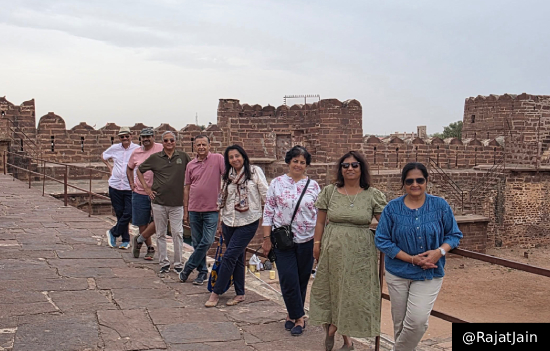 Pokhran Fort.
Fort Pokhran, the 14th century citadel also
known as “Balagarh”, stands amidst the Thar Desert. This monument is the
premier fort of the chief of the Champawats, one of the Rathore clans of the
state of Marwar-Jodhpur. Fort Pokhran is open for visitors. Part of the fort is
run as a heritage hotel by the royal family of Pokhran.
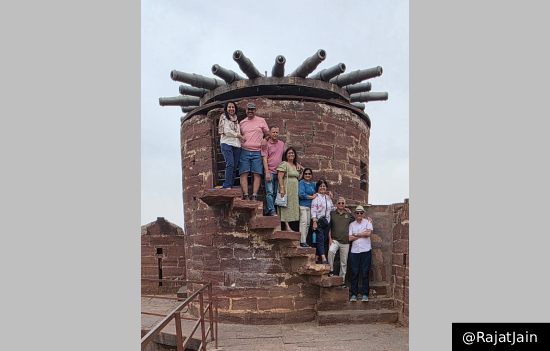 Pokhran Fort.
The
image shows a group of tourists, US, on the stairs of a circular red sandstone
tower at Pokhran Fort (also known as Fort Pokaran) in the Thar Desert. This tower is distinguished by multiple old
cannons arranged in a radial pattern on its roof. The fort is known for housing
well-preserved ancient weaponry, including the unique arrangement seen on this
tower, symbolizing historical military.
Built
in the 14th century by Rao Maldeo of the Rathore clan, the fort is constructed
primarily of local red sandstone.
Architecture: It features a blend of Rajput and Mughal styles, with ornate
Jharokhas (balconies), arched porticos, and grand courtyards.
Attractions:
Inside the premises is a museum that showcases royal collection of artefacts,
armour, miniature paintings, and pottery.
Nuclear Significance: Beyond its royal history, Pokhran is famous for being the site of India's underground nuclear tests in 1974 and 1998
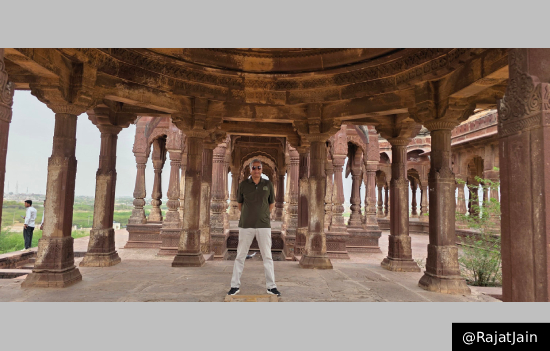 Pokhran Fort. Chhatris, also called cenotaphs, grave
monuments in the cemetery of the Champawat Rajput Maharajas of Pokaran.
Pokhran Fort. Chhatris, also called cenotaphs, grave
monuments in the cemetery of the Champawat Rajput Maharajas of Pokaran.
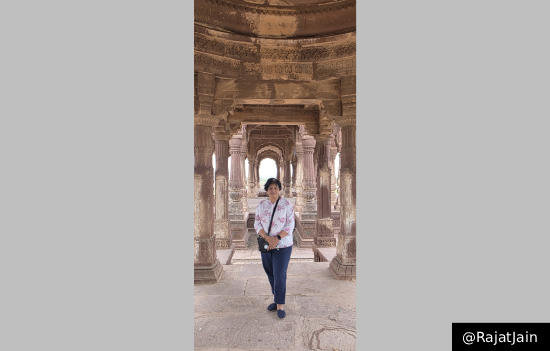 Pokhran Fort.
Day 5 covered Kiradu Temples and Nakoda Parashnath. Night stay Nakoda.
In
the morning we visited Kiradu Temples, about 30 minute drive from Barmer. We had Nakoda Parashnath darshan in the evening plus shopping.
Kiradu Temples are a hidden jewel. To see album
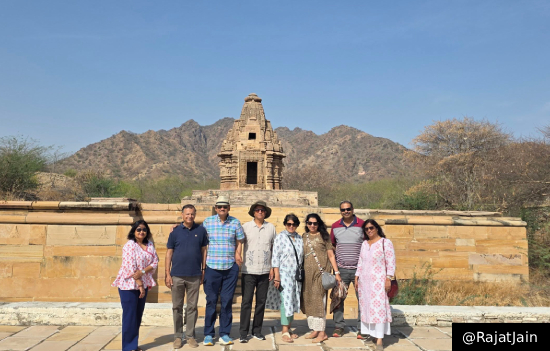 Kiradu Temples. There are 5
temples going back to about 11-12 century A.D. Biggest and best is Someshvara
Mandir.
Kiradu Temples. There are 5
temples going back to about 11-12 century A.D. Biggest and best is Someshvara
Mandir.
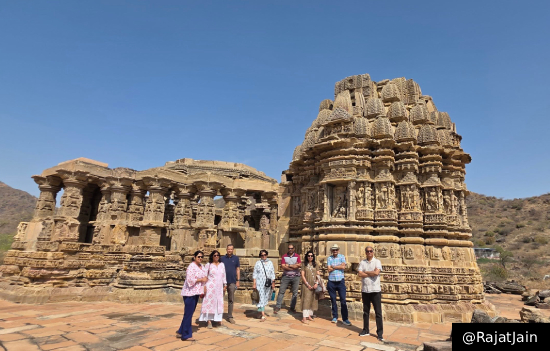 Kiradu Temples. Temple on left is Someshvara, dedicated to Shivji.
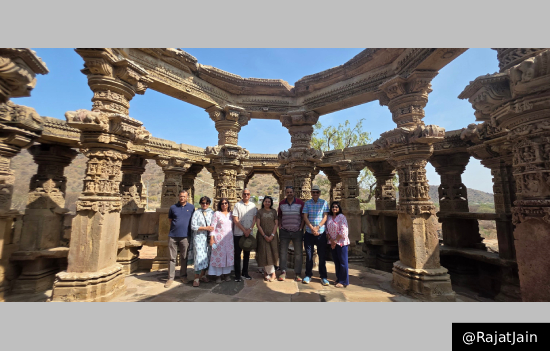 Kiradu Temples.
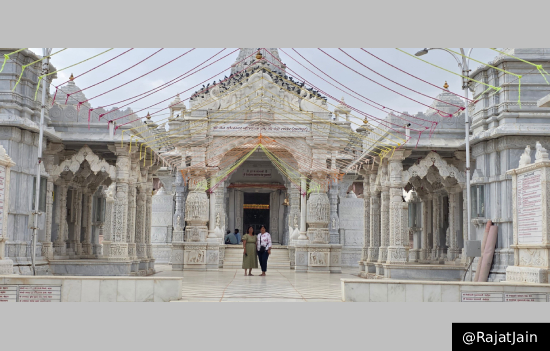 The Kushal Vatika Jain Mandir is situated just out of city Barmer.
Being a Jain Temple the carvings are exquisite
which makes you marvel at this place. This is a modern temple and when we
visited some parts were still being worked upon like the Samosaran. The Temple
grounds are well maintained and clean. Since this place is on Ahmedabad Road,
it is easy to visit. One can plan visit to Mahabar Sand Dunes, which are not
there, by the way! And visit this temple.
Accommodation arrangements are very fine in the
temple complex.
All the temples and statues are in white marble.
Do visit.
Day 6 covered Bhinmal Jain and Sundamata Dev Temples. Night stay Jeerawal.
From
Nakoda ji we drove to Bhinmal Jain temple. Next was Sundamata is a Devi temple
with a ropeway. From Sundanmata we drove to Jeerawal for Jeerawal and Varman
Temples.
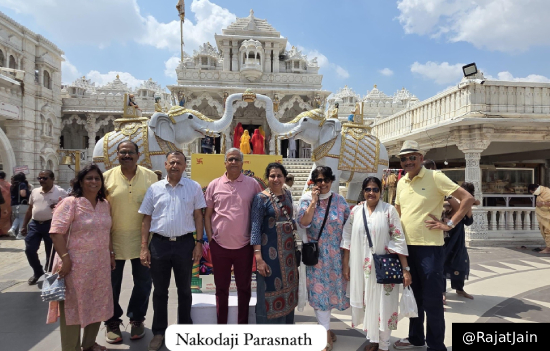 Nakoda ji Parashnath Mandir.
Nakodaji
Tirth is a major Śvetāmbara Jain tirth (pilgrimage site) of Tirthankara
Parshwanatha. It is located between the villages of Vikrampura and Nakoda in
Barmer District. The temple houses the icon of Nakoda Bhairava, a prominent
Śvetāmbara guardian deity. The temple is an important pilgrimage center visited
by both Jains and Hindus. Devotees visit the shrine, especially after marriage.
The temple is administered by Tapa Gaccha (monastic order) of Murtipujaka
Śvetāmbara.
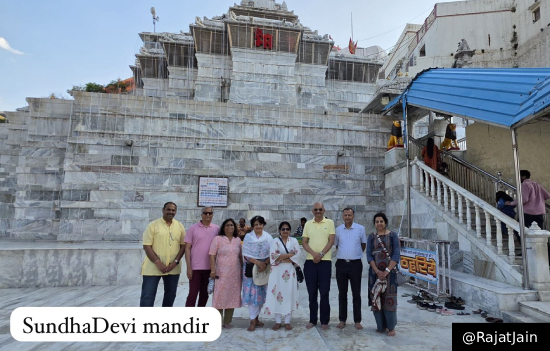 Sundamata Mandir.
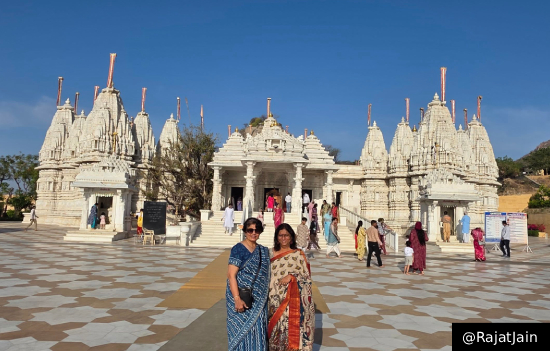 Shri Jirawala Parshwanath Jain Tirth.
Jirawala Tirth is a Śvetāmbara Jain temple
in Jirawala village of Sirohi District. It is 58 km from Abu Road. The temple
is an important Śvetāmbara Jain pilgrimage center, and the Jirawala Parshvanath
idol is one of the 108 prominent Śvetāmbara
Parshvanaths.
According to Jain belief, the temple dates back 2,800 years. Jirawala has been
an important Jain centre between 506 CE to 1324 CE and received patronage by
multiple Jain Acharyas. The iconic idol of Parshvanath, the principal deity of
the temple was found during an excavation. A cow, belonging to Brahmin boy,
Kadwa used to pour out its milk every day near a cave in Jirawala. Upon hearing
about this, Jain Seth Dhanna Shah dreamt of a Parshvanath murty where cow went
to pour milk. After a search, idol was found at the same spot. It was installed
by Acharya Deva Gupta Suri in 894 CE.
The
temple has ornate architecture. It has a large domical structure as the
principal shrine with domical 52 sub-shrine along the axis of principal shrine.
There are 108 idols of Parshvanatha in these shrines each bearing a different name
with central shrine housing murty of Jirawala Parshvanatha, the principal deity
of the temple. There are total of 60 Dhwaja Stambha in complex.
Day 7 covered Varman, Kumbharia Ji Jain and Ambaji Temples. Night
Pali.
We
visited Varman Temple in the morning. Next, drove to Ambaji temple in Gujarat
(a Shaktipeeth) and then to Kumbharia Ji, a defaced Jain Temple.
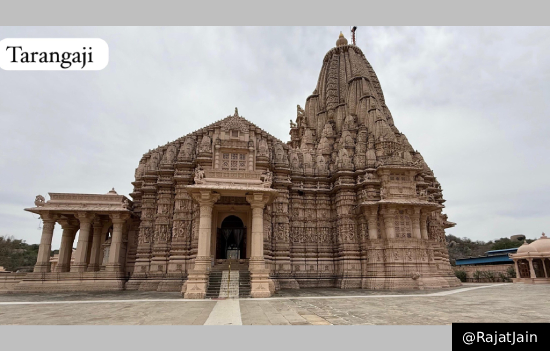 Taranga Ji Jain Mandir.
Taranga
is a Jain pilgrimage center near Kheralu in Mehsana district, Gujarat, with two
compounds of Jain temples that are important examples of the Māru-Gurjara style
of architecture. The Ajitnatha Temple, was constructed in 1161 by the Solanki
king Kumarapala, under the advice of his teacher, Acharya Hemachandra. Both the
main sects of Jainism are represented, with adjoining walled compounds: the
Śvetāmbara compound consists of fourteen temples in all, and there are five
Digambara-affiliated temples at Taranga hill.
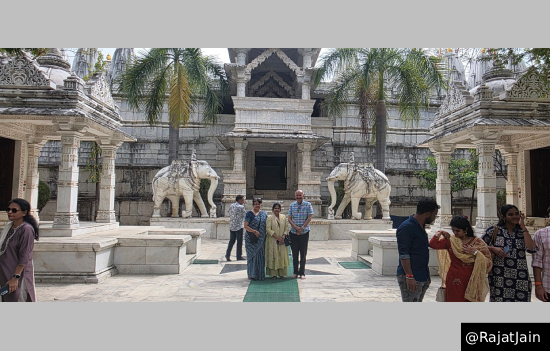 Kumbharia Jain Temple.
The Kumbharia Jain temples is a group of five
Jain temples in the Kumbhariya, Banaskantha district in Gujarat. Constructed
from 1062 to 1231 CE during the reign of the Chaulukya dynasty, they are known
for their elaborate architecture.
Mahavira temple was built in 1062 and Shantinath
temple in 1082, Parshvanath temple was built in 1094 by the Chalukyan king
Jayasimha Siddharaja. Neminath temple was built in 1136 during the reign of Jayasimha
Siddharaja and Sambhavanatha temple in 1231.
The Kumbharia temples are famous for their
elaborate architecture. Along with the Dilwara temples, Girnar Jain temples,
and Taranga Jain temple, they are considered excellent examples of Chalukyan architecture.
The Mahavira, Shantinatha, and Parshvanatha temples in the Kumbharia Jain
temple complex are some of the most renowned Jain temples in India. These five
marble temples vary in size, image carvings, and architectural detail, with
each having its own characteristics. Every temple is surrounded by a protective
walled courtyard with elaborate porched gateway. (author is not a historian).
To
see album Ambaji. To see album Brahma Kumaris
Ashram
at Abu road.
Day 8 covered Mira Bai Museum, Jain temple Falvridhi Parshvanath & Home.
We
drove from Pali to Merta. Merta is the birth place of Mira Bai.
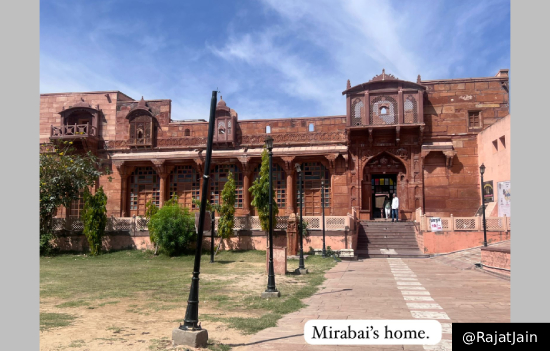 Mira Bai Smarak.
The
Mira Bai Temple is a sacred shrine dedicated to Bhagvan Vishnu as Charbhuja
Nath, the four-armed God. The history of the temple is steeped in divine
occurrences and traditions that have contributed to its significance.
According to the temple's lore, the deity appeared in a dream to Rao Dudhoji, expressing the desire for a temple to be built on the spot where it stands today. The murti is said to have emerged from the ground at this sacred location. Mira Bai, the renowned saint poet, and granddaughter of Rao Dudhoji, is believed to have merged with the deity at this temple, leading to its association with her name.
 Inside Mira Mahal.
“This is the fort of her family that has now been converted into a
museum. It documents her life and stories. You have a life-size Murti in the
middle, folios from manuscripts in large format talking about the stories of
her life.”
Mira
Mahal, not so known, is a treasure house of the life stories of Mirabai. The
paintings, sculptures, exhibits and a shaded-garden situated at the spot where
some noteworthy incidents of Mirabai’s life occurred are visual delight, and
evoke reverence for the Bhakti-poet.
Read
about Mira Bai
birthplace Merta
(good read) Visit Mira Bai Smarak. “Merta is the
kingdom of Mertia Rathore Rajputs. Rao Duda, her grandfather is the best-known
ruler of this land in the early 16th CE.”
From
Merta we visited Falvridhi Parshvanath Jain Temple in village Falodi. From
Merta we drove back to Gurgaon, reached late night.
So
ended a great eight-day trip. Yeah Dil
Mange More.
To read all
travelogues by author
Best
of Marwar in 10 days
Jain
Temple Lodurva near Jaisalmer
Ranakpur
Jain Temple near Udaipur
Dilwara Jain
Temples, Mount Abu
Delwara
Jain Temples near Udaipur
For albums of Jain
Temples across India