- This photo feature tells why Dilwara Jain Temples are a wonder of the world
and who made these temples. Vimal Shah,
builder of the grand Vimal Vasahi Temple was a devout Jain whilst his family
deity was Ambaji.
I visited in 2008. This piece has article published in the Bharatiya Vidya Bhavan Journal in 1980 followed by Editor Notes – Editor.
The Dilwara temples of Mount Abu have won superlative encomia from esteemed Englishmen. Tod, the author of “The Annals of Rajasthan”, wrote: “This is the most superb of all the temples of India, and there is not an edifice besides the Taj that can approach it.”
Sir Edwin Arnold considered that such workmanship was possible of achievement only with the aid of Alladin’s wonderful lamp. Henry Cousens, in his book “Architectural Antiquities of Western India,” observed: “The crisp, thin, translucent, shell-like treatment of the marble surpasses anything seen elsewhere and some of the designs are veritable dreams of beauty.”
According to Fodor, the exuberance of sculpture at the Dilwara temples attains the zenith. Of Indian inventive genius in the art of decoration. What else is required but the words of these experts to rouse one’s curiosity and propel one to
proceed to Mount Abu, often described by zealous tourist guides as the “Olympus of Rajasthan?”
Mount Abu, a tiny
hill station, with an altitude of 4,000 feet above sea level is located at a distance
of 29 Kms from Abu road Railway Station, on the Delhi-Ahmedabad rail route.
The term Abu is derived from Arbuda, the mythological
son of Himalayas, who was supposed to have saved Nandi, the sacred Bull of Siva
from a pit into which it had fallen. Abu is also
considered the seat of hermitage of the epic Sage Vasishta. But let these
mythological links better be lost in the mists of memory.
We are going to
Mount Abu to see the marvellous Jain temples, five in number, but of which only
two are world famous: the ones built by Vimal Shah and Tejpal in 1031 and 1230.
Who were these gentlemen, who built these enchanting
temples and how did they come to build them? How did Jainism come to Abu? What
is the historical backdrop to these fascinating questions and their answers?
Heinrich Zimmer, in his monumental work “The Art of Indian
Asia” writes: “The chief period of Jaina temple building began within seven years of the Mohammedan sack of Somnath by Mahmud of Ghazni in 1024 and ended within a few years of the invasion of Gujarat by Allaudin Khilji in 1297. The aspirations and the dynamic consciousness of a great era of Indian national life thus were crystallised in this richly flowering architecture. It was a brief but glorious day, burning with the fine frenzy of the religious zeal that flared in reply to the iconoclastic ruthlessness of the Muslim invaders.
The temple of Somnath, the fabulous magnificence of which has never since been surpassed, had been outrageously desecrated and destroyed by Mahmud. His act of barbarism intensified among the native Indians an activity that had already begun even prior to the invasion and during the few years that remained before the fall of northern India buildings rose multitudinously in living protest. Moreover, by this time patronage had passed into the hands of merchants and humbler subjects, so that the temples of Mount Abu can be regarded as an architecture of the people, as, distinguished from the architectures of kings.”
One may or may not agree with Zimmer’s views. But his remarks offer an explanation as to why, though Jainism is a religion which does not believe in a God or incarnations of a God, the temples of Mount Abu are a riot of sumptuous sculpture, of Gods and Goddesses and incarnations, chiselled majestically out of marble.
Will Durant considers the temples of Vimala and
Tejpalaas the greatest achievement of Jains in the field of art.
To quote him: “The dome of the Tejpala shrine is one of those overwhelming experiences which doom all writing about art to impotence and. futility. The temple of Vimala, built entirely of white marble, is a maze of irregular pillars, joined with fanciful brackets to a more simple carved entablature; above is a marble dome too opulent in statuary, but carved into a stone lacework of moving magnificence;”
“Finished”, says Fergusson, “with a delicacy of detail and appropriateness of ornament which is probably unsurpassed by any similar example to be found anywhere else. Those introduced by the Gothic architects in Henry Vll’s Chapel at Westminster, or at Oxford, are coarse and clumsy in comparison.”
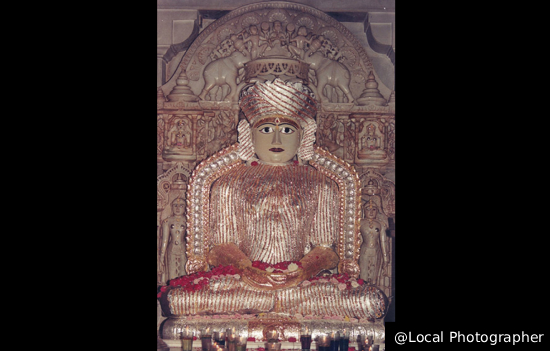 Adhinath Bhagwan in temple 1.
Vimal Shah was a minister at the court of Bhim Deva, the first Solanki ruler of Gujarat. The Vimal Vasahi temple, "which he built, was started in '1031 and was completed in 14 years. 1200 workers laboured on it. It is dedicated to Adinath, the first Jain Tirthankara. According to the Jains “their faith is eternal and has been revealed through the successive ages of the world by the Tirthankaras, a line of saints or prophets, 24 in number, each of whom attained perfection and absolute freedom and then preached Jainism to the world.” The wife of Bhima
Deva I (1022-1063) Udaymati, made Rani-ki-Vav Patan
Though Vimal Shah was a devout Jain, his family deity was Ambaji
or Ambika, the Divine Mother and this probably explains the importance
given to the depiction of the 16 manifestations of Sakti (Vidya Devis) in the
supporting pillars of the marble dome.
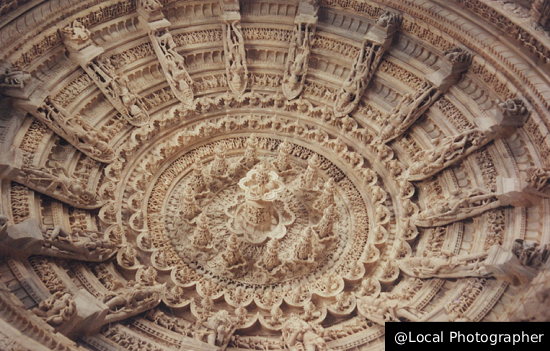
Tejpal
who built the latter temple in 1231 and dedicated it to the twenty second
Tirthankara, Neminath, was a minister to Rana Vir Dhaval. He is said to have
built the temple with the help of his brother Vastupal (merchant brothers) at the
specific insistence of his wife Annapurna.
The most striking feature of the Tejpal temple is the marble pendant of the temple’s dome which, as Fergusson puts it, “hangs from the centre more like a clustre of crystal drbps than a solid mass of marble.”
The marble with which both the temples were built was quarried in the plains below and carted 4000 feet up. While admiring the breath-taking beauty of the delicate marble carvings in the Jain temples Abu, certain critics have observed that these represent a “frozen, lifeless beauty devoid of true monumentality.” In fact, such criticism has been extended to all Indian sculpture by even experts like Will Durant with the remark that “the sculpture of India never acquired the grace of her literature, or the sublimity of her architecture, or the depth of her philosophy; it mirrored chiefly the confused and uncertain spirit of her religions.”
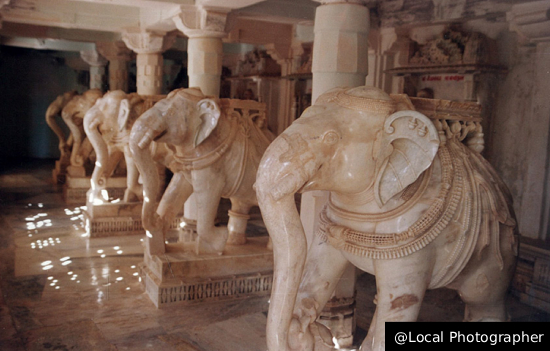 Elephants brought the
marble up to Mount Abu.
Elephants brought the
marble up to Mount Abu.
One has
respectfully to disagree with such views. The creative genius of India has
found its untrammelled outpouring in marble and sandstone, granite and bronze
and attained the zenith, of excellence, irrespective of the medium,
irrespective of the period, irrespective of the rulers, irrespective of the
religious protagonists who caused its monuments to be built.
The fountain head of its artistic expression is (to use Durant’s own words), “the tolerance and gentleness of the mature mind, the quiet content of the unacquisitive soul, the calm of the! understanding spirit, and a unifying, pacifying love for all living beings” -- a philosophy preached not only by the Jain religion, but 'which is India’s cardinal teaching to the world’.
The Jain temples
of Mount Abu are a symbol and sample of this artistic expression.
This article was first published in the Bhavan’s Journal, November 2, 1980 issue. This article is courtesy and copyright Bhavan’s Journal, Bharatiya Vidya Bhavan, Mumbai-400007. eSamskriti has obtained permission from Bhavan’s Journal to share. Do subscribe to the Bhavan’s Journal – it is very good.
Editor Notes
“By the beginning of the 11th century the Chalukyas had firmly established themselves in Gujarat.” According to a search in Gujarat
Chalukyas and Solanki belong to the same royal lineage. Sun Temple Modhera
was constructed during rule of Solanki ruler Bhima Deva 1
Chalukyas
were Hindu Kings They had various branches. The Chalukyas of Badami were most famous, made Badami Caves
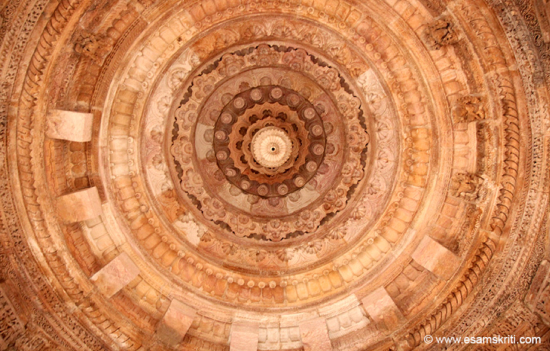 Temple Dome, Surya Mandir Modhera, Gujarat. Note Dilwara has the 16 Devis murty. Here place kept for murty. 2018.
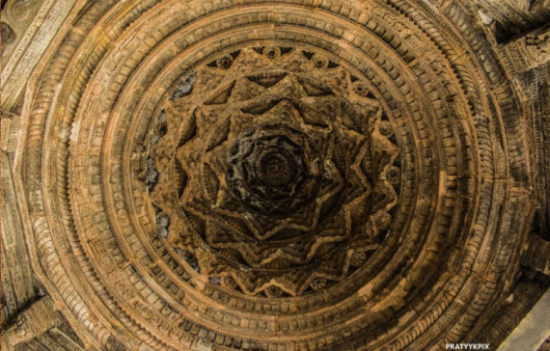 A blackened dome at Adhai-din-ka-jhopda, Ajmer. It became a mosque in 1192 A.D. 2021.
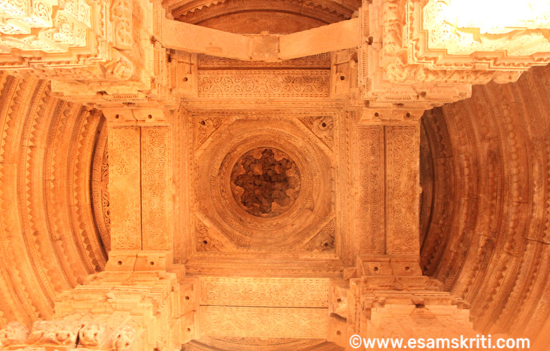 A variant of the dome at the Sas-Bahu Temple in Gwalior Fort. 2020.
I
visited in 2008. We found a
photographer who had clicked pictures in 1992. All credit to him. Temple
information given by local photographer.
You would be surprised to see ghumbaz’s and assume it is an Islamic monument. To avoid catching attention of Muslim invaders people of those times deliberately made a ghumbaz top with simple exteriors so that it did not attract attention of invaders and possible destruction thereafter.
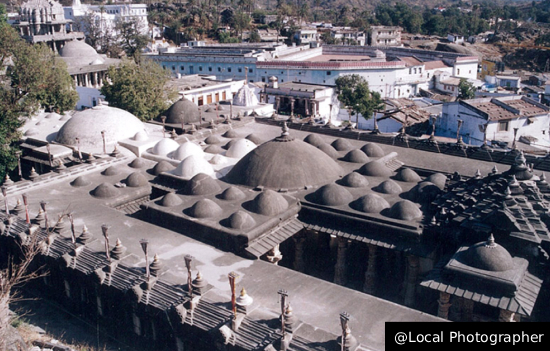
Dilwara is a cluster of five Swetamber Jain
temples dedicated to the Tirthankaras dated between the 11-12th century a.d.
The first of the two imposing temples were built in 1031 A.D. by Vimal Vasahi
and dedicated to Adhinath the first Tirthankara. 1500 masons & 1200 labourers
worked on this temple for 14 years. A pratima of Vimal Vasahi on a horse overlooks the temple entrance.
As you enter first big temple there is a Rang
Mandap in the centre (you see lower part of mandap) supported by intricately
carved columns that lead you to the sanctum. The beautiful carvings connecting
two columns are called Torans. They are made of one piece of stone.
The first temple has 57 temple small temples
of Tirthankaras on the periphery of the main temple. Ceiling is beautifully
carved, some have 3 layers of carving within, other have 2 icons in the
ceiling, predominance of elephants & flowers.
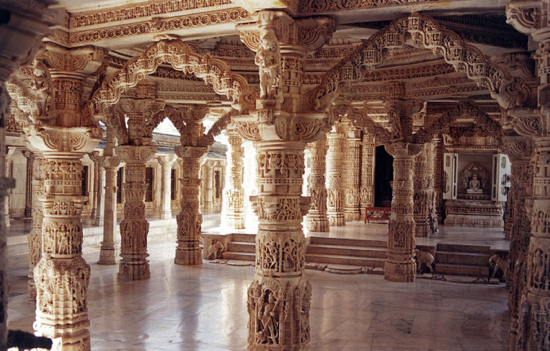
The four corners of the Rang Mandap have icons of Brahma,
Vishnu, Shiv & Ambika. Has Krishna Bhagwan ki Ras leela in temple no 23. In
temple nos 30 there is Krishna Bhagwan & Nag demon.
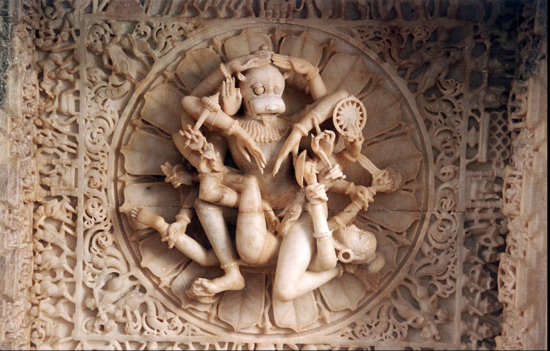 Narasimha avatar of
Lord Vishnu.
Narasimha avatar of
Lord Vishnu.
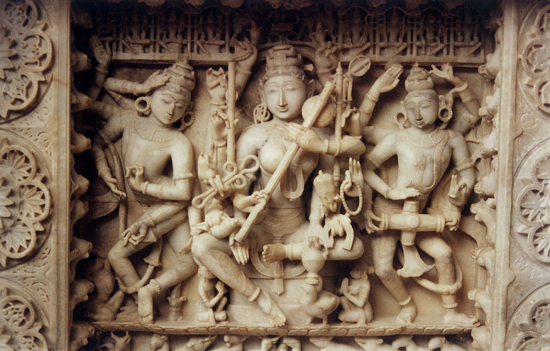 Saraswati.
You see Goddess in four directions. Taking
left to right they are Saraswati with a peacock, Mahalaxmi with a flower,
Gajalaxmi with an elephant and Chakeshwari with a garud.
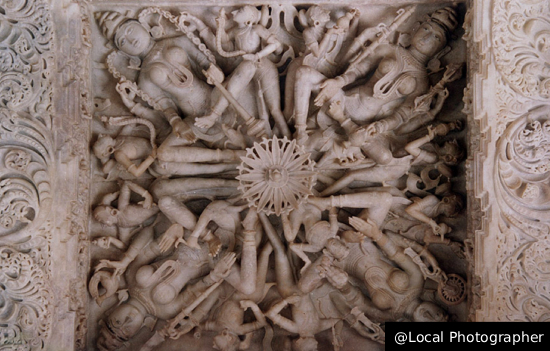
A
close up of the Rang Mandap & columns. In the center is Jhumar ki kala.
Took 6 years to make, weight 800 kgs, is 1.25 metres inlength. Destroyed in
1368, was restored between 1950-65.
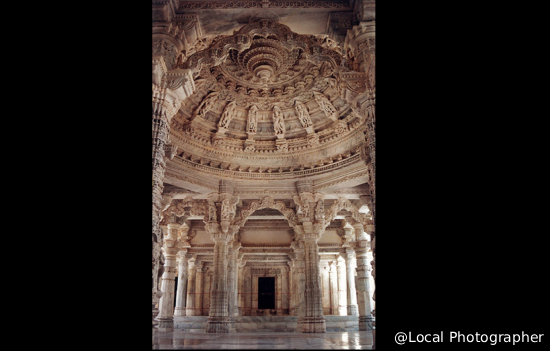
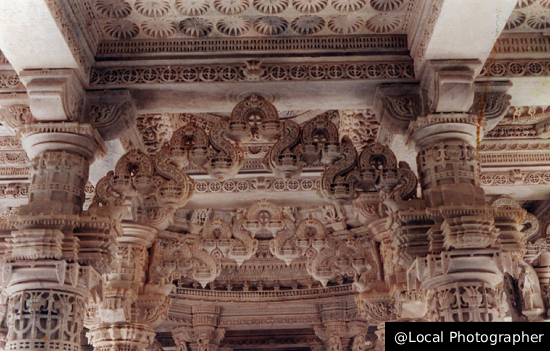 Toran inside temple.
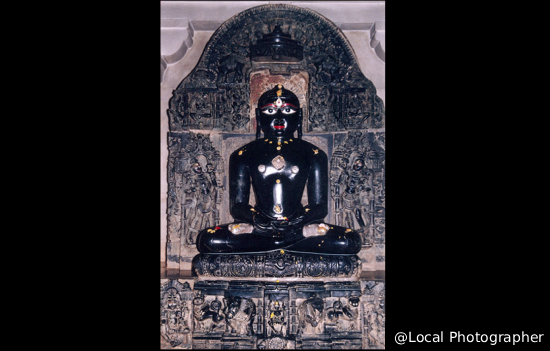 Bhagwan Neminath.
Bhima Shah’s Pittalhar temple has the magnificent icon of Lord Rishabh Dev is built of 5 metres and installed in the year 1482 a.d. The weight of the icon is 4.5 tons, length 8.5 feet and width 5.5 feet.
“The Jainas claim the 22nd Tirthankara Nemintha was a contemporary of Lord Krishna and he belonged to the Yadav family.” Pg 631 The Cultural
Heritage of India
In case of any errors, do mail in and happy to correct.
To see albums
1. Dilwara
Jain Temples
2. Ranakpur
Temples
To
see pictures of Jain Temples across India
To
read articles on Jaina Darsana