- Names of Indians from the state of Kerala who contributed to the drafting
of the Indian Constitution. Not to forget Sir B N Rau who prepared the first
draft of the Constitution in October 1947. The Provincial Committee read all
constitutions of the globe and took the best part of each constitution.
Do you know that the first draft of the Indian Constitution was prepared by
Sir B N Rau in October 1947? Almost every
clause of the first draft had a marginal note giving references to the
corresponding provisions in other constitutions or in the Government of
India (GOI) Act 1935. Read Pictures
in Handcrafted Constitution of India and Is India's Colonial Constitution a result of the Drafting Committee being dominated by Lawyers – Editor
This article was
first published in the Bharatiya Vidya
Bhavan Journal.
In the galaxy of Malayali leaders who made their mark on the national scene, pride of place goes to Sir C. Sankaran Nair, the only Keralite to hold the prestigious post of the President of the Indian National Congress. He chaired the INC Session of Amaravati in 1897. Later he secured global fame when he resigned from the Executive Council of the Viceroy in India in 1919 in protest against the Jallianwala bagh massacre. In 1922 when he published the book ‘Gandhi and Anarchy’, Sankaran Nair became persona non grata to the national leadership of the Congress.
The following Keralites played decisive roles in the making of the Indian
Constitution as Members of the Indian Constituent Assembly formed in July 1946:
1. PATTOM A THANU PILLAI later Prime
Minister of Travancore (1948-49), Cochin and Chief Minister of Kerala (1954-55
and 1960-62) and Governor of A.P. and Punjab (1962-68).
2. ADV. R. SANKAR, Chief Minister of
Kerala (March 1908 to 07-11- 1972) and the General Secretary of the SNDP Yogam
for ten years and President for one year (Sankar was Dy.CM 1960-62, and Chief
Minister of Kerala 1962- 64).
3. PANAMPALLY GOVINDA MENON leader of
Cochin Congress, Minister of Travancore-Cochin State and Chief Minister of
Kerala (1955-56). Born on 1-10-1908 he lived up to 23-5-1970 and was Railway Minister
in the Nehru Cabinet (in 1966-67).
4. JOHN MATHAI Union Finance Minister in
the Nehru Government and foremost Economist of India. He was selected from
United Provinces i.e. U.P. State in the open quota. The Economics department of
Calicut University in Thrissur is named after Dr. John Mathai.
5. ADV. P. T. CHACKO, Home Minister of Kerala
during 1960-64 (9-4-1915 to 1-8-1964) Elected Member of the Central Constituent
Assembly 1949-50 and was Member of Parliament during 1952-57.
6. P. S. NATARAJA PILLAI, PSP Leader,
State Finance Minister 1954-56 and son of Manonmaneeyam Sundaram Pillai. Born
as an aristocrat and died in a rented house in Peroorkada, Thiruvananthapuram,
Pillai drafted the land reform act, which was modified later by K. R. Gouri
Amma, EMS and C. Achutha Menon later Ministers of Kerala in charge of Revenue.
7. ADVOCATE ANNIE MASCRENE (6-6-1920 to 19-7-1963) MABL, Constituent Assembly Member 1949-50, MP 1950-57, State Health Minister 1949-50 Kerala Government. Her statue is erected in front of the Trivandrum Government Women’s College for Women liberation struggles.
8. DAKSHAYANI VELAYUDHAN about whom
Prime Minister Narendra Modi too made references recently was born in
Mulavukadu near Chittur in Ernakulam. Dakshayani (04-7-1913 to 20-7-1978) is
known as the First SC Graduate of Kerala. Out of three women she was elected
from Kerala to the Constituent Assembly. As per All India Status she was one out
of 15 women members in the Constituent Assembly. The first Dalit (SC) elected
to the Constituent Assembly is another landmark.
Her anti-congress stand could be seen in Jay Bhim, a weekly of All India Scheduled Caste Federation (AISCF).
She opposed not only Congress but also M. Nagappa and B. R. Ambedkar and she
stood for separate electorate for SCs. During 1946 to 1952 she was a
Constituent Assembly member despite Congress resistance.
In 1945 Cochin Legislative Council nominated her as a member. She was Rajya Sabha Member K. K. Madhavan’s sister. She did her degree from Maharajas College, Ernakulam affiliated to Madras University. As a teacher she worked hard and married R.Velayudhan a Parliament Member. They had five children. History
Researcher Meera Velayudhan is their youngest daughter. On Nov 29, 1948
Dakshayani stood for the abolition of caste distinction especially with her
very active debate on clause 11. She contested from Adoor but was able to get
only the 4th position in the election. Worked as Teacher, LIC
Information Officer and in Mahila Jagrathi Parishad (1977). Small yachts were
put together to create a ground for a public meeting in Ernakulam when land was
not available due to Savarna opposition. The Kerala Government instituted
Dakshayani Velayudhan Award for Women Empowerment in 2019. SC upliftment was
her life motto.
9. AMMU SWAMINATHAN, mother of Captain Lakshmi of Rani Jhansi Regiment of INA founded by Subhash Bose. Govinda Menon’s daughter Ammu Amma (born 1894) of Anakkara Vadakkedath Veedu married Dr. Swaminathan, an Advocate in Madras. They had two daughters Cap. Lakshmi of INA fame and Mrinalini Sarabhai famous dancer (present Chairman of the Kerala Kalamandalam), besides a son who was Advocate General Govind of Madras. Ammu was a founder Member of All India Women’s Conference in Madras.
Joined INC in 1934 influenced by Gandhiji, Nehru, Sarojini Naidu and Lajpat Rai (1934-39). Ammu was elected as Madras Corporation Member. Jailed for two years in 1946 elected to the Constituent Assembly. Attended Women’s Conference in Ethiopia in 1948, Geneva 1949, and many places like Copenhagen. Elected to Lok Sabha as a Member during 1950-57 and Rajya Sabha during 1957-60. She was President of Bharat Scouts during 1962-63. Served All India Film Boards as well.
10. K. A. Muhammed Sri Mulam Assembly
Member during 1944-47 was in TVC-Cochin Assembly during 1948-52 from Kollam
Constituency. It was during 1948-50 that Muhammed actively participated in the
Constituent Assembly.
11. A. K. Menon Hindi Promoter of Cochin. The Constituent Assembly tried to give representation to all ill-represented sections of the society and consequently Hindi promoters got a chance to discuss Constitutional reforms in the Constituent Assembly.
12. B. Pocker Sahib Bahadur had signed
in the Sign Manual of the Constituent Assembly Book kept in the Parliament Hall
in those days.
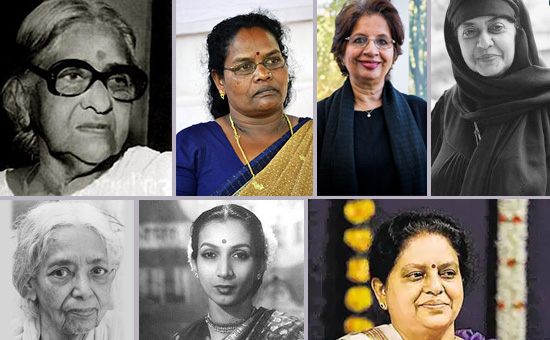 Kerala’s Outstanding Women.
13. P. Kunhiraman is one who signed in the Constituent Assembly Book of
records. Details about him are lacking in records and books. A real search is
yet to be made.
14. KTM Ahmed Ibrahim.
15. Abdul Sathar Haji
16. Muhammed Ismail Sahib
(Three Keralites who lived in Madras during the period of nomination to the
Constituent Assembly.) These three giants were nominated but they were migrants
to Madras probably as businessmen. (Details yet to be secured.)
The Constituent Assembly wanted to alter the provisions of the 1935
Government of India Act which consisted of several objectionable clauses as per
Congress perspectives. A constitution drafting committee of seven members was
formed with
Dr. B. R. Ambedkar as Chairman who is the real architect of the Indian Constitution.
Jawaharlal Nehru was the architect of the Preamble. Sardar Patel was the
architect of the Chapter on Fundamental Rights in India. The Constituent
Assembly convened for the first time assembled in the Central Hall of
Parliament.
Partition agreed on 3 June 1947: Dr. M. R. Jayakar supported by Dr. B. R. Ambedkar criticised the Objective Resolution of 13 December 1946
presented by Jawaharlal Nehru in the Constituent Assembly as wrong, illegal,
immature, disastrous and dangerous. Still the house adopted it on 22 January
1947. The constitution consisting of 448 articles in 22 parts, Eight schedules
and 97 Amendments was signed last by Dr. Rajendra Prasad. It replaced the Government
of India Act of 1935 with 1,45,000 words.
It was the Cabinet Mission Plan which proposed a Constituent Assembly for
drafting a constitution taking into account the British decision to transfer
Power to India.
The Final session was held on 24 January 1950. It unanimously elected Dr.
Rajendra Prasad as the first President of the Republic of India under the new
Constitution w.e.f. 26-1-1950. It was in
the INC Lahore session that January 26, 1930 was declared as the Indian Independence
Day. To mark this the date 26th January was fixed by the Constituent
Assembly.
One Socio economic revolution was aimed at by Dr. S. Radhakrishnan in the drafting
of the Constitution. Vallabhbhai Patel was not an original member but attended
many sessions of the Constituent Assembly like V. K. Krishna Menon,
Raja Hathee Singh, Prof. A. Appadorai, Mridula Sarabhai etc. who stepped
into
the Parliament Hall along with leaders like Jawaharlal Nehru.
The Provincial Committee read all constitutions of the
globe and took the best part of each constitution. Policy of pick and choose from other
constitutions of USA, Australia, Canada, Switzerland etc. was the policy
adopted. Canada was a model federation to many.
The Ninth Schedule was brought out in 1951. This is the first Amendment of
the Indian Constitution.
According to the Indian Independence Act (1947) the Central Assembly
elected in 1945 ceased to function. The Constituent Assembly became the Constituent
Assembly for legislative purposes during those days of transfer of power. When
the constitution was finalised it adopted a resolution to end the Constituent
Assembly with effect from 26-1-1950.
Author Dr. T. P. Sankarankutty
Nair is the Former Professor of History and Ex-Director General, Centre for Heritage
Studies, Govt. of Kerala.
To read all
articles by author
This article was first published in the Bhavan’s Journal, August 1-15, 2026 issue. This article is courtesy and copyright Bhavan’s Journal, Bharatiya Vidya Bhavan, Mumbai-400007. eSamskriti has obtained permission from Bhavan’s Journal to share. Do subscribe to the Bhavan’s Journal – it is very good.
Also read
1.
To buy online
Christian Constitution in a Hindu Nation
2.
Kerala’s Outstanding Women