- Photo
feature has pictures Jijabai birthplace-Rajwada and her contribution to making
Chhatrapati Shivaji Maharaj what he became.
In 2018, I was driving back from Lonar to Aurangabad when the driver stopped at the Rajwada of Shivaji Maharaj Aai or Mother, Jijabai. Sharing-
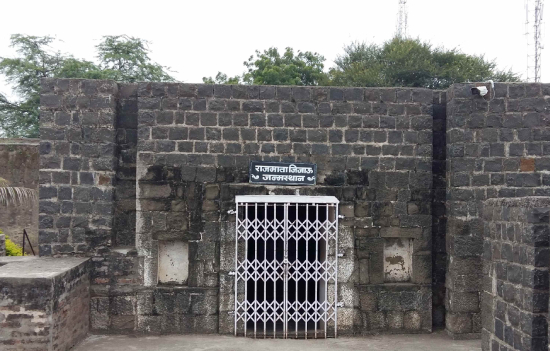 Place where Rajmata Jijabai was born in 1598.
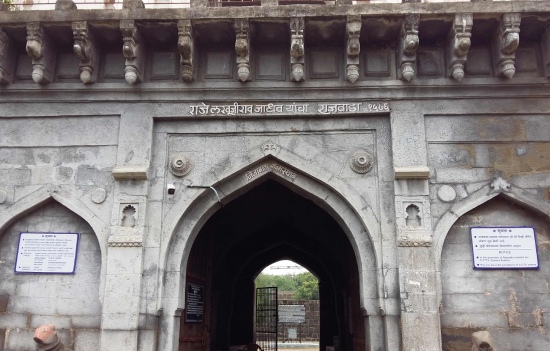 Entrance to Raje Lakhujiraoji Jadhav Rajwada, Sindhkhedraja, Buldana. Made in 1576. It has Nandi on either side.
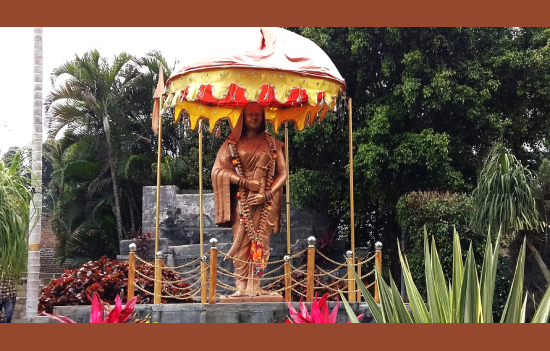 Pranams Jijabai.
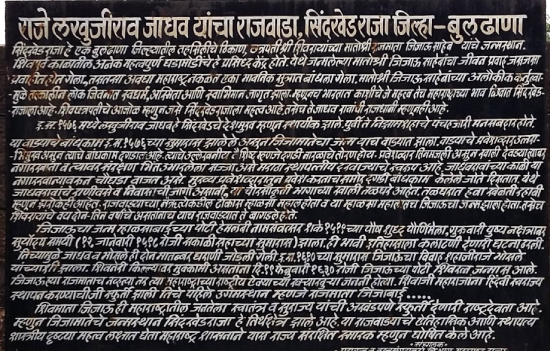 For translation scroll down.
This
is a compilation of writings of various authors.
Volume
7 of The History Culture of Indian People published by the Bharatiya Vidya Bhawan – Three Maratha families were connected with the rise of Shivaji. The Yadavas of Devagiri (Daulatabad), the Bhosles of Verul (Ellora) and the Nimbalkars of Phaltan. Jijabai belonged to the Yadavas family. Their Rajwada was close to Daulatabad.
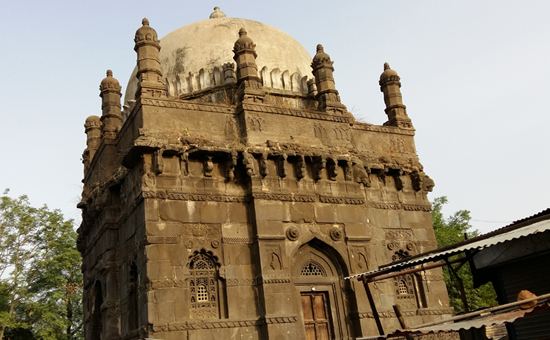 Shahji (father of
Shivaj) Samadhi at Verul (near Ellora Caves).
Shahji (father of
Shivaj) Samadhi at Verul (near Ellora Caves).
Jija Bai was captured by Shah Jahan’s officers but she managed to cleverly have Shivaji taken out of the village. She was released on payment of a huge fine. Mother and son then moved to Pune. Jija bai developed in her son a spirit of defiance and self-assertion. The Nizam Shah had openly murdered Jijabai’s father, his brothers and sons. Bajaji Nimbhalkar, the ruler of Phaltan, a scion of the old Paramara race, was converted by the Sultan of Bijapur. Pg 250-252.
Shefali
Vaidya wrote in Swarajyamag, “Why did Shivaji choose to dedicate his life to carve out an independent Hindu kingdom, when he could have chosen the easy way out and serve as a feudal lord at the court of one of the Deccan sultanates like his father. Babasaheb Purandhare smiled that knowing half-smile of his, and replied with the customary twinkle in his eye, ‘he had a mother like Jijabai’!”
“As a single mother, Jijabai was the greatest influence on a young Shivaji. She encouraged him to read stories from Hindu scriptures to develop a strong moral compass in her son. She was also a skilled warrior and a horse rider. She often rode alongside her son and encouraged him to get out of his palace and mingle amongst common people to see how they lived. Shivaji, though the son of a nobleman, grew up amongst common people. Many of his childhood friends became his most trusted warriors who later helped him achieve his dream of Hindavi Swarajya.”
She is remembered as the ‘Mother of Swaraj’ and impact that a mother can have on her children.
When
Shivaji was a child, husband Shahaji entrusted her with the administration of
Pune. She was a nationalist and ahead of her time. Source
Srikant
D wrote
in Linkenin three things that Jijamata taught Shivaji – One-Never make your kids or juniors feel your inadequacies or fears, two-Be vigilant and observant, and create a team with the necessary expertise, three Applaud Women.
Source India Today. “RC Majumdar writes in Shivaji, “The courage that made Shivaji fearless and resolute found its roots in the strength of Jijabai. She not only instilled in him the ideals of Swarajya but, at crucial moments, also served as his mentor and guiding force.”
“In 1665, when Shivaji was forced to sign the Treaty of Purandar under pressure from Mirza Raja Jai Singh, Jijabai reminded him that it was not the end. She told him to treat it as a temporary compromise and to stay focused on the bigger goal -- Swarajya.”
“A year later, when Shivaji was called to Aurangzeb’s court in Agra and no one knew if he would return, Jijabai took care of the political matters of the state.”
“After the death of Shivaji’s wife Saibai, Jijabai took care of Sambhaji Maharaj and instilled him with the thoughts of Swarajya, repeating the role she had taken with his father.” India
Today
To
read all articles on Maratha History
To
read Dr Uday Kulkarni articles on Chhatrapati Shivaji Maharaj
To
read about Maratha Queens Tarabai, Ahilyabai
Holkar
and Lakshmibai
of Jhansi
Translation of Board pic 4 above.
Palace of Raje Lakhujirao Jadhav, Sindkhed Raja, District-
Buldhana
Sindkhed Raja, an important town in the Buldhana district of Maharashtra, is a birthplace of Rajamata Jijabai, the mother of Chhatrapati Shivaji Maharaj. Sindkhed became a prominent place in late 16th Century when Lakhuji Raje, the maternal grandfather of Shivaji Maharaj settled there as a ‘Deshmukh’ (a landlord/ district head) of the area. He was Panch Hajari (5000) a very high ranking noble under Nizam Shahi of Daulatabad.
This
palace was built around 1576 CE, and Jijabai was born in this palace. The main
entrance of the palace was built in stone masonry and facing north. The special
feature of this entrance is its carvings of coconuts in a form of toran (auspicious
door hanging as per Hindu culture). The height of the entrance arch is close to
three floors and depicts typical Maratha style architecture of the era.
On both the sides there are platforms known as ‘Devdi’ for sitting, ‘Nagarakhana’ (a place for the beating drums) and a viewing balcony with a protective wall. Beating of the drums during entry-exit of the nobles or on the special occasions was a ritual way of informing these important events during the Medieval era.
After entry through the main door, the residential part lies on a high stone platform. The area contains several cellars, air circulation for these was achieved by ingenious way of keeping multiple ‘jharoka’- niches. The Mhalsa Mahal, the part of palace where Maharani Jijabai was born lies in the South-West direction of the palace. The palace has also seen very young Shivaji Raje (around 3 years old) when Jijabai has visited Sindkhed Raja in 1630’s.
Maharani
Jijabai was born to Raje Lakhuji Jadhavrao and his wife Mhalsabai in Hemlambi
Samvastar, on the day of Paush Paurnima (Full moon day of Paush month) in the Shalivahan
Era 1519, Thursday, on Pushya Nakshtra, at the time of Sunrise (12th January
1598, morning around 6am). This was a turning point in the history of India.
Jijabai
was married to Shahji Raje Bhosale, another eminent noble family in 1610 CE. Due
to the marriage of Jijabai to Shahaji Raje, Jadhav and Bhosale, the two prominent
families of the Maharashtra were bonded together. The couple, Shahaji Raje and Jijabai
were blessed with a son on 19th February 1630 CE atop fort Shivneri. The son
was named Shivaji from Devi Shivai, the goddess of the fort Shivneri.
The
concept of Hindvi Swarajya, was first pan-Indian indigenous rule was said to
put forward by Maharani Jijabai, which later became the source of inspiration
for young Shivaji Raje. The message of Swarajya-independence and Surajya-good
governance given by Rajmata Jijabai was propagated and implemented by
Chhatrapati Shivrai in his kingdom.
Due
to her immense contribution in national awakening, her birthplace at Sindkhed
Raja has been equated with a sacred pilgrimage site.
To
preserve this important historical and architectural milestone, this palace was
declared a protected monument by the Government of Maharashtra.