- This essay traces Indian History/Lists Dynasties from Buddhist times to 1000 A.D. What was impact of Ashoka’s policies? Why Gupta rule is called the Golden Period of India? Concept of Satyagraha is explained. What was the impact of Gandhi’s understanding of Ahimsa on post 1947 India? Select verses from the Bhagavad Gita on Dharma.
In 2001, I wrote Why
has Asceticism lead to the Weakening of Bharat . A lot of water has flowed
down the Holy Ganga since then so decided to convert the earlier piece into a
more relevant and shorter article.
In India’s Rebirth, a book that has excerpts from Maharshi Aurobindo’s thoughts he told Shri Motilal Roy of Chandranagore, “You must understand that my mission is not to create Matts, ascetics and Sannyasis, but to call back the souls of the strong to the Lila of Krishna and Kali. Every
ascetic movement since the time of the Buddha has left India weaker and
for obvious reason. Renunciation of
life is one thing, to make life itself national, individual, world-life greater
and divine is another. You cannot enforce one ideal on the country without
weakening of the other. You cannot take away the
best souls from life and yet leave life stronger and greater. Renunciation of
ego, acceptance of God in life is the Yoga I teach.”
Sri Aurobindo’s words are as relevant today as it was when spoken i.e. around 1920. To understand the reasoning behind these words this essay covers Indian history from times of Buddha, Mahavir, Ashoka, Gandhi, Nehru and ends with Vajpayee i.e. from about 500 BC to 2000 AD excluding the Islamic period. To read in PDF without pictures click on PDF.
I have referred
to The History and Culture of Indian
People by the Bhartiya Vidya Bhavan, Defending
India by Shri Jaswant Singh. Special thanks to the late Kulpati K M Munshi
whose words I have liberally borrowed. I am most grateful to my email Guru, an
exponent on Vedanta, for correcting the manuscript wherever necessary. The
essay has eight chapters.
1. Dharma. Buddha and Mahavir, their teachings and impact on our lives.
2. Asoka: covers political events during Asoka’s rule, teachings, concept of Dharma, Post Asoka, Reasons for downfall of Mauryan Empire and impact.
3. Rulers after Asoka: Yavanas, Sakas, Kushanas in brief and their impact.
4. Prosperous India (320-750): Gupta Rule, Arab
invasions myth and impact.
5. 750-1000: Rule of Pratiharas, Rashtrakutas, Palas in brief with impact.
6. Gandhian Asceticism: Gandhi’s definition of Satyagraha, Did India get independence because of Ahimsa and Will Ahimsa work everywhere.
7. Impact of Ahimsa on thinking in Independent India.
8. Holy Geeta: verses from the Holy Geeta by Swami Chinamayanandji.
1. Buddhism and Jainism
Pre-Buddha
The Vedic Culture had, for its Central Idea, Rita, the Cosmic Order. The fundamentals flowing from it were Satya, accord between thought, word & deed, Yajna, the complete dedication of one’s cherished things to the Higher powers, the sublimation of passions and instincts through discipline which brought self-mastery.
Sage Kanada said, “Dharma is that which gives prosperity in this life and liberation in the next.” There is no higher Dharma than truth. Action without Yajna is bondage says the Bhagwad Gita. Tapas came to comprise, as the Bhagwad Geeta has it, truth and non-violence.
Long before the coming of Buddha, a central idea was
becoming clear from the mass of incoherent urges, which went under the generic
name of Dharma. Dharma is a way of life based on the eternal truths of life.
Man was not a struggling worm but a self with a supraphysical destiny that could
be attained only by the mastery over misery. This was possible by man becoming self-disciplined.
Simply put, the mind must not be affected the joys and
sorrows of life. The discipline implied relinquishment of the greed for life
and broadening of the personal self into a universal self. The end of this
discipline was variously aimed at self-realization (Siddhi), emancipation
(Mukti), and freedom (Nirvana), enlightenment (Jnana), and bliss (Ananda).
For such a planned life, stability was
essential. It implied
protection without slavery. Power was thus conceived as moving and having its
being within the framework of Dharma. Kingship was to be a religious trust.
Rajadharma, Smriti and tradition were to be interpreted from the time to time
to regulate life. The ambition of kings was controlled by a fundamental law
whose basis was Smriti and the Parishad-the Assembly of learned. As the country
grew bigger a military overlord was necessary, Rajadhiraja or Chakravartin as
the Protector of Dharma.
The Mahabharata (about 1200 BC) is all about Dharma and
Adharma. Indian kings, all of whom accepted, the law of the Dharmasastras as
unalienable, waged wars according to human rules. Whatever the provocation, the
shrine, the Brahman, the cow were sacrosanct to them. Harassment
of the civilian population was considered a serious lapse in the code of honor.
The Kshatriyas had high regard for women ruled out their abduction as an
incident of war.
Essential Features of Buddhism
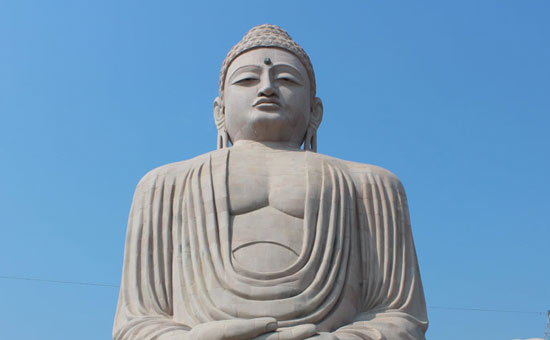
Gautama alias Siddharta was born at Lumbinivana in 563
BC. His father was the chief of the Sakya clan. Gautama lived a life of easy
and luxury, got married, had a son called Rahula. After seeing four persons in
four different stages, the idea of renunciation entered his mind. At age 29 he
left home.
At Vaisali he met Arada Kalama who espoused the Sankhya school of philosophy. Not satisfied with the teachings of this school he moved on to teacher Rudraka Ramaputra’s heritage. He went to Uruvela where he became Buddha, the Enlightened One. Next, he traveled to Kosala, Vaisali, Kapilavastu, Kausambhi, Veranja. Buddha died in 486 B.C.
Read Introduction
to Buddhism and Introduction
to Schools of Buddhism
Without admitting the existence of the soul, the early
Buddhists accepted the theory of Karma i.e. the inevitability of the effects of
deeds in regulating future births. Sankya, Yoga and the Upanishads were the
sources of his inspiration. He was a product of the Aryan order and represented
the ascetic orders. He proclaimed the supremacy of Dharma (called Dhamma in
Pali) but stressed on universal compassion.
Impact
of Buddha- He was revered as
an ascetic reformer, in the process of a general acceptance by the masses he
became a divinity. On the other hand, Krishna was Sasavata Dharmagopta the Protector of Eternal Dharma.
JAINISM (brief)
Jain tradition speaks of 24 Tirthankaras. The last two were Parsva and Mahavira. Parsva lived some 250 yrs before Mahavir and is always referred as “beloved of men” who believed in the eternity of matter as Mahavir did. The followers of Parsva preached that self-control results in the cessation of Karma and penance leads to annihilation. There was a difference between the two sects. Parsva followed allowed the use of a white garment by monks while Mahavir forbade this. Hence, two sects Svetambara (white-clad) and Digambara (naked).
Mahavir became a
monk at the age of 30, left home in the beginning of winter, 13 months later he
abandoned his clothing. Mahavir died in 468 B.C.
Jainism showed a close affinity with the Samkhya
system. It also developed a kind of logic, which cut at the root of all stable
knowledge. It was called Syadvada or
the theory of May Be. Jains had a theory of reality. Their logic was not intended
to deny reality. The world consisted of two categories the conscious (jiva) and
the unconscious (ajiva). Read Jain
philosophy simplified and Essentials
of Jain Philosophy
Impact
Buddhism and
Jainism emphasized non-injury, compassion for others, suffering, austerity and
non-violence. The most important teaching was that of non-violence. This influenced
the minds of people.
Buddha
introduced a unique institution of monasteries whereby young men and women gave
up ordinary lives and moved into monasteries to achieve higher spiritual goals.
Thus, the services of these people were permanently
lost to society and not available for protection of Dharma. These influences increased man’s ability to suffer oppression, made their hearts soft, weakened society and reduced the will to fight for the protection of Dharma. Since Buddha and Mahavir were divine souls and not rulers, it did not lead to an immediate loss of political control by the ruling class.
2. ASHOKA 273 to 236 B.C.
The first major foreign invasion was by Alexander in
326 BC. The adventure was brilliant but he never fought any of the great armies
of Bharat. It did not result in a permanent occupation of Punjab. Whatever
Greek occupation remained was wiped out by Chandragupta Maurya.
Alexander’s invasion promoted the political unification of India, smaller states got merged into bigger ones, paving the way for Chandragupta. The only permanent result of Alexander’s campaign was that it opened up communication between India and Greece.
Chandragupta was succeeded by his son Bindusara
(300 to 273 BC) followed by Ashoka (273 to 236 BC). A unique feature of Ashoka’s rule that left a permanent record of his history in inscriptions engraved on natural rocks and pillars.
An able soldier he carried on a policy of conquest and
aggression. He conquered Kalinga in the
eight year after his coronation. The severity of the resistance and resulting
horrors are written in Rock Edict XIII-1.50 lakhs captured, 1lakh slain and
many times more died. The war brought about a complete change in Ashoka.
According to Buddhist tradition, Asoka became Buddhist
after the Kalinga war.
In Rock Edict XIII, Asoka expresses genuine remorse
for the sufferings caused by the war. He made two
resolutions. One was to eschew all war in the future. “If anyone does him wrong the Beloved of the gods must bear all that can be borne”. Henceforth his policy would be one of
conciliation towards all. The exhortation of good deeds was the foundation
for his second resolution i.e. the inculcation of his Dharma (Dharma or law of
Piety) not only among the people of his own dominions but all over the world.
Asoka entered and or lived in the Buddhist Sangha or
monastery, took up missionary activities, the task of propagating Dharma, which
is of such universal equality as to appeal to humanity at large. He set up a
network of missions within India and abroad. To his credit, he did not ignore
governance. His new outlook made him compassionate towards his subjects.
Dharma
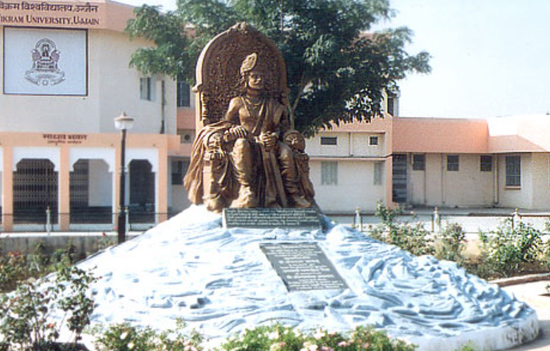 Vikramditya at Ujjain University. 2006.
Asoka worked for the moral upliftment of people,
insisted on family as the basis of morality, respect towards elders and
teachers. Thus, the starting point of religious and moral life was purification
of home, family and domestic life by cultivation of relations with all
concerned. Character, conduct and behavior counted more than ceremonies to him.
Next religion was to extend from family to communities.
The 12th Rock is an appeal for the toleration of all religious sects. Above all, Asoka stood for Ahimsa to men and animals, which he preaches in all his edicts. Further,
he purified his national policy by proclaiming war
as an unmitigated and absolute evil.
A consequence of this passion for peace was that, unlike his illustrious grandfather’s scheme of establishing authority all over India, Asoka left unsubdued smaller and weaker people, states of India and established all states big or small on equal sovereignty.
Post Ashoka
The history of his successors is shrouded in mystery. The reason being the empire was too large to be kept as one by unworthy successors. It is agreed that Brihadratha was the last king of the Maurya dynasty i.e. up to 187 BC. The progressive disintegration that followed Asoka’s rule is marked by-According to Rajatarangini, Asoka’s son Jalauka became an independent ruler in Kashmir and conquered territory up to Kannauj. Another son Virasena set up at Gandhara.
The disintegration of the Mauryan Empire was speeded
up by the Yavana invasions, the final blow struck by the revolt of Pushyamitra,
the commander-in-chief of Brihadratha.
What were the reasons for the downfall
of the Mauryan Empire?
One view is that the humiliation of Brahmans led to a
backlash and a revolution by a Brahman Pushyamitra. This seems slightly
far-fetched. Since Ashoka eschewed all wars, naturally this reduced the
military efficiency of his empire. However, considering the circumstances of
those days, such a large empire was bound to break. There were other causes
too, the spirit of local autonomy, oppressive rule and rebellious disposition
of governors, palace intrigues and official treachery. Foreign invasion too.
The repeated revolt by the province of Taxila, due to the opposition of local
officials is one e.g.
There is no doubt that the moral ascendancy of Indian
culture over parts of the world was thanks to Ashoka. What it meant was a weak Central authority.
IMPACT
Freedom fighter
K M Munshi wrote in History and Culture
of Indian People, “But welfare states, which eschew armed coercion of recalcitrant elements are not known to survive. As soon as Asoka died, his Buddhist leanings and pacific policy evoked open resistance. Due to a lack of a vigorous military policy, the outlying provinces rose in revolt. The Greeks invaded India and advanced up to Ayodhya and
Chitor.”
“Further disintegration was halted when Pushyamitra (187 to 151 BC), took over what was left of the Empire. Dharma Vijaya was no longer to be achieved by abjuring war but by building military strength, politics became real. The Sungas vanished Greek invaders, were respected by foreign kings. They fostered a revival of art, literature and architecture. In Madhyadea, among the wise and intellectual, the ascetic look lost its attraction. Dharma was strengthened. The new wave of collective enthusiasm found its
expression in a combative attitude against Buddhism in search of a fuller and
richer life, in the cult of Karttikeya-the god of war, in the resurgence
of the Bhagwata Cult, in the unchallenged supremacy of Vasudeva
Krishna in the Hindu Pantheon.”
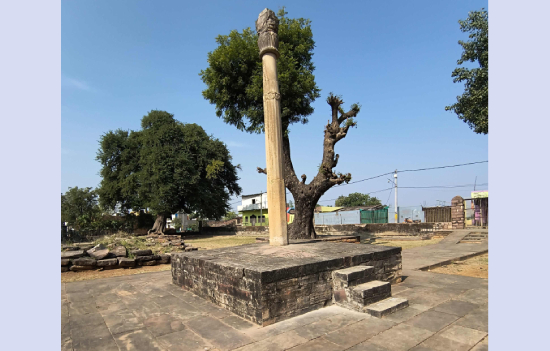 Pillar at Vidisha (MP) refers to Sri Krishna worship about 150 B.C.
Three main teachings of Asoka were “we must bear all that can be borne, policy of conciliation towards all and tolerate all religions”. These thoughts are divine but impractical then and today. Read History
of Indo-Pak Wars
Asoka left an unparalleled example of the chaos that
would reign in India when there was a weak central authority. Sardar Patel
understood this and insisted on a strong center during his discussions with the
British.
3. Rulers after Asoka
Pushyamitra’s rule (187-151 BC) covered only central portions of the old Mauryan Empire. In south and southeast the Andhras and Kalingas, together with parts of Northern India, had already asserted their independence.
Pushyamitra defeated the Greeks, performed two horse sacrifices,
indicates he was a powerful ruler who was not intolerant of Buddhism. During
his reign, the Buddhist stupa at Bharhut was erected. Pushyamitra is credited with
stemming the tide of foreign invasions and for the time being arrested the
disintegration of the Mauryan Empire. The Sunga period saw the revival of
Brahmanical influence, importance of Bhagwata religion, the great grammarian
Patanjali, was most probably a contemporary of Pushyamitra. Sunga rule ended in 75 B.C.
The most interesting period of post-Mauryan history is
the establishment of foreign supremacy in Uttarapatha and the adjoining region
of Madhyadesa, successively ruled by several foreign powers, the Yavanas (about 2nd century BC) were the
first among them. The Yavanas or Greeks of Bacteria gradually became Indianized
by adopting Indian names, religious beliefs and were eventually absorbed into
the Indian population. In fact, Nagar Brahmans of Punjab are supposed to be
descendants of the Greeks. Areas of rule were mainly Southern Afghanistan and
northwestern India.
Next were the Sakas (Scythians) and the Pahlavas (Parthians). The Sakas are believed to be
from a tribe of Central Asia nomads, settled in Iran later. In India, they soon
adopted Indian names and religious beliefs.
Next invader were the Kushanas,
a branch of the Yueh-chi tribe in Chinese Turkestan. Kanishka (78 to 101 AD) was the greatest of
the Kushana emperors. His rule extended over Madhyadesha, Uttapapatha and
Aparanta divisions of ancient India. His empire seems to have stretched from
Bihar to Khorasan in the west, from Khotan in the north to Konkan in the south.
It shifted the centre of political power from
Pataliputra to Peshawar. Their power declined after the reign of
Vasudeva (145 to 176 AD).
Saka satraps ruled large parts of Western and Central
India while in U.P., Rajasthan subordinate ruling houses raised their head. The
Kushanas had complete control over Punjab, NWFP and Afghanistan up to the
middle of the 3rd century AD. The dynasty paved the way for Indian
civilization to reach Central and Eastern Asia. The period saw the rise of
Mahayana Buddhism, Gandhara art, idol-worship of Buddha,
development of Saivism and the introduction of Buddhism into China by Kasyapa
Matanga in 61-67 AD.
Under foreign rule, the social pattern accepted as
part of divine origin reorganized itself, orthodox cults revivified by a
resistance to heterodoxy. For e.g. Kushana was a Buddhist while his father Kadphises I was a Saivite and son a Bhagavata. Thus, social and religious tenacity developed a mighty absorptive power.
The Andhras defeated the Sakas, Parthians and Indo
Greeks. About the same time Kalinga under the great Jain conqueror Kharavela,
played a great part in diffusing Indian culture beyond the seas.
Impact
Ashoka’s compassionate policies led to the weakening of India starting 236 BC to the 3rd century AD except the rule of
Pushyamitra. Starting with 236 BC, a weak central authority had been the bane
of India, allowed foreign invaders to come and rule India. On the flip side,
the Kushanas opened doors of communication with Central Asia, China allowing
her to share her pearls of wisdom with that part of the world.
With foreign rulers vanquished and foreigners absorbed
into Sanatan Dharm, the country was ripe for a mighty national revival,
military, political and religious.
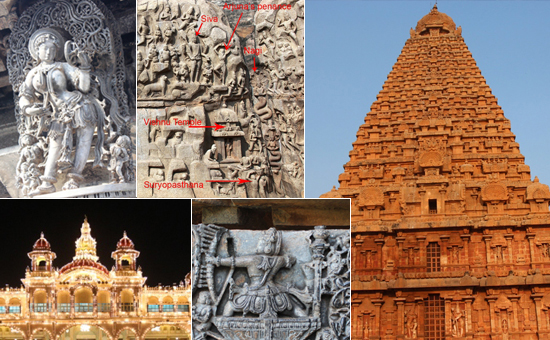 There is more to India than the Taj – South.
4. Prosperous India (320 to 750 AD)
About AD 320, Chandragupta I, the founder of the Gupta
Empire revived the charavarti ideal in North India. His marriage probably
resulted in the union of her principality with Magadha and launched him on a
career of wide conquests in North India.
Next was Samudra-gupta
(335 to 380 AD) who laid the foundation of an irresistible military machine.
Politically, this was the age of integration of India. A farsighted statesmen,
patron of arts, he became a symbol of a mighty creative urge among people,
which drawing vitality from tradition and race memory, took on a new shape and
power.
Next was Chandragupta II or Vikramaditya (376 to 414 AD). The country south of the Narmada was dominated by two friendly powers, the Pallavas and Vakatakahs who shared the Gupta’s enthusiasm for strengthening Dharma. Next were Kumara-gupta and grandson Skangupta (455 to 467 AD) who inflicted a heavy
defeat on the Huns. Read About
Gupta Kings detail
Why
150 years of Gupta rule is called the Golden Period of India?
They upheld
Dharma, the powerful integrating force was the Dharma-sastras that provided the
basis of Aryan society, mode of social adjustment, laws of inheritance and of
civil and criminal justice.
However, Dharma-sastras
were not thrust upon people. The
stress was always on making people appreciate the essence of Dharma and then
live it. Even the backward and immigrant
classes happily adopted them. Sanskrit, a living language, elastic in
structure, rich in expression was the living embodiment of Dharma and a
powerful integrating force.
The works of Kalidasa, a contemporary of Vikramaditya, became
the models of literary beauty throughout the country. The six systems of Indian philosophy took final shape
during this period. There was Aryabhatta, Varahamihira and Brahmagupta whose works in mathematics, astronomy are reckoned as India’s contribution to the world.
The cultural upswing was based on Dharma. It predicated an
unalterable faith in human behavior, self-restraint and self-discipline.
Emphasis was laid on individual experience rather than belief. Running through
a diversity of religious beliefs and social outlook, it laid emphasis on
non-violence, truth, non-stealing, continence and non-possession as essential
steps in progress.
The age saw the perfect lyric and drama of Kalidasa,
the astronomical discoveries of Varahamihira, Iron Pillar of Delhi, the beauty
of early Ajanta frescoes, the completion of the Mahabharat and the composition
of Vayu, Matsya Puranas. Its strength lay in its
integral outlook and was based on as much as military strength as on
internal order and economic plenty, the sap of its vitality was drawn from
ancient tradition and race memory. The people, having discovered in their
traditional way of life something noble and splendid, saw that it reflected the
greatness of their rulers.
Hun Invasion
The Huns from
their homeland on the northern shores of the Caspian Sea had brought the
downfall of the powerful Roman empire began to enter India in 445 AD but were
beaten back by Skanda-gupta. After his death a war of succession followed
weakening the empire in its hour of danger. 12 years later they came again,
this time began to pour into India after defeating the Kushana rulers of the
northwest. By 512 AD, they overran north India up to Eran in Madhya Pradesh.
They spread terror wherever they went. By 525 A.D. they became masters of a
vast territory in North India.
However, India hit back. Yasosharman Vishnudharma fought the Huns grimly. His swift
victories arrested the progress of the Hun Mihirakula (devotee of Lord Shiva).
In the east he met with heavy reverses thanks to Emperor Narasimha-gupta
Baladitya. A series of kings followed. Now the Huns disappeared as they came.
However, the Hun invasions had a devastating effect.
The race of the Kshatriyas of Madhyadesha,
lost its vigor, in perhaps
trying to drive out the Huns. Vast social
and cultural changes followed.
The caste-system became weak. Due to foreign invasions, there was a weakening of the race. As
a result, instead of being associated with the masses as its natural
leaders, the Brahmanas and Kshatriyas became dominant minorities.
The Gupta Empire
had grown very weak, the virile Maukharis emerged victorious. A new phase
emerged in Indian history. Kanauj emerged as the symbol of a new order. The
Golden Rule was history, the military superiority of Magadha disappeared.
Sri Harsha emerged. He suffered a serious defeat at the hands of
Pulakesin II. At the height of his career, Harsha was an ardent Buddhist. He
could not restore the lifeblood of the old social organization, for he could
not identify with their urges. The secret of establishing military power
founded on traditional strength was not his. The internationalization, for
which Buddhism stood, negatives the building of a compact unity rooted in the land.
He could conquer but not build.
About the end of this period the Arabs appeared.
The naval raids against Thane, Broach, Debal were repulsed. Attempts to reach
through Khyber Pass failed, defended by the Hindu states of Kabul and Zabul.
They tried to enter through the Bolan Pass but the JATS of KIKAN did not allow
the pass to fall into the hands of the invaders. The Arabs attempted to advance
through the Makran coast. Sindh has just emerged from civil wars. Sindh was
captured in 712 AD.
In 725 AD, one Arab army sent to invade North India
met a disastrous setback at the hands of Nagahata I, a Pratihara
king. Inspite of unremitting pressure exerted for over two centuries, the Arabs
had petty states of Mansura and Multan in the 9th and 10th
centuries. When compared with their
dazzling victories over the contemporary states of Middle East, Europe, this
loss was a tribute to the superior military strength and political organization
of the Indians.
End Note- During Gupta rule peace prevailed, Dharma was upheld, India’s level of prosperity’s scaled new heights. Inspite of being weakened by the Huns, Indians repulsed the Arabs everywhere except in Sindh.
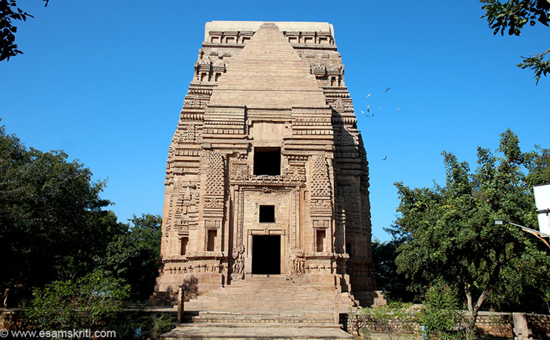 Teli-ka-Mandir, Gwalior Fort made by Pratihara king.
5. 750 to 1000 AD
This period is being referred to just to take you to
the point of Muslim invasion which is why am very brief.
The three great dynasties during this period were the
Palas of eastern India, the Gurjara-Pratiharas of western India and the
Rashtrakutas of the Deccan. Under Dharmapala and Devapalla the Palas claimed
allegiance of nearly the whole of north India. Then came the Pratiharas who
under the Bhoja and Mahendrapala, brought under direct administration territory
from Kathiawad in the west to northern Bengal in the east. Both of them felt
the brunt of the Rashtrakutas. Under Dhruva and his son Govinda III, they
proved to be greatest military power in India. No other power south of the
Vindhyas, played such a dominant role in the history of North India, until the
advent of the Peshwas in the 18th century.
The Pratiharas stood as a bulwark against the Muslims
of the Sindhu Valley. It has been asserted by various Muslim rulers that the
Pratiharas were the greatest foes of the Muslims and could easily defeat the
latter but when they advanced, Muslims threatened to destroy the Sun-God in
Multan which made the Pratiharas
retreat. Read about
Pratihara Kings
The Rashtrakutas (Kannada was their mother tongue) went
one step further. They befriended the Muslims and gave them all facilities for settling in their territory. They
even allowed Muslim settlements to build mosques and be ruled by their own
governors. Their attitude is undoubtedly a manifestation of that spirit of
religious tolerance, which has characterized India for centuries.
During this period was born the great saint Sankara (788 to 820 AD). He created an
extraordinary position for Vedanta. Writers belonging to Vaishnava and Saivite
sects began to utilize Vedanta as the philosophical basis and background of
their sects. He unified India into one cultural unit and reiterated the
superiority of Sanatan Dharma.
Yet Indians retained high social character as is borne
out by the tribute paid to the mental and physical qualities of Indians by an
Arab observer Ibn Khaldum, “The Hindus says Masudi are distinct from all other black people in the point of intellect, government, philosophy, strength of constitution and purity of color”.
End Note - Though, the Ahimsa preached by Jainism is of a more extreme form than Buddhism, there are numerous instances of Jain kings and generals who were not averse to warfare since they followed the Jain precept of doing one’s duty, it did not constitute violation of Ahimsa as prescribed by the code of Sravaka.
6. GANDHIAN Asceticism
- 1920 to 1948
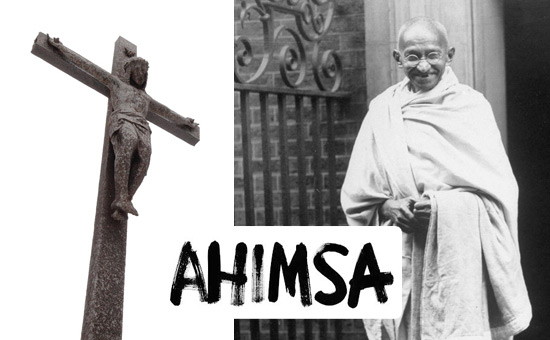 Gandhi, Ahimsa and Christianity.
Gandhi emerged as a political leader in 1919. In 1893,
he went to South Africa as the lawyer of a firm of Porbander Muslims and was
shocked by the disabilities of Indians there. He used Satyagraha to achieve
success. Gandhi popularized the principle and technique of Satyagraha in Indian
politics.
What are the general ideas and
philosophy underlying Satyagraha?
1. The word Satyagraha consists of two words i.e. satya or truth and agraha or adherence. The word was described as Passive Resistance. Later on, Gandhi distinguished between the two words and said, “The latter has been conceived as a weapon of the weak and does not exclude the use of physical force or violence for the purpose of gaining one’s end, whereas the former has been conceived as a weapon of the strongest and excludes the use of violence in any shape and form.”
2. Satyagraha is the law of love, the way of love for
all.
3. On Non-violence Gandhi said, “When a person claims to be non-violent, he is expected not to be angry with one who has injured him. He will not wish him harm, not cause him physical hurt. He will put up with all injury. Complete non-violence is complete absence of ill-will against all that lives.”
4. “Satyagraha eschews violence absolutely as a matter of principle, at all stages and forms. The idea is not to destroy or harass the opponent, but to convert him or win him over by sympathy, self-suffering and patience. It approaches the evildoer with love. The Satyagrahi has infinite trust in human nature and its inherent goodness.”
5. “Non-violence, in its dynamic condition, means conscious suffering. It does not mean meek submission to the will of the evildoer, but it means the pitting one one’s whole soul against the will of the tyrant. Working under this law of our being, it is possible for a single individual to defy the whole might of an unjust empire, to save his honor and lay the foundation for that empire’s fall or regeneration.”
6. “The religion of non-violence is not merely meant for the rishis and saints. It is meant for the common people as well.”
Gandhi’s satyagraha did produce results e.g. the Champaran Agrarian Bill of 1917, was with the millowners of Ahmedabad who lead a fast for higher pay to workers. Then there was the Satyagraha by the farmers of Kheda. While the Non-cooperation was called off and some gains lost, the mostly non-violent movement had two important gains. One was the willingness and ability of people to endure a remarkable degree of hardship inflicted by the government. Two is that Non-Cooperation became a mass movement and the Congress a revolutionary organization. Read Gandhi,
Ahimsa and Christianity
Did India get
its independence because of Ahimsa? Read my
article
Will
Ahimsa succeed everywhere?
Noted strategic
thinker K Subrahmanyan wrote in Defending
India, “It has been assumed that Gandhian prescriptions of non-violent mass action would be applicable, irrespective of context. Recently, after Attenborough’s film Gandhi, was released, questions have been raised whether Gandhian methods would have succeeded against Hitler, Stalin and the like.”
“In strategic parlance, offense and defence are different. While the former aims at changing status quo, the latter attempts to preserve it. In India, the Brits were on the defensive, while the freedom movement was on the offensive. While in the offensive mode the leader had the choice of strategy, including use of massive non-violent mobilization of people. If the state were to go on the offensive, the populace would not have been allowed non-violent mass mobilization. That is why non-violence could not have succeeded against Hitler, Stalin and Mao Zedong.”
End
Note - It would be incorrect to deride the role of Gandhi’s Satyagraha in India’s freedom movement but to say that it got India independence would be a travesty of truth.
7. How Gandhi and Ahimsa influenced Indian thought?
Examples of how Gandhi
influenced our thinking in Independent India.
1.
Nehru is quoted in Defending India, “Gandhi found himself unable to give up his fundamental principle of non-violence ever in regard to external war. He wanted Congress to declare its adherence to the principle of non-violence even in free India. He realized that a government of free India was not likely to discard violence when questions of defence were concerned and to build up military, naval and air power. But he wanted if possible, for Congress at least to hold the banner of non-violence aloft and thus train the minds of the people and make them think increasingly in terms of a peaceful solution.”
2.
Noted strategic thinker K Subrahmanyan wrote in Defending India, “In order to develop an understanding of our policy in post-independence India, it is essential to look at the roots of that policy during the freedom struggle, since Gandhi was a fervent advocate of non-violence, Indian defence preparedness was not given the attention it deserved. There is also the view that Nehru was anti-militarist in his orientation and as, as an advocate of peace and non-alignment, neglected the role of military power in international relations.”
3.
Nehru is quoted in Defending India, “If Nehru bent backwards in accommodating China it was not out of fear of what it would do but of the common belief among gentlemen that human nature being essentially good, one sided favors done to our neighbors would fill them with gratitude and would cause them to reciprocate. This is a direct outcome of Nehru’s idealistic romanticism”.
4. However, Nehru did make references on the necessity of defence expenditure. Nehru’s speech in the Lok Sabha in November 1962 read, “defense and development were two sides of the same coin.”
5. Nehru believed that with India’s spiritualism and history of non-violence it could play a leading role in world’s affairs. He was a founder member of the Non-Aligned movement, introduced the mantra of peaceful coexistence. Yet what came out of it was 1962.
6. As a result, India ignored defence expenditure continuously in the 1950’s. Gandhian Acharya Kriplani spoke on the Defence Budget in the Lok Sabha in 1957, “The mounting expenses on the Army must be cut down. The followers of Gandhi and adherents of universal peace should not increase military expenditure.”
7.
Nehru had another important effect on the Indian psyche. We like leaders who
are idealists, good orators, become international statesmen, profess peace even
at the cost of getting hurt themselves. We do not like and remember leaders who
talk tough, speak the truth, profess violence to those which is the only
language they understand. Things changing since 2014.
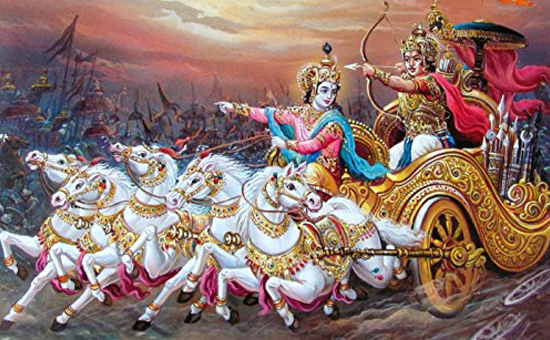
8.
Holy Geeta Verses made me think
A few verses and
commentary by Gurudev Swami Chinamayananda.
1.
Ch 2, verse 31 Further, looking at thine
own duty thou oughtest not to waver, for there is nothing higher for a
Kshatriya than a righteous war.
“Arjuna’s personal call-of-character (Swadharma) is that of a leader of his generation (Kshatriya) and as such, when his generation is called upon to answer a challenge of an organized un-Aryan force (Adharma), it his duty not to waver but to fight and defend his sacred national culture.
To the leaders of people, there can be nothing nobler than to get a glorious chance to fight for a righteous cause. That a king must fight on such a occasion is vividly brought out in the Mahabharata, Udyoga Parva –72-18 says “The sin that is committed by killing one who does not deserve to be killed is as great as the sin of NOT killing one who deserves to be killed”. It’s like saying that the man who pays a bribe as much in the wrong as the man who accepts one.”
2.
Ch 2, verse 32, Happy indeed are the
Kshatriyas, O Partha, who are called to fight in such a battle, that comes of
itself as an open door to heaven.
“As used here, Kshtriya is not the name of a caste. It merely indicates a certain quality of the mental vasanas in the individual. Those who have ever-bubbling enthusiasm to defend the weak and poor, besides their own national culture from all threats of aggression are called Kshtriyas. Such leaders of men are not allowed to be tyrants or aggressors according to the code of morality of the Hindus.
But, at the same
time, a cold, feminine and cowardly
non-resistance is not the spirit of the Hindu tradition. In all cases where the Hindu nation is forced to wage a war on the principles of righteousness the leaders of India are ordered to fight in the defense of their culture. Such battle-fields are the wide-open gates to Heaven for the defending heroes who fight diligently on the side of Dharma”.
3.
Ch 2, verse 33, But, if you will not
fight this righteous war, then, having abandoned your own duty and fame, you
shall incur sin.
4.
Ch 2, verse 34, People too will recount
your everlasting dishonor, and to one who has been honored, dishonor is more
than death.
5.
Ch 3, verse 21, Whatever a great man
does, that other men also do, whatever he sets up as standard, that the world
follows.
“The moral rejuvenation of a society in any period can take place only because of the example set up by leaders of the nation. The very creed of Krishna is active resistance to evil. His non-violence is not the instinctive incapacity of the day-dreaming coward who cannot stand up against injustice and fight for the accepted principles of national culture.”
So
are you suggesting that we follow the Pakistanis and Chinese!
I am all for
love, non-violence, peace, compassion. Admire Krishna, Buddha and Mahavir.
Having said that I will not accept injustice, allow anyone to destroy my
culture, Dharma, peaceful state and above all motherland.
Also read
1. War
and Non-violence in the Bhagadvad Gita
2. Why
India is called Punya Bhumi
3. The
ancient roots of Indian strategic thought
4. Did
India lack strategic thinking post independence
5. Dharma
in Foreign Policy
6. Must read book referred to Defending India by late Jaswant Singh.