- India’s first Param
Vir Chakra was given to Maj Somnath Sharma in 1950 for bravery and leadership
during the Battle of Badgam 1947. Know about Battle in brief, his Leadership
Qualities and Lessons for Every Young Hero.
The Param Vir Chakra (PVC) was introduced on January 26, 1950 (Republic Day
of India), by the President of India, with effect from August 15, 1947
(Independence Day of India). This is the highest military honour and the
second-highest government decoration after the Bharat Ratna.
It is awarded to Indian armed forces personnel for the most conspicuous bravery or highest degree of
valour or self-sacrifice, exceptional courage and firm determination in the
presence of the enemy during wars, whether on land, at sea, or in the air.
The PVC has been awarded only twenty-one times, including 14 posthumously,
a statistical rarity that underscores the supreme sacrifice required to earn
it. There are 20 recipients from the Indian Army and one from the Indian Air
Force.
From this issue onwards, we shall bring you the stories of the Param Vir
Chakra award winners. We shall begin with the first PVC that was awarded to
Major Somnath Sharma for his gallant actions on November 3, 1947.
This article was
first published in the Bharatiya Vidya
Bhavan Journal.
In the early years of independent India, when the nation was still finding
its feet, a young army officer showed the world what it truly means to be
brave. He believed that duty could not wait for comfort, and he stood firm
against overwhelming odds in the defence of Kashmir in 1947. When Jammu and
Kashmir came under attack in October 1947, he refused to stay behind despite
his right arm being in plaster from a recent fracture. He insisted on moving
with D Company of the 4th Kumaon Regiment because he knew that, at moments like
these, an officer must stand where their soldiers stand. His courage,
leadership, and sacrifice not only saved a city but was also inspirational.
He was Major Somnath Sharma. His supreme sacrifice earned him India’s first Param Vir Chakra (PVC), the highest award for wartime bravery. It was conferred on him posthumously for his bravery during the Battle of Badgam.
The PVC is given to members of the Indian Armed Forces who perform acts of extraordinary heroism during war. The PVC is not just a medal, it is a living legacy of India’s bravest heroes, a reminder that courage in the face of overwhelming odds can change the course of history. It is the ultimate recognition of courage on the battlefield, equivalent to the Medal of Honour in the United States and the Victoria Cross in the United Kingdom.
The name ‘Param Vir Chakra’ means ‘Wheel of the
Ultimate Brave’ in Sanskrit. The medal represents the nation’s gratitude to its bravest soldiers. It is a source of inspiration for generations of Indians and a reminder of the values of duty, courage, and patriotism. His story teaches us that true heroes put others before themselves, face danger without fear, and inspire teamwork and hope—even when the odds are against them. This is his story of valour, duty, and love for the motherland.
Major Somnath Sharma’s life reads like an adventure novel full of daring rescues, unbreakable resolve, and selfless leadership. He was a 24-year-old army officer with a broken right arm in plaster when he rushed to defend Kashmir in 1947. He showed that true courage means putting your duty first, even when you are hurt. His journey, from mist-shrouded Kangra to the smoking trenches of Badgam, is very fascinating.
Early Life and Inspirations
Somnath was born on January 31, 1923, in Dadh village of Kangra, in Himachal Pradesh, into an illustrious military family. His father, Major General Amarnath Sharma, was an Army Medical Corps Officer who retired as Director of Army Medical Services. His brothers, Lieutenant General Surinder Nath Sharma retired as Engineer-in-Chief and General Vishwa Nath Sharma retired as Chief of Army Staff from 1988 to 1990. His sister, Major Kamla Tewari, was a doctor in the Army Medical Services. His uncle, Captain K.D. Vasudeva died heroically in World War II’s Malayan Campaign, saving hundreds of soldiers.
This act of selflessness became a guiding light for young
Somnath. As a child, Somnath was deeply influenced by the teachings of the Bhagavad Gita,
explained to him by his grandfather. These lessons on duty and courage stayed
with him forever. Somnath Sharma alias Somi carried water each morning from the
stone well, a chore he turned into a test of endurance. At age nine, he pruned
the family orchard under monsoon downpours, discovering that grit beats comfort.
Evenings brought stories of ancient heroes by lantern light, sparking his dream
to one day wear the Army uniform himself.
School Days: Protector and Mentor
He did his schooling, along with his brother, at Hampton
Court Convent, Mussoorie. When Somi and his little brother Tindy went to school
in Mussoorie, Somi used his height and strength to protect Tindy and some
friends from bullies. In return, those friends helped him sharpen his Hindi
essays and arithmetic. He captained the hockey team, held late-night study
groups for juniors struggling with homesickness and showed early leadership
qualities. His friends remember him as disciplined, cheerful, and always ready
to help others.
Even as a student, he dreamed of serving the nation in
uniform, not for glory, but to protect people. Later, he went to Sherwood
College, Nainital and to the Prince of Wales Royal Military College (now
Rashtriya Indian Military College) in Dehradun, because of his strong desire to
join the army.
Selection to Become an Army Officer
In 1941, Somi was selected to become an Army Officer. He
was trained at the Royal Military College, Sandhurst in the UK, one of the most
prestigious military academies in the world. Nine months of
reveille-to-lights-out drills tested his body and mind. He topped his platoon
in map-reading and night navigation. He volunteered to supervise extra kitchen
duty, earning a reputation for fairness and compassion. In field exercises, he
repeatedly led solo scouting missions, proving both stealth and initiative.
On February 22, 1942, he was commissioned into the 8th
Battalion, 19th Hyderabad Regiment (later the 4th Battalion, Kumaon Regiment)
of the Indian Army, when he was just 19 years old.
World War II Service
In 1944, he fought in the Arakan Campaign in Burma
(Myanmar) under Colonel K S Thimmayya, who later became Chief of the Army
staff.
Deployed during World War II on the Arakan coast against Japanese forces, Somnath’s courage showed in one act that became regimental legend. Amidst heavy Japanese shellfire, he spotted his orderly, Bahadur, who was badly wounded under enemy fire and pinned to the mud. Somnath carried him on his shoulders and raced through exploding mortars to safety, undaunted by the risk or his fatigue. He refused to leave him behind despite orders. For this, he was ‘Mentioned in Despatches’, a formal recognition of bravery. This act displayed Somi’s lifelong courage and compassion.
By mid-1947, now a Captain, he worked as an adjutant in Punjab, helping to keep peace during India’s partition in 1947. When fighting broke out in Kashmir, Somi was determined to lead his men there. He found himself orchestrating refugee relief when India was partitioned. He mapped safe corridors for fleeing families, organised medical camps under a single kerosene lamp, and penned reassuring letters home for worried parents.
The Indo-Pak War of 1947–48
In October 1947, Pakistan sent tribal raiders into Jammu
& Kashmir to capture it by force, and Srinagar
airfield was their main target. The Maharaja of
Kashmir signed the Instrument of Accession, making the state part of India. The
Indian government made an urgent call for reinforcements.
Major Somnath Sharma was promoted to Major on October 1, 1947. On October 31, 1947, despite his injured arm in a plaster cast from a hockey match accident, he insisted on flying with his ‘D’ Company of 4 Kumaon to Srinagar. The valley was tense and uncertain.
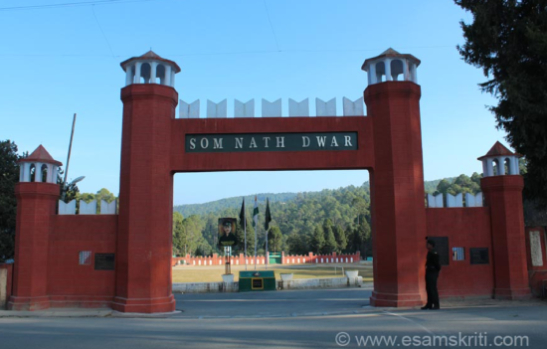 Entrance to Raniket War Memorial, Kumaon is called Somnath Dwar.
Battle of BADGAM
Tribal raiders and irregular forces were pushing toward
Srinagar, and the airfield there was the lifeline by which reinforcements,
ammunition, and medical help could arrive. Major Sharma, along with his D
Company of 4 Kumaon, was ordered to patrol and hold the approaches that might
let the enemy into Srinagar city. The next morning, his soldiers dug trenches near
Badgam village, just south of the Srinagar airfield.
Their job was to stop the Pak tribesmen who wanted to
capture the airstrip and cut off reinforcements. By the morning of November 3,
1947, his company had taken up positions south of Badgam village. They were
expected to stay only until mid-afternoon while other troops returned to
Srinagar, but the enemy came sooner and in greater numbers than anyone had
imagined.
Around mid-afternoon, a lashkar of nearly 700 Pak raiders
advanced from the direction of Gulmarg. They surrounded D Company from three
sides and penned up fire with small arms, mortars, and heavy automatic weapons.
The attack was sudden and fierce. Under the heavy barrage, casualties mounted
quickly, and the situation looked dire.
Major Sharma understood what was at stake: if the ridge south
of Badgam and the airfield fell, Srinagar could be cut off. He moved through
the trenches and foxholes, not barking orders from behind cover but standing
where bullets flew. He changed fear into purpose by the way he spoke, by the
calm of his gestures, and by doing the dangerous things himself.
Leadership in the Heat of the Battle
Major Somnath Sharma exemplified front-line leadership
when his D Company came under attack at Badgam. Fully aware that losing their
position would expose Srinagar and its airfield, he moved across open ground
under accurate and heavy enemy fire to rally each section and direct their
fire. His visible presence, even with a plastered arm, inspired soldiers
outnumbered seven to one, to hold their ground. He combined tactical foresight
with personal example.
For six hours, Major Sharma and his soldiers faced the
700 enemy attackers. He ran from post to post, reloading magazines, handing
weapons to soldiers who had lost theirs, and manning a light machine gun
whenever a gap appeared. His right arm was in plaster, yet he reloaded Bren
guns with his uninjured hand and kept the lines firing.
When the Indian Air Force Dakotas were called in, Major Sharma
did something extraordinary. Under enemy fire, he laid out brightly coloured cloth panels on the ground to mark
enemy concentrations and guide the aircraft for precise strikes.
Those panels helped the planes drop their bombs exactly where they could hurt
the raiders most and spare the village. His voice and signals were calm and
clear in the chaos. Where panic could have broken the defence, his steady
orders created disciplined resistance. When ammunition began to run out and
many men were killed or wounded, he kept giving magazines, kept firing, and kept
encouraging his soldiers to hold on.
The Ultimate Act of Bravery and Final Words
As daylight waned and ammunition ran dangerously low, Somnath’s radio crackled one last time: “We will fight to our last man and our last round.” His words echoed across every Indian barracks, becoming a timeless rallying cry. He moved from post to post, encouraging his soldiers, distributing ammunition, and even manning light machine guns himself. Suddenly, a direct mortar explosion occurred near the ammunition dumb that Major Somnath Sharma was handling, and he became a martyr. In that action, one junior commissioned officer and twenty Jawans also sacrificed their lives.
As the company’s fighting power weakened, Lance Naik Balwant Singh and other soldiers gathered
what courage remained for a desperate counterattack. They charged out and
struck at the enemy, a bold move that bought precious minutes. Those minutes mattered.
Their courage and sacrifice stopped the
enemy long enough for the airfield to remain under Indian control and for reinforcements
to pour in.
Without that delay, Srinagar might have been lost.
Because of their brave stand, Srinagar airfield remained open, reinforcements
arrived, and the enemy advance was stopped. Twin Dakotas landed fresh troops,
two jeeps brought more ammunition, and medical supplies were flown in.
Award of the Param Vir Chakra
For his “most conspicuous bravery, indomitable leadership, and self-sacrifice”, Major Somnath Sharma was posthumously awarded the Param Vir Chakra on June 21, 1950. He was the very first recipient of India’s highest military honour.
Incidentally, the Param Vir Chakra medal was designed by Savitri Bai Khanolkar, whose daughter was married to Major Sharma’s brother, Lieutenant General Surindra Nath Sharma, PVSM, AVSM.
MEMORIALS
1. His life and bravery were featured in the 1990 TV
series, Param Vir Chakra.
2. His name is engraved at the National War Memorial, New
Delhi.
3. His story is now part of NCERT school textbooks,
ensuring young Indians learn about his courage.
4. IMA’s annual cross-country race carries his name, spurring cadets to push past limits.
5. Schools in Kangra and Mussoorie hold ‘Sharma Day’ debates and quizzes, teaching young minds the meaning of duty and self-belief.
6. Statues and busts honour him in Himachal Pradesh and
at military establishments.
7. The Shipping Corporation of India Ltd (SCI) named its first Crude Oil Tanker MT ‘Major Somnath Sharma, PVC’.
8. On Independence Day 2025, a new statue was unveiled in
his home state to inspire future generations.
Key Leadership Qualities:
Major Sharma’s leadership not only stalled the enemy advance but also cemented his legacy as a commander who embodied the ethos of ‘soldier first, leader always’. His key leadership qualities are:
Leading by Example: Exposed himself repeatedly to heavy fire to encourage his
troops.
Resolute Calm: Maintained composure under mortar bombardment, making
clear decisions that kept his company cohesive and focused.
Resourcefulness: Employed simple signal panels for air support and
improvised roles of loader, machine-gunner, ammunition bearer, to plug gaps in
his defences.
Inspirational Communication: His final radio message- “We will fight to our last man and our last round”- became a rallying cry for future generations of Indian soldiers.
Lessons for Every Young Hero
Major Somnath Sharma’s life teaches us that:
Duty Above Self: Even with an injured arm, he chose to lead from the
front. A simple act of kindness, a firm stand in crisis, a voice that lifts others
when hope falters Courage in Adversity: True bravery is standing firm when the odds are against
you. True courage shines brightest when pain, fear, or disadvantage stand in
its way.
Leadership by Example: He never asked his men to do what he would not do
himself. His leadership grew by serving others first, clearing trenches, or
guiding air strikes.
Sacrifice for the Greater Good: His actions saved Srinagar and possibly all
of Kashmir for India.
Inspiration for All: Age, injury, or fear should never stop us from doing what
is right.
Unbroken Spirit and Beacons of Bravery: Whenever you face a bully, a daunting test, or the chance to help someone in need, remember Somnath’s plastered arm and his unbroken spirit. In him, you will find the spark that turns ordinary hearts into beacons of bravery.
A Legacy of Courage
The real legacy of Major Somnath Sharma is the story he left for young people: that courage mixed with care, quick thinking combined with calm, and selfless action in the face of danger can save others. He replied to the Brigade Commander in his last message, “The enemy is only 50 yards from us. We are heavily outnumbered. We are under devastating fire. I shall not withdraw an inch but will fight to our last man and our last round.”
Stories like his are not only history. They are lessons
about what it means to be responsible for others, to act bravely when it
matters most, and to put duty above comfort. If you are ever faced with a hard
choice, let the courage of that small company at Badgam remind you that holding
the line for what is right can change the future
This article was first published in the Bhavan’s Journal, January 16-31, 2026 issue. This article is courtesy and copyright Bhavan’s Journal, Bharatiya Vidya Bhavan, Mumbai-400007. eSamskriti has obtained permission from Bhavan’s Journal to share. Do subscribe to the Bhavan’s Journal – it is very good.
Also read
1.
Raniket
War Memorial dedicated to Major Somnath Sharma
2.
The
Battle of SHALTENG-Story of How Srinagar was saved in 1947
3.
All
about Accession of Jammu and Kashmir to India