- This photo feature is a response to a learned man’s article that Chanakya never lived. It is presented in a Q&A format.
I read with interest article by Devdutt P
titled, A
Fantasy called Chanakya. The author makes the
following points to doubt that Chanakya ever lived or that he guided Chandragupta
Maurya.
One, “there is absolutely no historical evidence that a man called Chanakya ever lived. Two, the story is imagined based on Indic scriptures and Sanskrit plays like Mudra-rakshasa, all imagined after 500 AD, i.e, 700 years later. Three, Chandragupta adopted Jainism and even fasted to death in Karnataka.
Four, Brahmins argued that Chandragupta owed his success to a Brahmin minister—Chanakya, who was even identified with Kautilya, the author of Arthashastra. Five, the Chanakya myth is thus less about Mauryan history and more about our present hunger for a disinfected past in which power is wise, violence is necessary, and the Brahmin is
indispensable.”
The learned author’s divisive approach reminds me of the British policy of divide, provoke and rule and does not cover Chanakya contribution to Chandragupta Maurya. The presence of Shaivite, Buddhist and Jain Caves at Ellora for centuries is proof of co-existence. Recent divisions are more colonial or post 1947 in origin.
Savtri Mumukshu tweeted a detailed
response to article. This article adds to the tweet with different
points. Format
of reply is Q&A with pictures, responding to points made and lots more.
1. Who was Chandragupta Maurya?
“The clan Moriya to which Chandragupta belonged was a Kshatriya clan originally ruling over Pipphalivana which probably lay in Uttar Pradesh.” 1 Pg 56 Unlike what is told now that he
belonged to the depressed or backward classes.
2.
Where did Chandragupta go to in Karnataka?
He went to modern day Sravanabelagola in modern day Karnataka. Some pics by me-
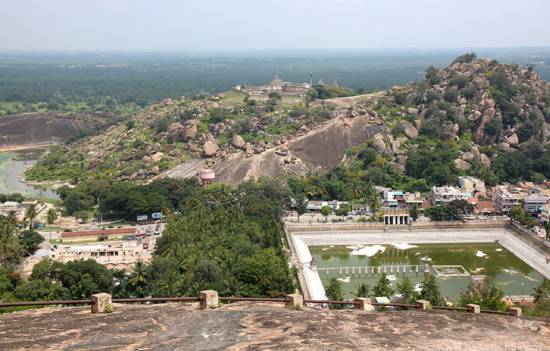 Chandragiri Hill at Sravanabelgola is where Chandragupta Basti is.
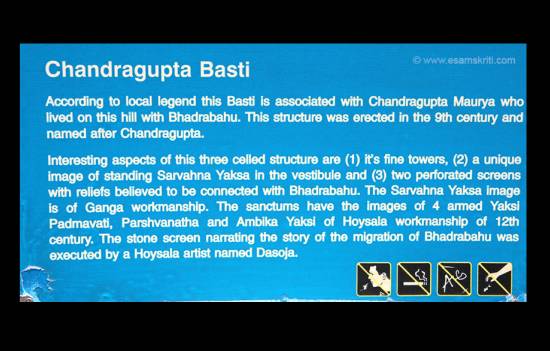 Left to right is Chandragupta Basti. It was erected in the 9th century. Read.
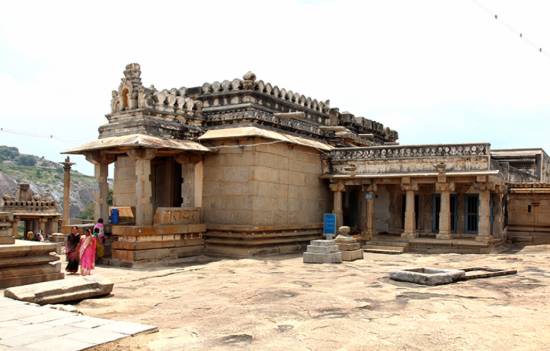 Chandragupta Maurya lived on this hill with Bhadrabahu.
There is no reference on the board of Chandragupta becoming a Jain or his fasting to death. Any way those days, unlike today when Jainism is referred to as a religion, Jaina was one of the Nine Darsanas that existed in Bharat. One could follow any darsana or even change the darsana.
3. Background to Arthasastra (quote from Cultural Heritage of India by RKM).
“From a number of sources we learn that there arose (probably in the 4th century before Christ) no less than 4 distinct schools and 13 individual teachers of Artha-sastra. Among the old masters of the science mention should be made of the schools of Manu, Brhaspati, and Usanas (Sukra), and the two teachers Visalaka and Bharadvaja, who are singled out for salutation and quoted by later writers in different branches of learning.” 2 Pg 451 The authors imply that earlier writings were merged into Kautilya’s Artha-sastra.
Author L N Rangarajan wrote in The Arthasastra, “The full text on palm leaf in the grantha script came in the hands of Dr R. Shamasastry of Mysore in 1904. Dr R.P. Kangle also published 3 volumes of the Arthashastra between 1960 and 1965. Though Kautilya wrote long after the time of Buddha, who died in 486 B.C., the state of society portrayed in the Arthashastra is, in the main pre-Buddhistic.”
4. Kamandakiya Nitisara (3rd century A.D.) based on Kautilya’s Arthasastra
According to Cultural
Heritage of India, “This treatise belonging to the 3rd century A.D. is based mainly on Kautilya’s Arthasastra. In fact, Kamandakiya, at the beginning of his work acknowledges Visnugupta (i.e. Canakya or Kautilya) as his master and eulogises him as the creator of the science of polity who has drawn from the great ocean to Artha-sastra, the nectar of Nitisara.” 2 Pg 461
5. Jain scholar Somadeva 959 A.D. book based on Kautilya’s Arthasastra
According to Cultural
Heritage of India, “The Nitivakyamrtam or the Nectar of the Science of Polity, an interesting work on statecraft, was written in A.D. 959 by the Jain scholar Somavadeva. He based on his work mostly on the discussion of the topics in Kautilya’s Arthasastra.” 2 Pg 462-3
Now claim that Chanakya’s existence is based on plays like Mudrarakshasa.
6. Chanakya’s existence relies on plays e.g. Mudrarakshasa imagined 500 A.D.
Author
is Vishakhadatta, “Mudrarakshasa is seven-act play, Chanakya, Chandragupta and Nanda's Swamibhakt Amatya (official) are in the center of the Rakshasa.” Practical Aspect of Natya Module 8
This book by Prof Dhruva puts the date of Mudrarakshasa as 4th
century CE. An English translation of Mudrarakshasa by Shri K T Telang 1915 puts
date as early part of the 8th century. Pg 28.
When a person becomes part of India’s collective consciousness the person is written about repeatedly/remembered centuries later. Examples below.
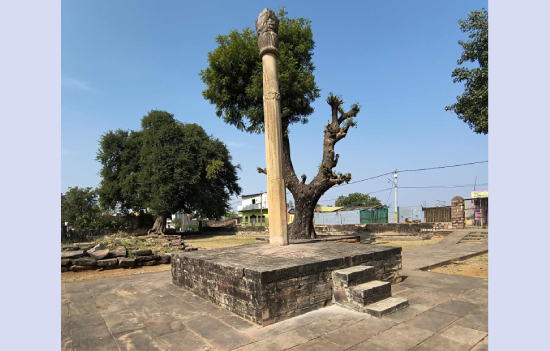 Garuda Pillar 2nd century BCE inscription refers to Vasudeva.
Read Importance of a
Second Century Bce GARUDA PILLAR in Vidisha
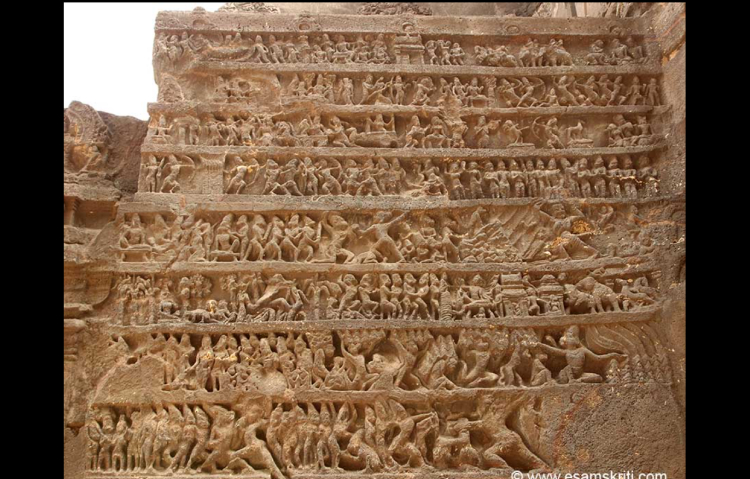 Entire Ramayana on wall of Kailasa Temple, Ellora.
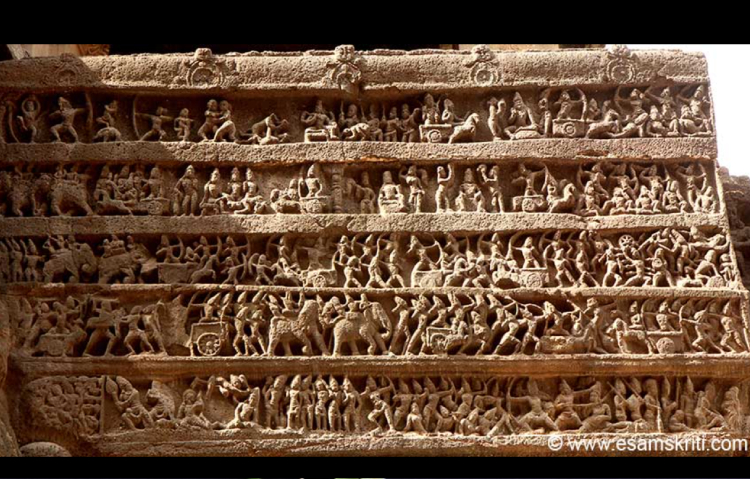 Kurukshetra Yudh (War) on wall of Kailasa Temple, Ellora.
Just because Kailasa
Temple Ellora was made in the 8th century does one doubt the
Ramayana and Mahabharata?
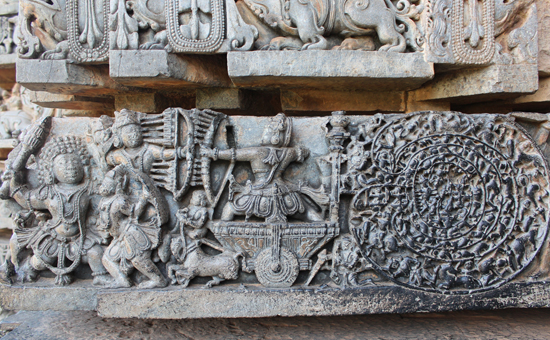 Chakravayu scene from Mahabharat in Halebidu Temple, Karnataka. Completed around 1160 A.D.
So
also, because it is claimed that Mudrarakshasa was written after 500 A.D. can
one say that Chanakya never existed? Being part of Indian tradition for atleast 1500 years re-confirms the existence of Chanakya.
7. Now what is the date of Chanakya’s Arthasastra?
According to 1, period is 4th century BC. It reads, “divergences between Kautilya and Manu-smriti show the antiquity of the former, and that the civil and constitutional laws explained by Kautilya were similar to those recorded by Megasthenes.” Pg 274 The opponents of the traditional view say that the Arthasastra was composed much later than the time of Chandragupta and may be as late as 300 A.D. Pg 275 Note Chandragupta ruled from 324 to 300 BCE.
Author L N Rangarajan wrote in The Arthasastra, “those who question the ascription of the 4th century B.C. as the date of the work place it not later than 150 A.D.” Pg 20.
Savitri M tweeted, “Ashoka’s edicts (3rd c. BCE) describe an administrative system of mahāmātras, welfare officers, anti-animal-slaughter days, judicial ethics - all straight out of the Arthaśāstra.” She added, “Then comes the Spitzer Manuscript, the oldest Sanskrit manuscript found so far (1st–2nd c. CE), which contains
unmistakable references to the Arthaśāstra. And where was it found? A Buddhist monastery in Kizil, Xinjiang - 1000s of miles away from any “Brahmin power structure.”
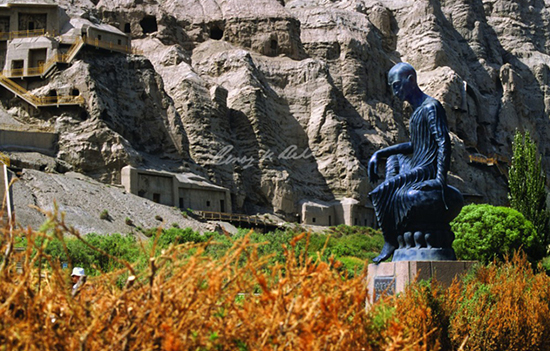 Statue of Kumarajiva, Kizil Caves, Kucha, Xinjiang Uygur Autonomous Region, China. Pic by Benoy K Behl.
Full caption by art historian and photographer Benoy K Behl – “Kumarajiva, of the 4th century CE, was the son of the Indian Pandit Kumarayana, the royal teacher at Kucha. He was married to Princess Jiva of Kucha and their son was named Kumarajiva, after both their names. At a very young age he was taken to Kashmir, the land of his father, to learn Sanskrit and Buddhist scriptures. He returned to Kucha to become the greatest translator of Buddhist texts into Chinese.” 6
and 7
8. Author wrote, “more about our present hunger for a disinfected past in which power is wise, violence is necessary, and the Brahmin is indispensable.”
For reasons some have wrongly understood violence and Ahimsa in Indic thought and given Brahmins too much importance. Please read the following –
a. War
and Non-Violence in the Holy Gita
b. Gandhi,
Ahimsa and Christianity
c. OBC
Kings of India Every varna had a role to play, Brahmins too.
As always, am happy to stand corrected. Thanks
Devdutt for getting me to write this.
References and also Read
1.
History and Culture of Indian People Volume 2 published by the Bharatiya Vidhya
Bhavan.
2. Cultural Heritage of
India by RKM published by the Ramakrishna Mission Institute of Culture in 1937
and last in 2001.
3. Study of
Literary Sources and Inscriptions during the Mauryan era
4. Arthashastra
Lessons for Management Theory
5. My
album on Sravanabelagola
6. Scholar Pilgrims from India to China – Sanskrit on the Silk Route
7. Buddhist sites in Xinjiang – Sanskrit on the Silk Route