- Know about Operation Rajiv in 1987 that was launched to take control of the Quaid Post in Siachen Glacier. Plus lessons from Bana Sing’s life, memorials in his name and he was awarded the PVC.
This is a series of PVC awardees, the earlier articles being Major Somnath Sharma, Piru Singh Shekhawat, Rama Raghoba Rane Karam Singh , Captain Gurbachan Singh Salaria, Lt Col Dhan Singh Thapa, Subedar Joginder
Singh, Major Shaitan
Singh , Havaldar Abdul
Hamid , Nirmal Sekhon and Arun
Khetrapal
This article was
first published in the Bharatiya Vidya
Bhavan Journal.
There are battlefields where the enemy is not the only threat:
nature also poses an immense challenge to human survival. The Siachen Glacier, known
as the highest and coldest battlefield on Earth, is a desolate expanse of
unforgiving ice, plummeting temperatures, and deadly crevasses.
In the summer of 1987, the Indian Army faced an
impossible challenge on these frozen heights: a heavily fortified enemy post
perched at a dizzying altitude of 6,500 m (21,325 ft), surrounded by sheer, vertical
ice walls rising to 457 m. To capture it was deemed suicidal.
Yet, from the ranks of the Jammu and Kashmir
Light Infantry emerged a quiet, unassuming soldier who looked up at the impenetrable
fortress of ice and chose to conquer it. This soldier was Subedar Major and
Honorary Captain Bana Singh, a man whose superhuman courage in the face of an
absolute whiteout blizzard rewrote the limits of high-altitude mountain warfare
and earned him the Param Vir Chakra.
Early Inspiration
Bana Singh was born on January 6, 1949, in the modest village of Kadyal, situated in the Ranbir Singh Pura
(R.S. Pura) tehsil of the Jammu district in Jammu and Kashmir. His father, Amar
Singh, and his mother, Bholi Devi, were hardworking farmers. Bana was the
eldest among five brothers and three sisters. Coming from a large, deeply
religious family, a strong moral character and integrity came naturally to him.
Growing up in Jammu and Kashmir, young Bana
was no stranger to the realities of a military presence. His earliest
inspiration came from his own family; several of his uncles had served in the
Indian Army. Their tales of discipline, camaraderie, and patriotic duty captivated
his young mind. From a tender age, Bana Singh knew that his ultimate destiny
lay not in the fields of Kadyal but on the frontlines, defending his nation’s borders.
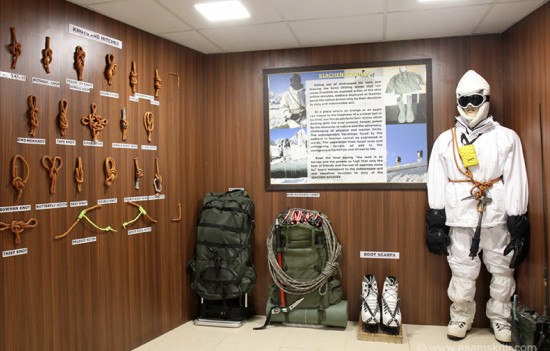 Hall of Fame Leh, 2016. How a soldier is dressed in Siachen Glacier.
To Make His Nation Proud
Bana Singh received his early education in
his village school, where he was known as a disciplined, focused, and
physically fit student. His ‘adventures’ were closely
tied to the physical demands of agricultural life, helping his father in the
fields, navigating the uneven terrains of his village, and participating in
local rural sports that tested endurance and courage.
This tough, physically demanding upbringing
was a blessing in
disguise; it forged an iron-clad stamina and
a resilient mindset. While other children dreamed of lucrative civilian jobs,
Bana’s big dream was singular and unwavering: to
join the Indian Army. Friends recalled that he often spoke of “doing something big for the country”, not for personal fame, but to make his village and his
nation proud.
The Journey Begins
On January 6, 1969, his 20th birthday, Bana Singh’s childhood dreams materialised. He was officially
enrolled on the 8th Battalion of the Jammu and Kashmir Light Infantry (8 JAK LI), a regiment
renowned for its fierce fighting spirit and specialised mountain warfare
capabilities.
His initial years in the army were marked by
rigorous training that transformed the sturdy village boy into a highly
skilled, razor-sharp infantryman. He served in various terrains and sector postings,
quietly building a reputation as a highly dependable and tactically sound
soldier.
Promotion followed, and he rose to the rank
of Naib Subedar, entrusted with the lives and leadership of a platoon. Little
did he know that his ultimate test would take place in a realm of eternal ice.
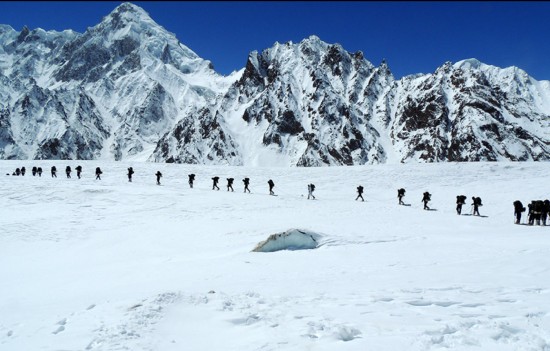 Indian troops on Siachen Glacier 2016.
Siachen Glacier
To understand the magnitude of Bana Singh’s actions, one must understand the strategic context of the Siachen Glacier. Situated in the Karakoram range, it is a place where temperatures regularly plunge to minus 50 degrees Celsius, and blizzards roar
at over 100 kilometres per hour.
In the 1980s, the strategic Saltoro Ridge became a massive flashpoint between India and Pakistan. Pakistan had controversially
ceded 80 square kilometres of the Siachen mountains to China under the guise of
‘research’.
Suspecting deeper military motives and observing clandestine activities, India realised the extreme importance of the region to its security. India was not ready to compromise its national security, leading to a race to secure the commanding
heights of the Saltoro Ridge.
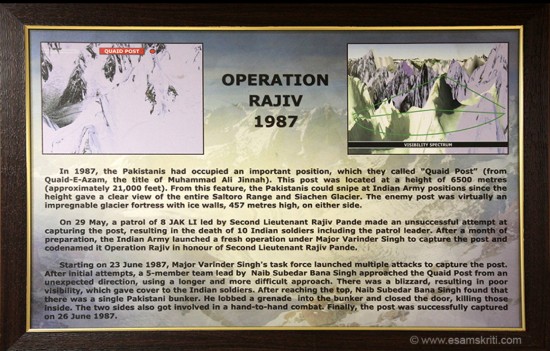 Left of pic is Quaid Post. Hall of Fame, Leh, 2016.
By 1987, Pakistani forces had infiltrated the
glacier and established a formidable fortress on the highest peak in the sector
at an altitude of 6,500 m. They named it the ‘Quaid Post’ in memory
of Pakistan’s founding father, Jinnah.
From this towering vantage point, the enemy had a clear
line of sight over Indian Army positions, effectively dominating the entire
ridge and inflicting casualties on Indian supply lines. The Quaid Post was
considered an impregnable glacier fortress, guarded on both sides by steep, 457-meter
high vertical ice walls.
Operation Rajiv
The Indian Army realised that the Quaid Post had to be destroyed at any cost. Several daring attempts were made to capture
the peak, but the combination of the sheer ice wall, lethal weather, and
accurate enemy machine-gun fire from the top proved devastating. In May 1987, a
reconnaissance patrol led by the Second Lieutenant Rajiv Pande and his 10
jawans was tragically wiped out just metres from the top.
In June 1987, the 8 JAK LI was deployed to
the Siachen area and tasked with the seemingly impossible mission of evicting
the enemy. The mission was named ‘Operation
Rajiv’ in honour of the fallen Rajiv Pande. A
special task force was assembled under the command of Major Varinder Singh.
When volunteers were called to lead the
final, most perilous assault up the vertical ice cliff, Naib Subedar Bana Singh
did not hesitate. He stepped forward, volunteering to clear the intrusion.
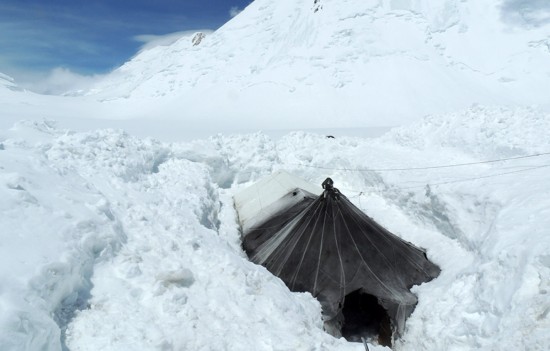 Tent Indian troops Siachen Glacier 2016.
Ultimate Act of Bravery
On June 26, 1987, a fierce blizzard engulfed the Siachen Glacier. The visibility plummeted to near zero, and the howling winds threatened to freeze the blood in their veins. Because the peak was covered in heavy snow and visibility was practically zero, observation from above was completely obscured. For Naib Subedar Bana
Singh, this lethal weather was not a deterrent; it was the perfect tactical
camouflage.
Leading a small, handpicked team of five men (including Rifleman Chuni Lal and Laxman Das), Bana Singh began
the treacherous ascent up the 457-m vertical ice wall from the rear. Carrying
heavy combat gear, weapons, and grenades, they climbed for hours using pitons
and ropes, their bodies battered by the sub-zero tempest. Frostbite and sheer exhaustion
were constant companions.
As they finally breached the crest near the
Quaid Post, they found the frozen bodies of Rajiv Pande and his men. This heart-wrenching
sight ignited a righteous rage within Bana Singh. He divided his team into small
groups and crawled stealthily through the snow trenches toward the main enemy
bunkers.
With a roar that pierced the howling
blizzard, Bana Singh hurled a hand grenade directly into the bunker, destroying
it and killing the Pakistani soldiers inside. Before the surviving enemy
soldiers could react to the explosion, Bana Singh and his men charged into the trenches
with fixed bayonets.
What followed was a brutal, close-quarter
hand-to-hand combat at an altitude where simply breathing is a monumental struggle.
Fighting with superhuman ferocity, Bana Singh moved from trench to trench,
personally bayoneting the enemy soldiers and clearing the post of all infiltrators.
Some enemy soldiers, terrified by the sudden and savage onslaught, jumped off
the cliff to their deaths.
Major Varinder Singh, who arrived with reinforcements,
was seriously injured during the battle, but Bana Singh ensured that the post
was completely cleared of the enemy.
Against all odds, the impregnable Quaid Post
had fallen. The Indian tricolour was hoisted, reclaiming the pride of the
nation.
Param Vir Chakra
For his most conspicuous gallantry,
outstanding leadership, and supreme devotion to duty in the face of certain
death, Naib Subedar Bana Singh was awarded the Param Vir Chakra (PVC), India’s highest military decoration.
He received the award on Republic Day,
January 26, 1988, from the then President of India, R. Venkataraman. Bana Singh
became one of the very few soldiers to be awarded the Param Vir Chakra while
still alive, becoming a living legend in the ranks of the Indian Armed Forces.
Memorials
The highest tribute paid to this extraordinary
warrior was etched into the geography of the Earth itself. Immediately
following the successful capture of the peak, the Brigade Commander hugged and congratulated
him, and the Indian Army officially
renamed the post ‘Bana Top’ (or Bana
Post). To this day, the highest peak in the Siachen Glacier region bears his
name.
Furthermore, a sports stadium in his native
region of R.S. Pura, Jammu, was named in his honour. Statues and busts of
Honorary Captain Bana Singh adorn various military cantonments and the Jammu
& Kashmir Light Infantry Regimental Centre.
Lessons from His Life
1) The Power of the Human Will: He proved that the human spirit, when fuelled by purpose, can overcome the most extreme physical and environmental limitations.
2) Turning Adversity into Advantage: While
others saw the blinding blizzard as a hindrance, Bana Singh saw it as tactical
cover, demonstrating brilliant battlefield adaptability.
3) Leading by Example: He climbed the ice
wall first, lobbed the first grenade, and led the bayonet charge, defining the
very essence of military leadership.
A Legacy of Courage
Operation Rajiv will forever be remembered as a massive collective victory. In recognition of the monumental
effort, besides Bana Singh’s PVC, one Maha Vir Chakra, seven Vir
Chakras, and one Sena Medal were awarded to the team. The Commanding Officer
and the Commander were awarded Uttam Yudh Seva Medals.
Bana Singh continued to serve the Indian Army
with quiet dignity, eventually being promoted to Subedar Major and later
granted the honorary rank of Captain.
Remarkably, during the 1999 Kargil War, he
was the only PVC awardee still in active service. He retired in 2000.
Today, he lives his ‘second innings’ in his
native village of Kadyal, leading a highly disciplined, simple life, working hard
in his agricultural fields just as he did in his youth.
Inspiring Future Generations
Bana Singh travels every year to New Delhi to
participate in the Republic Day Parade, a moment of immense pride where he
wears his polished medals. One of his proudest moments was when his son
Rajinder Singh joined the 8 JAK LI regiment.
He frequently visits the National Defence
Academy (NDA), the Indian Military Academy (IMA), and schools across the
country. For young cadets, meeting the man who captured the Bana Post is the
ultimate blessing.
He embodies the truth that heroes are
ordinary people from humble
backgrounds who choose to do extraordinary
things when their nation calls.
Author is Consultant Psychologist, Director & Prof (R) MGM Group of
Colleges.
This article was first published in the Bhavan’s Journal, October 16-31, 2026 issue. This article is courtesy and copyright Bhavan’s Journal, Bharatiya Vidya Bhavan, Mumbai-400007. eSamskriti has obtained permission from Bhavan’s Journal to share. Do subscribe to the Bhavan’s Journal – it is very good.