- This photo
feature tells how Buddhist cave tradition entered Xinjiang, translation of
Buddhist scriptures, scholar Kumarajiva, Buddhist Art in Kucha. It has o/s pictures, including of Shiva
and Parvati Mural in Kizil Caves, with
detailed captions.
Text and
Photographs by Benoy K Behl.
The
tradition of Buddhist caves that originated in India travelled to Bamiyan,
Kucha, Turfan and across the length of China to Dunhuang. Caves were excavated
in this vast region for meditation and as retreats for monks.
In the
Tarim basin, there were four main centres of art, at Miran and Khotan on the
Southern Silk Route and at Kucha and Turfan on the Northern Silk Route.
The
present-day Xinjiang Uighur Autonomous Region of Northwestern China is home to
many ethnic groups. It was a very active region of trade on the Silk Route,
which led to a wonderful blend of cultures here. The rule over the Xinjiang
region shifted between Indo-European language speaking tribes, nomads and the
Chinese. The nomadic Xiongnu tribe replaced the Central Asian tribe of Yuezhi,
who resided in the eastern Tarim basin in ancient times. The Chinese Han Rulers
then vanquished the Xiongnu tribe, gaining control over the area in the 1st
century CE.
The
Yuezhi tribe gradually migrated southward to form
the Kushana Empire in present-day Afghanistan, Pakistan and India. In
these regions, they came in contact with the Indic faiths of Hinduism and
Buddhism. The Gandhara and Mathura schools of art were established under their
rule.
The
area of rule of the Kushanas expanded in the 1st-2nd
centuries CE to include the Tarim Basin. They established a kingdom in Kashgar*
and competed with nomads and Chinese forces for control of the region. They
introduced the Indian Brahmi script and Prakrit language as their language for
administration.
The 2nd
century CE onwards saw an age of translation of Buddhist scriptures in Kucha.
The main tradition of Buddhism which prevailed here was the Theravada. However, Kucha also produced a major
translator of Mahayana Buddhist texts, Kumarajiva of the 4th century
CE. He was a person of great learning. He
translated many Buddhist texts and Mahayana sutras
such as the Lotus Sutra into Chinese and introduced Mahayana Buddhism in
the region in a systematic manner. Other important translators of this period
include Lokaksema (167-186 CE), Dharmaraksa (265-313 CE) and Bodhidharma
(440-528 CE), who was the founder of the Chan (Zen) school of Buddhism.
After
the 4th century CE, Chinese monks began to travel to India. They
wished to gain first-hand knowledge of Buddhism and to obtain original Indian sutras. Among the most influential and best-known Chinese pilgrims who travelled to India were Faxian (395-414 CE) and Xuanzang (629-644 CE). Xuanzang’s detailed accounts of his travels have provided much of the known historical information about his era. Besides these two, hundreds of other pilgrims also visited India in this period. The Silk Route transmission of Buddhism declined around
the 7th century CE, with the rise of Islam in Central Asia.
Kumarayana,
from Kashmir, was one of the greatest Buddhist teachers of the 4th
century CE in Central Asia. He became the guru of the king of Kucha and later
married his daughter Princess Jiva. Their son was named Kumarajiva, after the
names of the father and mother. Princess Jiva took Kumarajiva too Kashmir, the land of his father. There the young boy studied Sanskrit and Buddhist scriptures for 13 years. On their return to Kucha, Kumarajiva became very famous as the finest-ever translator of Buddhist scriptures. His fame spread far and wide and it is believed that China attacked and annexed Kucha because they were very keen to take Kumarajiva to their own court. Today, there is a beautiful modern sculpture of Kumarajiva made
in front of the Kizil Caves near Kucha. There even stands a large temple
which was dedicated to the white horse which Kumarajiva rode.
The Lotus Sutra and other translations of Kumarajiva remain
extremely popular in China even today. Others have translated the same sutras after him, but it is said that there is a poetic quality and charm to Kumarajiva’s writings, which the later translations do not have.
The
earliest treasure-trove of Buddhist art in
China is at Kucha. It was an ancient kingdom located on a branch of the Silk
Route that ran along the northern edge of the Taklamakan Desert, in the Tarim
Basin. Kucha’s geographic location made it a centre of Buddhism, as well as a key point for its spread to Central China. There are about 10 ancient sites in and around the city. These include caves at Kizil, Kumtura and Simsim.
The Kizil Caves are the best known among the monastic
complexes at Kucha. 60 kilometres east of Baicheng County, the Kizil Thousand
Buddha Caves are made on the cliffs on the northern banks of the river Muzat, 7
kms south-east of Kizil town.
The
caves at Kizil were carved from the 3rd to 9th centuries
CE. There are 236 caves here, spread over 3 kilometres. These caves were
probably painted by artists from Central Asia
or even from far-away India, supported by wealthy donors and patrons. The
murals in the Kizil Thousand Buddha Caves are in 81 caves. These show a high
quality of art. The stucco sculptures of the Kizil Caves have been largely
destroyed by natural forces, over the years. Unfortunately, some sculptures and
paintings have also been removed and taken abroad.
The
Kizil paintings depict various Buddhist themes: the Jatakas, Avadanas, scenes from Gautama Buddha's life, figures of Buddhas and Bodhisattvas, musicians, donors, Hindu deities, saints and yogis.
Besides
the themes themselves, other Indian elements in the
Kizil paintings include the representation of apsaras and other figures, the clothing of many of the
figures, the sensitive modelling of the forms and smooth blending of colours. The
Kizil artists have drawn largely upon the art of Ajanta and many of the Jatakas
and Avadanas depicted in Kizil
correspond to those painted in the Ajanta Caves.
The Mogao Caves (at Dunhuang) are one of the most
magnificent complexes of ancient Chinese Buddhist art. Around 492 caves
survive, which are repositories of the artistic traditions of ancient and
medieval China. These help to trace the development of Buddhism and the art of
the region.
Approximately
25,000 square metres of wall paintings and
more than 3,000 painted sculptures make this one of the most valuable sites of
Buddhist art in the world. The paintings and sculpture reveal Chinese, Indian,
Greco-Roman and Iranian influences.
The first Buddhist caves here are believed to have been founded
in 366 CE.
The making of the vast complex of the Mogao Caves spanned more than a thousand
years, in the Early Qin, Northern Wei, Western Wei, Northern Zhou, Sui, Tang,
Five Dynasties, Song, Xixia and Yuan periods. It was during the rule of the
Tang dynasty (7th-9th centuries CE), that the artistic
traditions at Dunhuang reached their greatest height.
Wealthy
traders and important officials were the principal donors responsible for
creating the caves. Caravans of traders stopped here for prayers or to give
thanks for a safe journey through the treacherous wastelands to the west. These
cave shrines were carved out of the gravel conglomerate of the cliffs. There
are murals made inside the caves which date from the 5th century CE
onwards.
The sculptures
at Dunhuang were made of clay, moulded around wooden armatures, as the gravel
conglomerate would not support direct carving. (This is a tradition seen in
Buddhist clay sculptures, from India till Dunhuang.) These figures were then
painted.
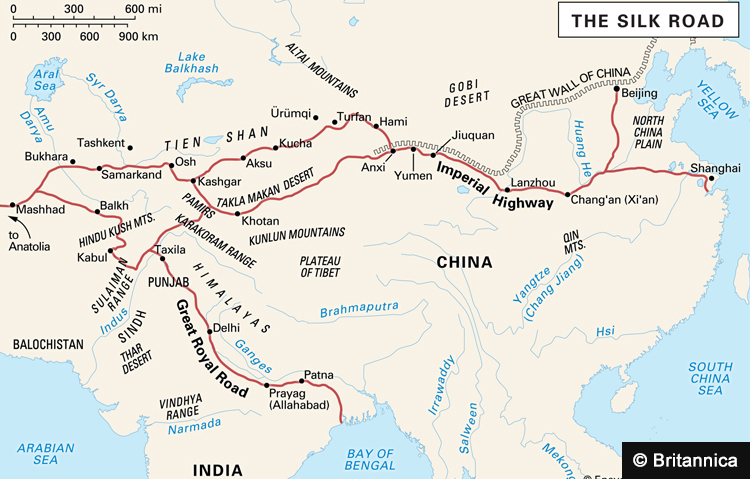 Note location of Kasghar,
Kucha,Turfan & Khotan.
Note location of Kasghar,
Kucha,Turfan & Khotan.
Now pictures by author. Format is short
caption followed by a detailed one.
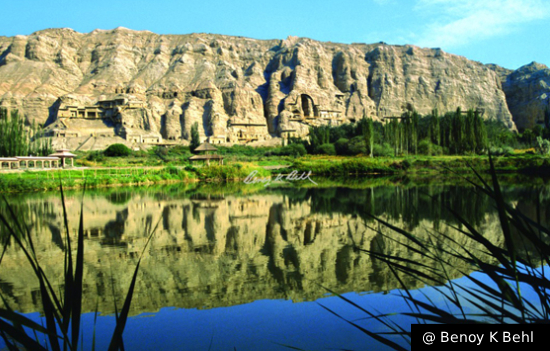 Kizil Caves, Kucha, Xinjiang Uygur Autonomous Region, China. Pic by Benoy K Behl
Kucha was one of the greatest Buddhist centres
in Central Asia in the first half of the First Millennium. There are 236 caves
at the site of Kizil, with paintings that date from the 3rd to 9th
centuries CE. Stylistically, they are a blend of Indian, Iranian and Chinese
influences. These are among the finest early paintings that have survived in
present-day China.
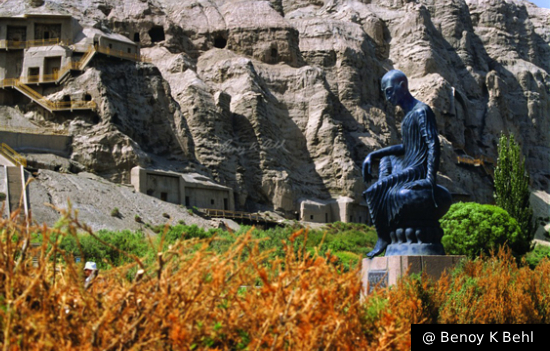 Statue
of Kumarajiva, Kizil Caves, Kucha, Xinjiang
Uygur Autonomous Region, China. Pic
by Benoy K Behl
Statue
of Kumarajiva, Kizil Caves, Kucha, Xinjiang
Uygur Autonomous Region, China. Pic
by Benoy K Behl
Kumarajiva, of the 4th century
CE, was the son of the Indian Pandit Kumarayana, the royal teacher at Kucha. He
was married to Princess Jiva of Kucha and their son was named Kumarajiva, after
both their names. At a very young age he was taken to Kashmir, the land of his
father, to learn Sanskrit and Buddhist scriptures. He returned to Kucha to
become the greatest translator of Buddhist texts into Chinese.
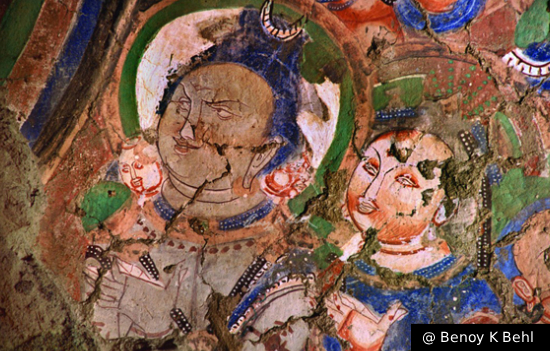 Shiva
and Parvati, Mural, Kizil Caves, Kucha, Xinjiang
Uygur Autonomous Region, c. 6th Century CE, China. Pic by
Benoy K Behl.
Shiva
and Parvati, Mural, Kizil Caves, Kucha, Xinjiang
Uygur Autonomous Region, c. 6th Century CE, China. Pic by
Benoy K Behl.
Hindu deities are commonly
seen in the art of the Buddhist caves in India and across the many countries of
Asia.
We are reminded of the cosmopolitan culture of ancient times, when Buddhist
caves and art were made in the rule of Hindu kings. Ancient inscriptions also
show that the wives of Hindu kings in India quite often worshipped a Buddha or
a Jaina Tirthankara.
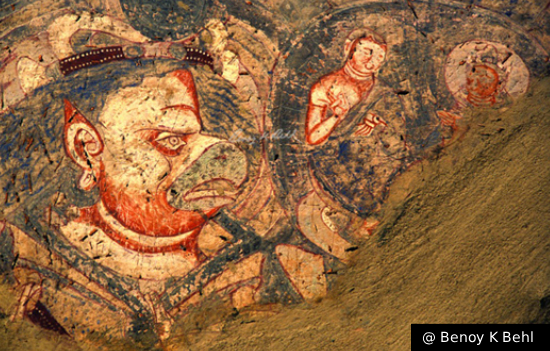 Garuda, Mural, Kizil Cave 178, Kucha, Xinjiang
Uygur Autonomous Region, China. Pic by Benoy
K Behl.
Garuda, Mural, Kizil Cave 178, Kucha, Xinjiang
Uygur Autonomous Region, China. Pic by Benoy
K Behl.
From Sri Lanka
and South-East Asia up to China and Mongolia, one
of the favourite representations is that of Garuda, the vahana, or
vehicle, of the deity Vishnu. This powerful eagle remains the national
symbol of Thailand and Indonesia and is one of the popular deities in India.
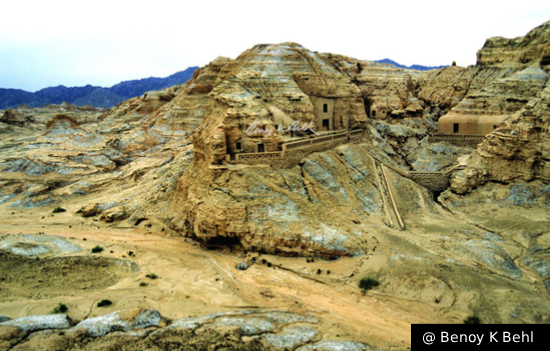 Kizilgaha Caves, Northern Banks of River Muzat, Xinjiang Uygur Autonomous Region, 3rd-8th Centuries CE, China. Pic by
Benoy K Behl.
Kizilgaha Caves, Northern Banks of River Muzat, Xinjiang Uygur Autonomous Region, 3rd-8th Centuries CE, China. Pic by
Benoy K Behl.
In the
north-west of Kuqa County, in a ravine, is the site of the 47 Kizilgaha Caves. This is one of the large groups of
Buddhist caves in China.
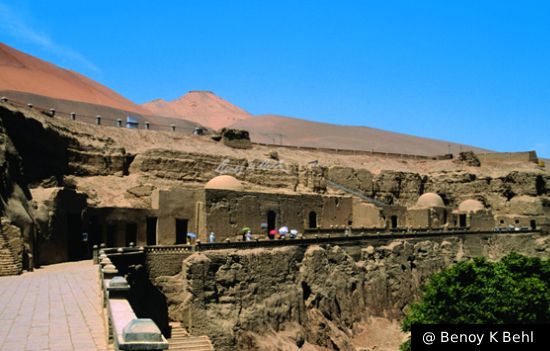 Bezeklik Caves, Xinjiang Uygur Autonomous Region, China. Pic by Benoy K Behl.
The 77 Bezeklik Caves date from the 5th
to 14th centuries CE. The site lies between the cities of Turpan and
Shanshan (Loulan) to the Northeast of the Taklamakan Desert. It was on the
Northern Silk Route in ancient times.
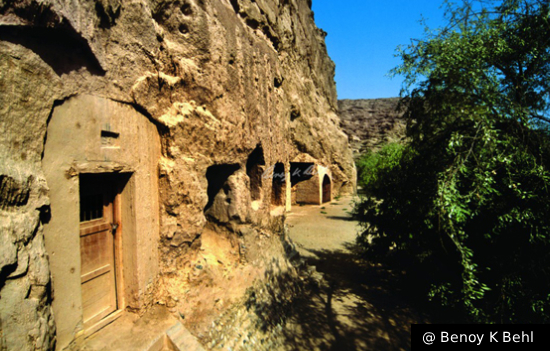 Cave 64 and Others, Kumtura Caves, Xinjiang Uygur Autonomous Region, 4th-10th Centuries CE, China. Pic by
Benoy K Behl.
Cave 64 and Others, Kumtura Caves, Xinjiang Uygur Autonomous Region, 4th-10th Centuries CE, China. Pic by
Benoy K Behl.
This site was among the first to be
designated for protection as a National Historical and Cultural Site. From 1999
onwards, extensive documentation and consolidation of the conglomerate rock,
from which the caves were excavated, was taken up.
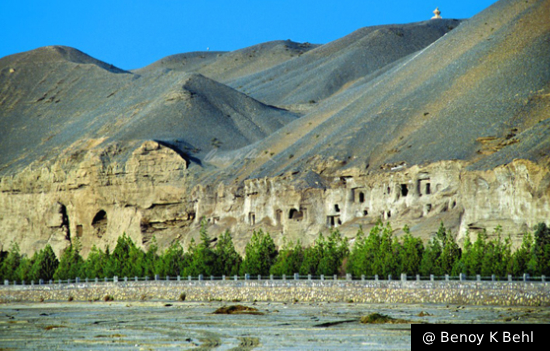 Mogao Caves, Near Dunhuang, 4th-14th
Centuries CE, China. Pic by Benoy K Behl.
Mogao Caves, Near Dunhuang, 4th-14th
Centuries CE, China. Pic by Benoy K Behl.
The Mogao Caves,
also known as the Caves of the Thousand Buddhas,
form a system of 492 Buddhist temples. These are near Dunhuang, which was an
oasis, strategically located at a crossroads on the Silk Road, in the Gansu
province.
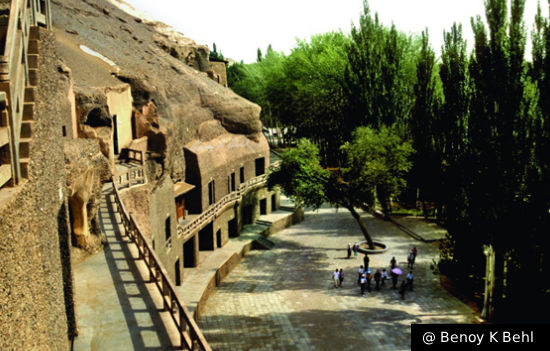 Mogao Caves, Near Dunhuang, 4th-14th
Centuries CE, China. Pic by Benoy K Behl
Mogao Caves, Near Dunhuang, 4th-14th
Centuries CE, China. Pic by Benoy K Behl
The 492 caves
which survive at this site were made over a period of a thousand years. The
first caves were excavated in 366 CE, as places of Buddhist meditation and
worship. The Mogao Caves are the best known Chinese
Buddhist caves.
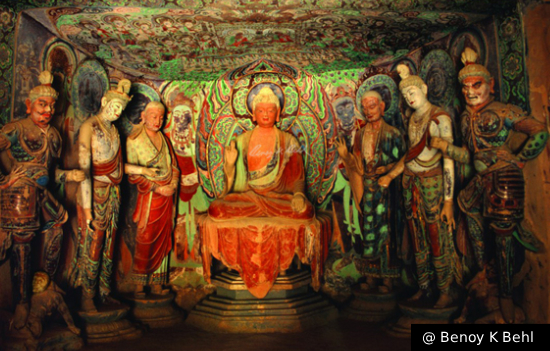 Interior,
Mogao Cave no. 45, Near Dunhuang,
China. Pic by Benoy K Behl.
Interior,
Mogao Cave no. 45, Near Dunhuang,
China. Pic by Benoy K Behl.
Buddhist cave art, which originated in
India in the 3rd century BCE, travelled to Bamiyan, Kucha-Kizil,
Turfan and Dunhuang. Buddhist caves were excavated for meditation and as
retreats for monks. The Mogao Caves are repositories of the artistic traditions
of ancient and medieval China. Approximately 25,000 square meters of wall
paintings and more than 3,000 painted sculptures make this one of the most
valuable sites of Buddhist art.
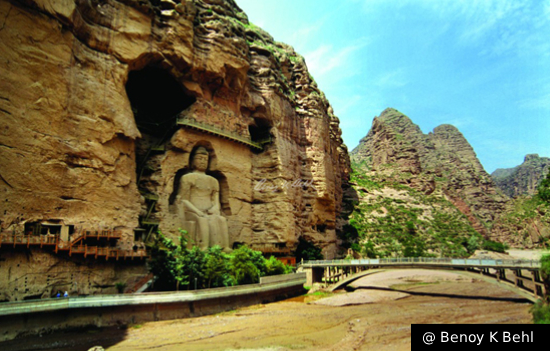 Colossal
Buddha, Bingling Si, Buddhist Caves on Yellow River, Gansu Province, China. Pic by Benoy K Behl.
Colossal
Buddha, Bingling Si, Buddhist Caves on Yellow River, Gansu Province, China. Pic by Benoy K Behl.
Bingling Si is a series of natural caves
and caverns in a canyon along the Yellow River, with Buddhist sculpture inside
them. They lie just north of where the Yellow River empties into the Liujiaxia
Reservoir, in Gansu province, some 100 kms Southeast of Lanzhou. The caves were
sculpted over a period of more than a millennium, beginning around 420 CE.
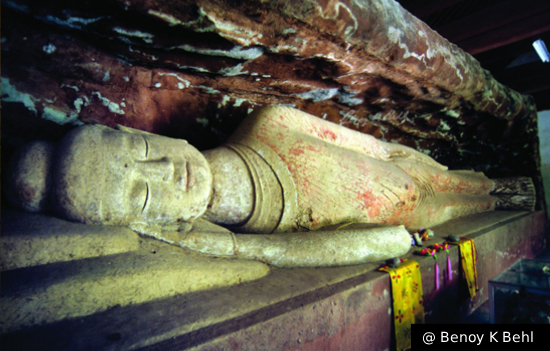 Parinirvana, Bingling Si, Gansu Province, China. Pic
by Benoy K Behl.
Parinirvana, Bingling Si, Gansu Province, China. Pic
by Benoy K Behl.
The theme of the
Parinirvana was first seen in the
caves of Ajanta
in Western India, in the 5th century CE. The sculpture at
Bingling Si reflects the movement of Buddhist art on the Silk Route, between
Bamiyan and Eastern China.
To read all
articles by author Benoy K Behl
To see albums of
Buddhist Monuments
To read articles
on Buddha Vakhya
Also
read
1. The Tarim Basin in Xinkiang was Kashmir’s twin by Subhash Kak
2. Buddhist sites in
Xinjiang
3. How
China became such so bigg – “The Xinjiang region came under Mongol
rule and was fully Islamicised by the 14th century. Later, the
Qing dynasty overthrew its rulers and conquered the area in the 18th century (1759).”
4. Scholar
Pilgrims from India to China
5. When
did Xinjiang become part of China