- This photo feature
tells briefly about the Trimurthi Temples of Brahma, Vishnu and Shiva in Java,
Indonesia followed by pictures including of the Ramayana Ballet and Travel Tips
for visiting.
Photographs &
Inputs by Jayavantha Prabhu
Part one of this
series featured Borobudur.
This one features Prambanan Shiv Temple. First, brief information about temple
by Rajiv Malik in Hinduism
Today.
About
Prambanan Temple
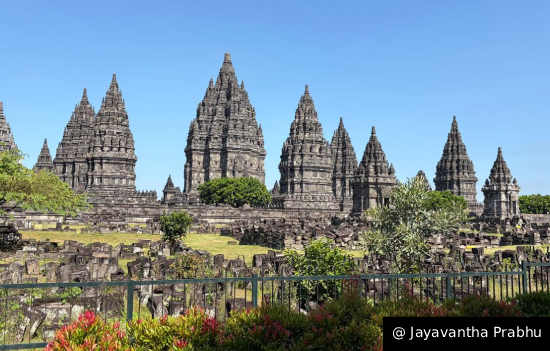
“Prambanan,” explains archaeologist Manggar Sarl Ayuati, “is one of the largest Hindu temple complexes in Asia with an enclosed area 390 meters on a side. It was built in 856 by King Rakai Pikatan of the Sanjaya dynasty, which ruled the Mataram Kingdom, and was expanded by later kings. It is dedicated to Siva.”
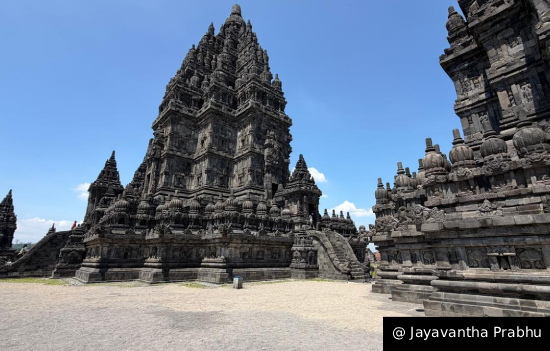
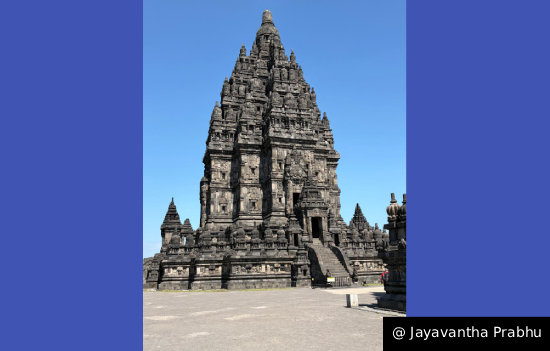
Prambanan has three concentric courtyards. The innermost contains 16 temples, including the 156-foot-high main temple to Siva and 108-foot temples to Vishnu and Brahma. Each is faced by a smaller temple for the God’s vahana (mount): Nandi the bull for Siva, Hamsa the swan for Brahma and Garuda the eagle (Indonesia’s national symbol) for Vishnu. Scenes from the Ramayana and the life of Krishna are carved on the outer walls of the temples. The Siva temple has multiple chambers - Siva in the center, Durga in the north, Rishi Agastya in the south and Ganesha in the west.
The second
courtyard originally contained 240 small temples; only 129 have undergone any
degree of restoration. The rest are just piles of rocks. No structures remain
in the third courtyard, and the historical use of that area is unknown. The
complex also contains four Buddhist temples, built by a Hindu king for his
Buddhist wife.
Prambanan was abandoned in the 10th century.”
Photo Dharma wrote, “The complex came to the attention of colonialists in the early 19th century, and some sporadic efforts were made to protect and restore the buildings, but it was only in the mid-20th century that really determined and sustained efforts made substantial progress.”
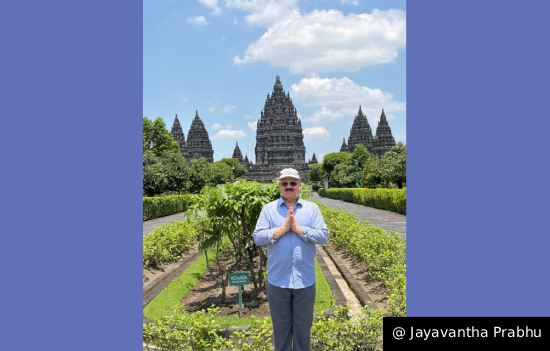 Photographer Jayavantha Prabhu welcomes you to Prambanan Temple.
If Borobudur
represents a silent, internal climb toward Nirvana, then Prambanan is a grand,
external architectural symphony. This complex stands as a soaring testament to
the Hindu revival in Central Java - a deliberate, magnificent answer to its
Buddhist neighbour just a few kms away.
As we stand in the
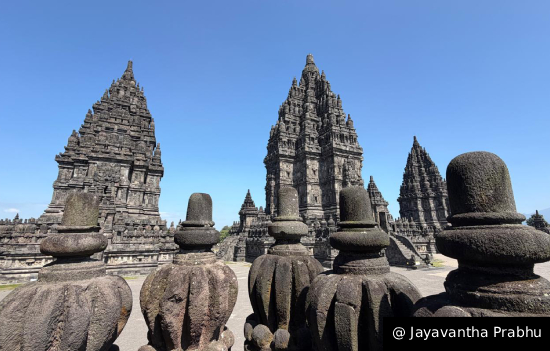
central courtyard, we are dwarfed by the Trimurti Towers, three main spires
dedicated to the cosmic functions of creation, preservation, and destruction.
The central Shiva Temple is an engineering marvel, reaching a height of 47 metres
and 34 metres wide and serving as the vertical axis where the divine world
touches the earthly Javanese soil.
The interior of
the Shiva temple remains the emotional heart for any visitor from the
subcontinent. In the main chamber, the Shiva Mahadeva statue stands in regal
silence, but it is the northern chamber that holds the most local intrigue.
Here resides the Durga Mahishasuramardini statue, an eight-armed masterpiece often called 'Loro Jonggrang' by the locals. Legend tells of a princess turned to stone to complete the temple, but to the student of Indian heritage, she is the familiar, fierce protector of Dharma.
Flanking the main
tower are the temples of Vishnu and Brahma, each housing their respective
deities and mirrored by smaller shrines for their celestial mounts: the noble
Nandi, the mighty Garuda, and the graceful Hamsa.
The true narrative
power of Prambanan, however, is revealed as we walk the inner galleries. The Ramayana Reliefs are perhaps the most vivid stone narratives in Southeast Asia, wrapping around the Shiva and Brahma temples in a continuous, flowing story. These are not merely static scenes; they are dynamic depictions of Rama’s exile, Sita’s devotion, and Hanuman’s heroism, all interpreted through a 9th-century Javanese lens.
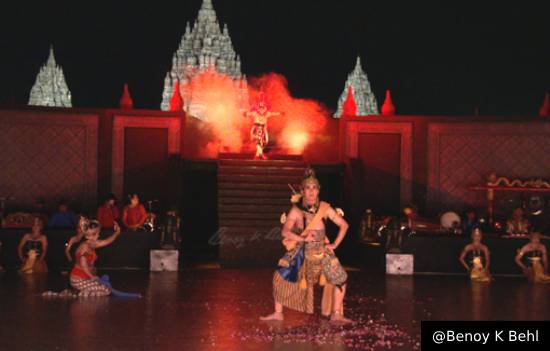 Burning of Lanka. Pic by Benoy K Behl.
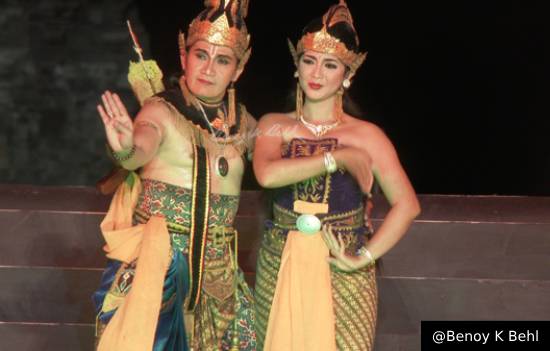 Rama and Sita. Pic by Benoy K Behl.
The carvings
follow the Ramayana Kakawin tradition, where the monkeys look more like local
primates and the architecture of Ayodhya resembles
a Javanese palace. It is a beautiful example of how a shared epic can
take on the flavor of its new home without losing its spiritual core.
To experience this
narrative in its living form, a traveller must witness the Ramayana Ballet performed on the open-air stage adjacent to the complex. Performed on Tuesday, Thursday, and Saturday nights, the ballet uses the lit-up spires of Prambanan as its backdrop, turning the static stone reliefs into a vibrant, moving tribute to the epic. It is a highlight of any Javanese itinerary, bridging the gap between a 1,000-year-old monument and the living culture of today’s Indonesia.
For the international tourist, a visit to Prambanan is best scheduled for the afternoon, arriving around 2:30 PM. This allows you to explore the sprawling site before the "golden hour" sets in, turning the grey volcanic rock into a deep, warm amber under the setting sun.
Unlike Borobudur,
the Prambanan complex is very exposed, so an umbrella for shade and a steady
supply of water are essential. Logistics are best managed by hiring a private
car and driver for the day (approx. IDR 900,000), which allows you the flexibility
to see the sunset at Prambanan and stay for the evening performance without
worrying about the 45 km trek back to Yogyakarta city in the dark.
The best months to visit remain the dry window of May
through October, though the shoulder months of May and June offer the most
pleasant experience with fewer crowds. Whether you are a devotee of Indian
heritage or a global traveller seeking architectural wonders, Prambanan stands
as a powerful reminder that our cultural roots are deep, resilient, and capable
of producing spectacular fruit thousands of miles from their origin.
Ensure your Visa on Arrival (VoA) is handled via the e-VoA
portal to skip the long queues, and keep your SATUSEHAT health declaration
ready on your phone. To truly capture the essence of Borobudur, plan your trip
for the dry season between May and September, when the clear skies allow the
volcanic peaks of Merapi and Merbabu to stand as silent guardians over your
morning meditation.
Official
Temple Ticketing
(Borobudur & Prambanan): borobudurpark.com — This is the only place to secure your specific time-slot for the Borobudur climb.
Indonesian e-Visa
(e-VoA):
molina.imigrasi.go.id — Use this to skip the physical "Visa on Arrival" queues at the airport.
SATUSEHAT
Health Declaration: satusehat.kemkes.go.id — The mandatory portal for your health pass, required within 72 hours of your flight.
Indonesian
Electronic Customs Declaration (e-CD): ecd.beacukai.go.id — Complete this online before you land to breeze through the "Nothing to Declare" green channel.
Yogyakarta
International Airport
(YIA):
yogyakarta-airport.co.id — For checking real-time flight statuses and ground transport options like the airport train.
Download the SATUSEHAT and Grab (for local transport) apps before you leave Mumbai. They are the "Swiss Army knives" of modern Indonesian travel.
Now pictures of the Shiv Mandir –
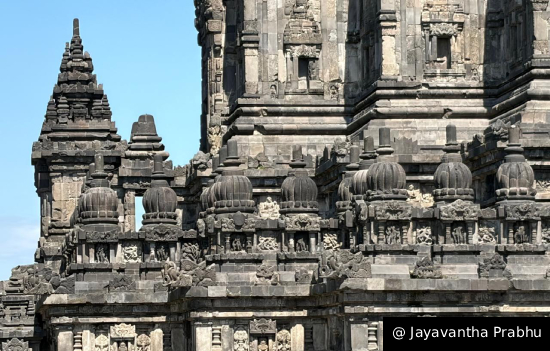
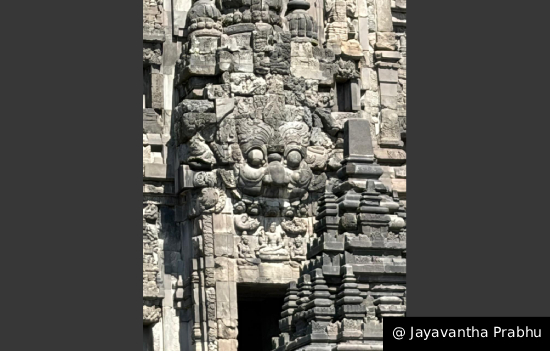 Kirti Mukha, found in Indian temples, to keep away evil spirits.
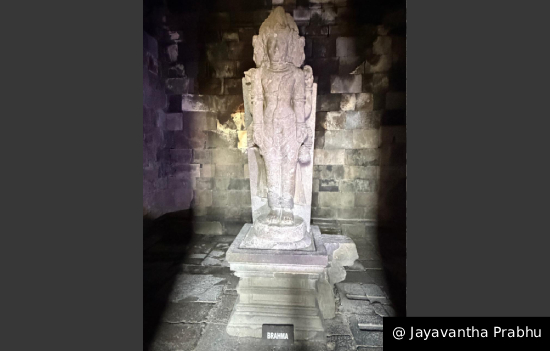 Brahma.
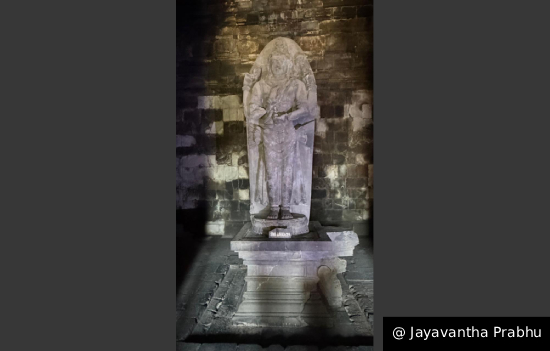 Shiva.
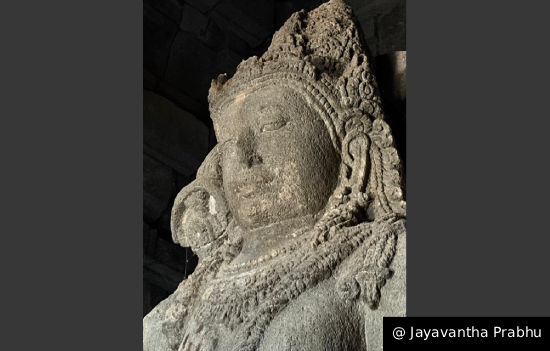
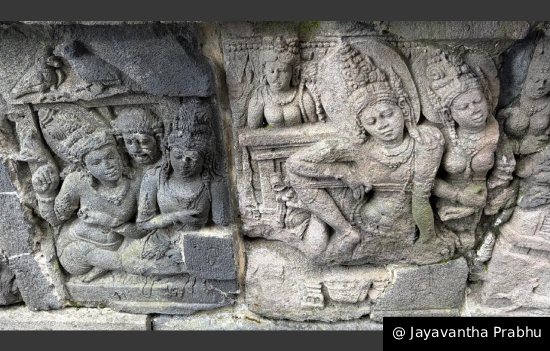 Three Princess.
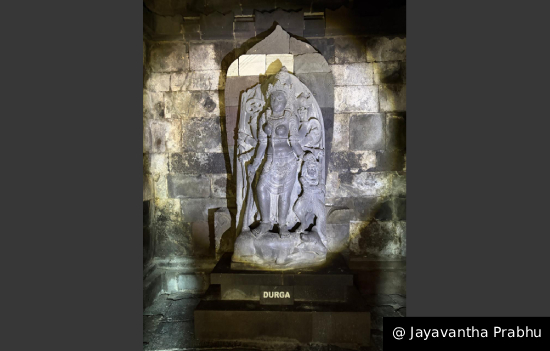 Durga.
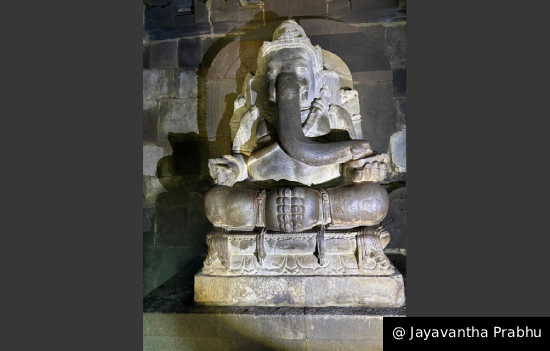 Ganesha.
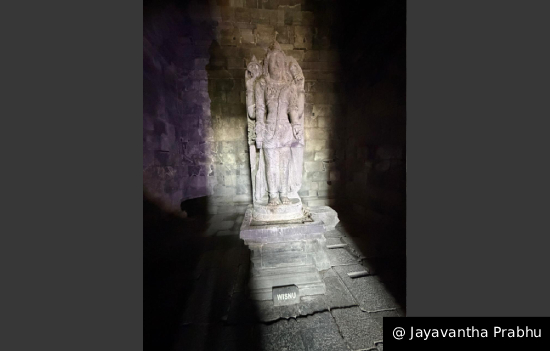 Vishnu.
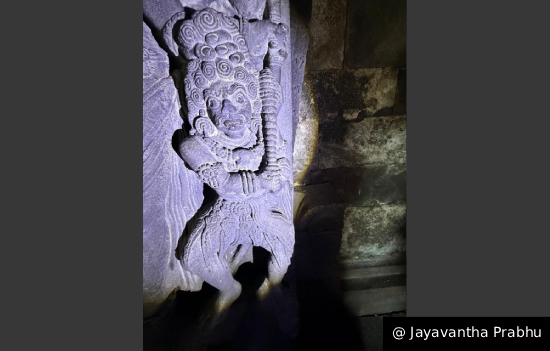
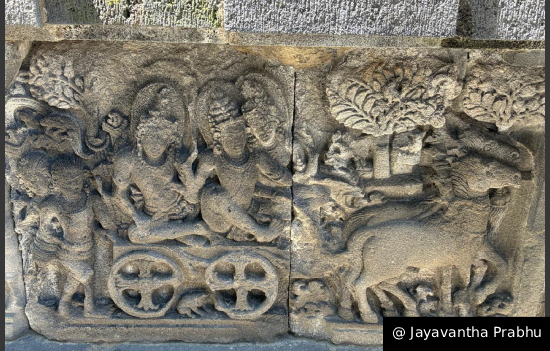 On a chariot pulled by horses.
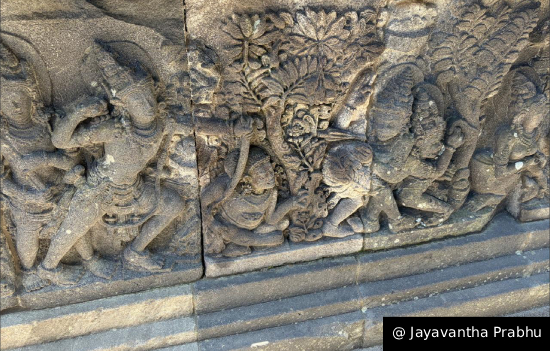 With a bow in hand. Not sure if Ramayana scene.
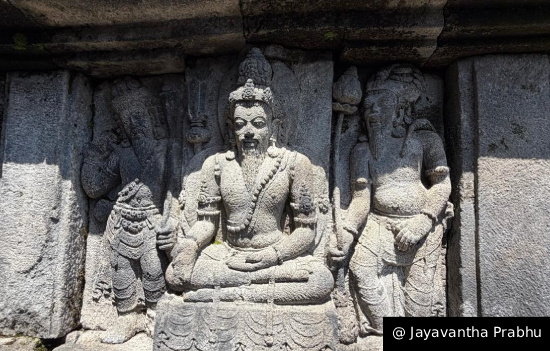 “Bas relief in Brahma Temple, Prambanan. The narrative bas-relief panels were carved along the inner balustrades wall on the gallery around the three main temples.”
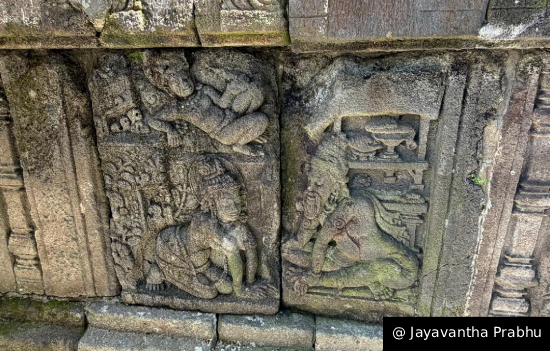 Right is Brahmin. Think teaching a student.
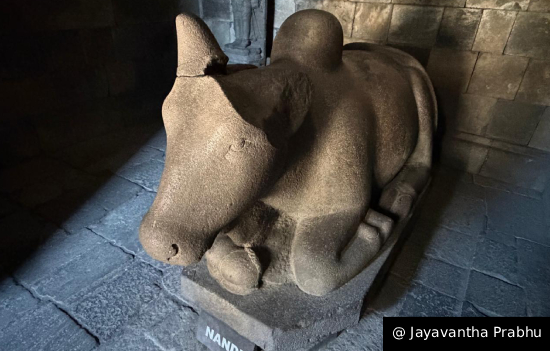 Nandi.
Also read
1. Hindu
Temples of Java
2. Album
Prambanan Shiv Temple
3. More pics on
Photo Dharma.net
4. Indonesia
Site on Temple
5. To book
tickets for evening Ramayana Ballet
6. Photo
Feature Ramayana Performance at Temple by Benoy K Behl