- This article includes what are Mudras, how they can be practiced, which
finger relates to which Element of Nature and are Mudras useful. Part Two will explore
simple Hasta Mudras, how to form them and when to include them in your practice.
My last article was Making
Yoga a way of Life
Start
with just five minutes a day to turn inward and become aware of yourself
Have you ever noticed what your hands do
when you feel stressed? You clench your fists, rub your palms, touch your face,
or keep moving your fingers without realizing it. And when you finally relax,
your hands soften too.
There exists a connection
between our hands, breath, mind and the way we experience the world. Yoga understood this connection for
thousands of years, through Mudras.
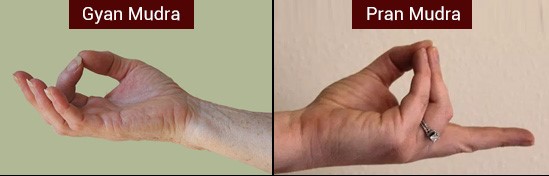
A “Mudra” means a gesture, seal or symbolic expression. In the yogic tradition, a Mudra is more than a simple hand position. It is a way of directing and containing , prana, also known as the life force. You have probably seen someone sitting in meditation with their thumb and index finger touching. You may also have noticed someone bringing their palms together in prayer. These are familiar examples of mudras. There are many different mudras in the yogic tradition. The most common are known as the Hasta Mudras, or hand gestures that form part of an asana, pranayama or a meditation practice.
Our mind is constantly scattered and over
stimulated, eating while looking at our phones, working while thinking about
what needs to happen next, multitasking and juggling many things at once.. A
mudra offers a simple way to bring our attention back to ourselves. When you
hold a mudra during meditation or pranayama, your hands give the mind something
tangible to focus on, creating a point of awareness, alongside the breath and
the body. Think of a Mudra simply as a gesture that
gives you a moment to turn inward and become aware of yourself.
What makes hand mudras particularly
accessible is their simplicity. You do not need a yoga mat, special clothing, a
quiet studio or an hour of free time. You only need your hands and awareness.
Perhaps this is why they are particularly relevant today as the mudra gives the
hands a chance to be still.
To understand Hasta Mudras better, we need
to understand the Pancha Mahabhutas, or the five elements of nature. These are
Agni or Fire, Vayu or Air, Akasha or Space, Prithvi or Earth, and Jala or
Water.
Table
1 Each finger is
associated with one of the five elements.
|
Finger
|
Represents which element
|
|
1.Thumb
|
Fire
|
|
2.Index
|
Air
|
|
3. Middle
|
Space
|
|
4. Ring
|
Earth
|
|
5. Little
|
Water
|
When we bring particular fingers together
in different combinations, we create different mudras.
Each mudra is traditionally understood to
influence the movement and direction of prana in a particular way.
This is why different mudras have different purposes and benefits. For example,
Apana Mudra is traditionally associated with Apana Vayu, the downward-moving
energy associated with elimination and release. The mudra is therefore, used
with the intention of directing energy in that particular direction.
Some may wonder, are mudras useful?
If you are not convinced, allow yourself to
experience with them as a practice than simply accepting an idea. Sit quietly
with any mudra that you know. Notice your breath. Notice your mind. Notice how
your body feels after a few minutes of practicing a mudra. Sometimes the change
may be obvious. Sometimes it may be subtle. And sometimes you may not notice much
at all, if you are a beginner. The experience will vary and will evolve with
regular practice.
Mudras do not always need 30 minutes every
morning. Start with just five minutes a day. Practice while sitting quietly
before your day begins, in between two tasks, alongside your pranayama, with or
after your asana practice or before you sleep. The practice can easily fit into
free moments you have.
If you are new to mudras, keep it simple.
Sit comfortably, allow your spine to be upright and relax your shoulders and
jaw. Place your hands gently into the mudra without pressing the fingers
together. Let the breath settle and stay with the practice for a few minutes.
Different traditions recommend varying durations
of individual mudras, depending on the practice and its purpose, but five
minutes is a good place to start. As with many practices, consistency is more useful than trying to do too much,
at once.
Each mudra has its own purpose and
associated benefits. Each mudra influences different aspect of prana and its five
elements of nature. While these practices support our physical, mental and
energetic wellbeing, they should not be presented as an absolute cure for a health
condition. They complement other forms of care, and should not be seen as a
replacement. The value also lies in giving yourself a few moments of focused
awareness and making the practice a consistent part of your day.
So the next time you are distracted,
anxious or low on energy, try a mudra for a few minutes. In a world that is
constantly busy and jostling, a mudra reminds us that yoga can also find its
way into the small spaces of everyday life, well beyond the mat.
In part two, we will explore some simple Hasta Mudras, how to form them
and when to include them in your practice.
To read all articles by author
Also read
1. Hasta Mudras
2. Introduction to Mudra Therapy
3. Dhyana Mudra
4. Shambhavi Mudra
5. Garuda Mudra
6. Bronchial Mudras
7. Ushas Mudra