- Why and how do Hindus celebrate Vasant Panchami?
Does the Nizamuddin Dargah celebrate it in the same way? Was Amir Khusrav a
liberal or. Does the Dargah festival story have a historical basis?
Vasant Panchami at Nizamuddin Dargah is not centuries
of interfaith harmony. It is a centuries-old appropriation of Hindu tradition,
stripped of its original meaning and repackaged under Sufi frameworks.
On January 23rd, 2026, Instagram reels, print media
posts and social‑media shares were flooded with claims of a “700-year
tradition of Hindus and Muslims celebrating Vasant Panchami together at
Nizamuddin Dargah.” By contrast,
content showing the millennia-old Hindu Vasant Panchami celebrations and
Saraswati pooja made up barely 15-20 % of the social-media feed.
The flood of visuals from the dargah is presented as
if this appropriation were an age-old symbol of Hindu-Muslim unity. At the same
time, influencers and journalists promote the claim that Amir Khusrau
introduced the festival to console his patron Nizamuddin Auliya over the death
of his nephew, a story with no support in credible historical sources.
Available chronicles do not support the claim that
such a figure existed in the context offered, nor that his death was unrelated
to the violent milieu of conquest in which he lived. If he died as part of the
jihadi campaigns typical of the era attacking Hindu polities, then the
foundation for this sentimental legend collapses entirely. What social media
celebrates as harmonious continuity, is a modern construct built on cultural
appropriation and historical fabrication, not historical facts.
The story that Vasant Panchami at Nizamuddin Dargah
began because Nizamuddin Auliya mourned a nephew, prompting Amir Khusrau to
dress in yellow and sing, is pure dargah lore. No contemporary sources-Persian
chronicles, Sultanate records, or other medieval writings confirm the existence
or death of Nizamuddin’s supposed
nephew, Khwaja Taqiuddin Nuh. This fabricated narrative originates with dargah
custodians and oral retellings and is being propagated by media over the past
century alone.
The glorification of Vasant Panchami at Nizamuddin
Dargah is strategic recasting of a sacred Hindu festival, diverting devotion
from Saraswati Puja to dargah-centric observance.
The fact is that celebrating Vasant Panchami with
yellow mustard flowers dates back to Rigvedic times. Vasant Panchami, also
known as Sri Panchami or Saraswati
Jayanti, is observed on Shukla Paksha Panchami of the month
of Magha (January-February). It marks the arrival of Vasant Ritu, the first
whispers of spring and the descent of Ved Mata Saraswati upon the earth to
awaken knowledge and creativity.
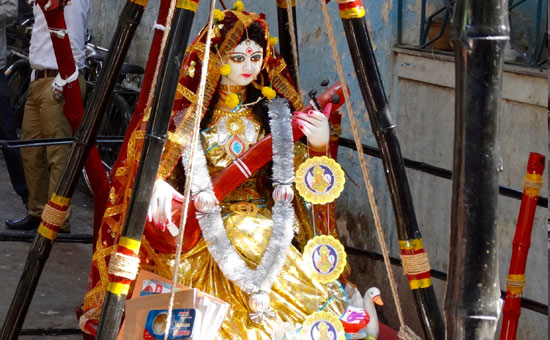 Ma Saraswati Pooja.
As Vasant approaches, fields of mustard burst into
bloom, spreading a golden carpet across the landscape. These blossoms are seen
as nature’s own
offering to Devi Saraswati, a symbol of fertility, prosperity and the vibrant
energy of spring. Devotees traditionally worship Her before sowing or
harvesting these crops, entwining devotion, labour and seasonal celebration.
This celebration of yellow fields and springtime
reverence on Vasant Panchami, traces back to Rigvedic times, where sarsapa
(mustard seeds) are offered in Chaturmasya Yajna (offerings made at four months
agricultural cycle). The Atharvaveda prescribes mustard for protection and
purification rites. Mustard oil, used in dipa (lamp lighting) brings divine
blessings.
Clad in radiant pitambar, Bhagwan Shri Krishna, worshipped Devi Saraswati on this day, setting the pattern for
centuries of Saraswati Puja. The
colour yellow is associated with Guru (Jupiter),
the cosmic harbinger of knowledge, prosperity and insight; thus, devotees wear
yellow as an invocation of wisdom and auspicious blessing on this day.
History is repeating itself. Hindu rituals are being
appropriated, their essence diverted from devotees’ focus. Hindi bhajans at Sufi sama were instruments to reshape Hindu Dharmic faith when they first set foot on our
land.
This very strategy feeds into a broader, aggressively
manufactured myth in the medieval history of Bharat; the idea of the “peaceful
Sufi.” Recast as gentle mystics; singing poets, lovers of
humanity and supposed bridges between Islam and Hindu Dharma, Sufis are
presented as standing outside conquest and coercion. This is historical
falsehood; Sufis were active instruments of Islamic
expansion in Bharat, operating within and
benefiting from an imperial order built on violence, dispossession and
religious subjugation. Through relentless repetition in textbooks,
documentaries and cultural propaganda, the myth has become an article of faith
within secular and left-liberal historiography. By severing Sufis from the
power, patronage and brutality that sustained them, modern narratives have
rebranded agents of empire as icons of tolerance turning history on its head.
This proceeds from a simple methodological demand;
history must be examined through evidence and structures of power, not through
slogans of “harmony” or post-colonial moral theatre. When subjected to such
scrutiny, the romanticised narrative of Sufism collapses. Sufi orders expanded
alongside military conquest, flourished under Sultanate patronage and operated
within Islamic-political system that systematically dismantled indigenous
Dharmic institutions, norms and sacred spaces. To isolate Sufism from this
context and present it as an autonomous, apolitical spiritual phenomenon
constitutes historical distortion, substituting hagiography for analysis and
recasting imperial collaboration as moral legitimacy.
A key premise of this analysis; “no religious movement embedded in conquest can be analysed honestly without confronting the power that enabled it.”
The word Sufi comes from Suf (wool), referring to the coarse woollen garments worn by Christian apostles. Muslim scholars and historians describe Prophet Muhammad as the first exemplar of Sufism, with his son-in-law Ali regarded as a leader of later Sufi traditions. Hasan al-Basri (642–728) is presented as a link between Ali and subsequent Sufi lineages. The founders of Sufi silsilas (orders) trace their spiritual genealogies to Ali or Abu Bakr.
Sufis were historically classified into: Ba-Shara (bound by Sharia) and Be-Shara (not bound by Sharia); the latter, did not establish orders in India. Mansur al-Hallaj is cited as an example of a Be-Shara Sufi; his pantheistic-sounding declaration “Ana al-Haqq” (compared to Aham Bhrahmaasmi), led to his imprisonment in Baghdad for eleven years and eventual execution.
Sufism did not arrive in Bharat as a detached, abstract spiritual movement. Roles of those who came to Bharat; from Nizamuddin and Chishti to Khusrau, Nasiruddin Chirag, Jalaluddin and others, are documented in their own chronicles and memoirs. The Chishti, Suhrawardi and Qadiri orders entered the subcontinent in the wake of conquest, deeply embedded within the machinery of Islamic expansion.
Moinuddin Chishti, originating from Chist in the Herat region, arrived alongside the invader Shihabuddin Ghori and established Chishti silsila in Ajay Meru (Ajmer). The Suhrawardi
order consolidated itself in Multan after the fall of Raja Kanda, where Shaykh
Shahab-ud-Din Suhrawardi of Baghdad directed his disciple Baha-ud-Din Zakariyya
to convert the conquered Hindu population.
Chishti networks in Delhi, including that of
Nizamuddin Auliya, developed under Sultanate dominance rather than outside it.
The Qadiriyya order, tracing its lineage to Abdul Qadir Jilani, entered the
subcontinent later in the late fourteenth century and expanded under
Turko-Afghan rule. Sufi khanqahs and dargahs functioned as patronage-dependent
institutions, maintained through Sultanate waqf endowments and sustained by
court protection.
Sufis were active participants in gazwa-e-Hind machinery of conquest. They played active roles in political power struggles, shared in loot and accepted captured Hindu women as rewards. Silent in the face of Muslim brutality, they exploited the spiritual bent of Hindus to facilitate conversion. Sufi orders did not “coexist” with Hindus, they deliberately appropriated Sanatan rituals and cultural practices to confuse and convert Hindus.
Historian Harry S. Neale argued, that pre-modern Sufis
accepted military jihad as a communal duty (fard kifaya) and that participation in jihad was considered
virtuous in several Sufi texts.
Singing Hindi bhajans at Sufi sama gatherings was
central to a strategy that lured surviving Hindus; exhausted, traumatized and
vulnerable from the devastation of invasions, into spaces designed to gradually
undermine their original faith. The music, poetry and chadar ceremonies
romanticised as benign or aesthetic, were calculated tools of influence, reshaped
from Dharmic rituals into instruments of conversion.
Hindwi rags, devotional melodies rooted in Hindu
bhajans, were mostly performed by newly converted Hindus lending an air of
familiarity while eroding traditional practice. Shaikh Ahmad, disciple of the
converted Imam Faqir Madhu (who retained his Hindu name), became renowned for
these renditions, exemplifying how conversion and cultural appropriation worked
hand in hand.
Intellectual
engagement was weaponised for Islamic expansion.
Mir Gisu Daraz studied Sanskrit to confront Brahmans
and convert them to Islam. Qazi Ruknuddin Samarkandi learned Hath Yoga from a Siddha Bhojar Brahman and translated yogic knowledge into Sufi
frameworks. Qalandars adopted visual markers such as earrings from Kanphat yogis.
Sayyid Murtaza, in his Yoga-Qualanar, explicitly aligned Qalandariya
disciplines with yogic techniques. Nizamuddin Auliya practiced pranayama;
Shaykh Abdu’l Quddus
and his Ruduls incorporated the teachings of Shri Gorakhnath. This was not
cultural exchange but strategic entanglement, embedding Hindu spiritual systems
into Sufi practice to blur lines, manipulate devotion and facilitate
conversion.
For centuries, Muslim chroniclers have boasted of “enriching
Bharat with poetry, ghazals, art and architecture.” But the reality is; they brought little original culture, borrowing and repurposing Hindu forms to serve imperial agendas. The deliberate, systematic appropriation of Sanatan Dharma, disguised as piety, masked as art and sold as spirituality, has been promoted as “shared heritage” since 1947.
What appears as cultural harmony was in fact the very
mechanism through which conversion was engineered; the idea of “peaceful
conversion” is a comforting fiction. Sufis labeled Hindu practices
as shirk, promoted saint-veneration in place of deity worship and with murti‑puja banned by Islamic rulers, encouraged tomb-centered
devotion as a substitute. These measures redirected Hindu devotional energy
toward dargahs and away from traditional pooja practices.
The gentle-mystic image of Nizamuddin Auliya is
manufactured; he thrived under Delhi Sultanate patronage and expanded where
Hindu society was destabilized. Amir Khusrau, his disciple, praised Hindu
slaughter and celebrated temple destruction as Islamic triumphs.
The soft, benevolent image of Nizamuddin Auliya that
dominates popular imagination is manufactured from tazkiras (memoirs) written
by disciples and not from historical records. Nizamuddin maintained close ties
with Delhi Sultanate elites, ensuring his khanqah flourished and that the
Chishti order expanded most aggressively in regions where Hindu society had
already been destabilized by conquest. There is no evidence that the Chishtis
opposed temple destruction, jizya, or the enslavement of non-Muslims. Their
silence in the face of widespread violence cannot be read as moral neutrality.
Celebrated today as the Sufi poet who brought music
and literary brilliance to Bharat; Amir Khusrau was first and foremost a court
chronicler of conquest. Serving multiple Delhi Sultans, he explicitly praised
campaigns that slaughtered Hindus, described them as kafirs, black-faced and
unclean. He celebrated temple destruction as triumphs of Islam.
In works such as Khaza’in-ul-Futuh and Nuh Sipihr, Khusrau repeatedly frames
Bharatvarsha as a land “purified by Islam,” with “idols broken and mosques raised” and depicted Hindu resistance as barbarism. Against
this historical record, the claim that he “introduced” Vasant Panchami at Nizamuddin’s dargah as a gesture of respect for Hindu culture is
absurd.
Can such a man plausibly have revered Dharmic traditions?
Stripped of its Hindu meaning, Vasant Panchami at
Nizamuddin Dargah is a facade advancing the unfinished agenda of Gazwa-e-Hind.
Devi Saraswati erased, the sacred cosmology
dismantled and centuries-old rituals stripped of their meaning; Vasant
Panchami is recast as Sufi Islamic worship disguised as “cultural harmony.” Local festival retained, indigenous theology removed, Islamic symbolism substituted and the whole presented as “shared heritage,” is a classic pattern of Islamisation seen across
history of Bharat.
Let us call it what it is: Vasant Panchami is a Hindu festival, linked
since millions of years, to Devi Saraswati, learning, fertility and the renewal
of spring.
Modern narratives defend Sufi appropriation to protect
the illusion of peaceful Islam turning perpetrators into saints, victimised
Hindus into “intolerant” and the persistence of Hindu festivals into evidence
of Islamic tolerance.
Dargah worship is diverting Hindu ritual allegiance
away from Sanatan practices. The devotional energies of large numbers of Hindus visiting
dargahs are systematically redirected into tomb-centered rites, eroding Hindu
and weakening the continuity of Sanatan sacred traditions. Practices such as “Vasant Panchami” at Nizamuddin and chadar offerings fuse incompatible
rituals by equating tomb worship with temple-deity devotion, diluting Hindu
civilizational identity while recasting centuries of conquest and domination as
“shared heritage.”
References and Sources
1. Sufi Warrior Saints,
Stories of Sufi Jihad from Muslim Hagiography, by harry S Neale.
2. Jihad in Premodern Sufi
Writings, by Harry S. Neale.
3. The Sufis of Bijapur,
1300–1700: Social Roles of Sufis in Medieval India, by Richard M. Eaton.
4. Al Jihad fil Islam, by Sayyid Abul A’la Maududi.
5. The History and Culture of Indian
People Volume 7, published by the Bharatiya Vidya Bhawan
To read all articles by author
Also read
1. Shrine and Cult of Mu‘in al-din Chishti of Ajmer by P M Currie
2. Basant Panchami at Nizamuddin Aulia
3. The Sufi Mission in Kashmir
4. Sufism by late Shri Ashok Joshi
5. Meera Om on Vasant Panchami in Times of India
6. Dr Priya Mathur, classical musician, on Vasant
Panchami
Meenakshi Sharan is a hospitality
entrepreneur, an avid history buff, an independent researcher known for
debunking false narratives and a civilisational activist. Her book, “Ancient Future, sanatan wisdom for preserving mother earth” is ready for publication and should be out soon.
Her campaign of Shraddh Sankalp Diwas and
Samoohik Tarpan for the Hindus killed throughout Islamic & Christian
invasions and partition of Bharatvarsh has become a movement observed by
thousands of Hindus spanning 14 countries of the world. Her production of
Odissi ballet “Saraswati Untold” in the classical Odissi dance form using relevant shloka from Vedas and Purans, based on the geographical evidences from Hindu Scriptures garnered critical acclaim. Saraswat Untold is the first ever repertoire on the Sarawati river. To serve her Indic roots, she has founded Ayodhya Foundation, which promotes revival of Vedic Culture & relevant art forms. She is on X, FB, Instagram as @MeenakshiSharan