- How
is a Tamil woman carved in temples of Cambodia and Northeastern Thailand? What
was the impact of Chola expansion, naval and culture, on the Khmer region and connect
with Chettiyar community/Nagapattinam port?
India’s relationship with East and Southeast Asia extends across more than two millennia and stands as one of the most outstanding examples of cultural contact in world history. Unlike later colonial encounters, this engagement was not only shaped by territorial conquest or direct political control.
It
was carried through religion, trade, language, art, and systems of knowledge.
Hinduism and Buddhism travelled across seas and trade routes, not as imposed
doctrines, but as living traditions received, adapted, and reinterpreted by the
local society. In this process, Indian ideas became part of the political,
spiritual, and artistic imagination of many Southeast Asian civilisations.
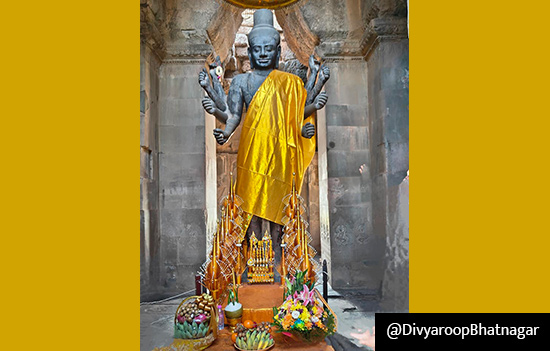 Murti of Vishnu in sanctum at Angkor Wat Temple, Cambodia.
The Khmer world offers one of the most powerful examples of this cultural exchange. Sanskrit inscriptions, temple architecture, royal rituals, and sculptural traditions reveal the deep presence of Indian thought in Cambodia’s sacred and political landscape.
The Pallavas and Cholas, in particular, played an important role
in this wider movement of ideas. Pallava script and architectural forms influenced
the development of writing systems and temple styles across the region, while
the Cholas strengthened maritime links through trade, diplomacy, and religious
patronage. These exchanges helped shape monumental sacred spaces such as those
of the Angkor region, where Indian deities, traditions, and devotional forms got
transformed through a distinctly Khmer artistic vision.
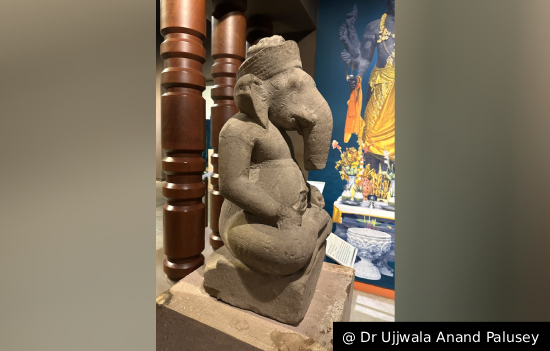 For example Ganesha, Khmer vision, Angkor National Museum.
Within
this broad history of Indic influence, the
depiction of Karaikkal Ammaiyar in Khmer temples is especially significant.
Read about Khmer Art
A revered Tamil Śaiva saint and one of the earliest women poets of the Bhakti tradition, Karaikkal Ammaiyar’s presence in Cambodian sacred art points to the movement not only of grand religious systems but also of deeply devotional and regional expressions from Tamil Śaivism. Her image in Khmer temples invites us to look beyond kings, empires, and monumental architecture, and to explore how personal devotion, Tamil sacred memory, and feminine spiritual authority travelled across the Bay of Bengal and found a place within the visual culture of Angkor.
Among
the many sacred images that travelled from India to Southeast Asia, the figure
of Karaikkal Ammaiyar is one of the most moving. She appears small, thin,
intense, often seated at the feet of Nataraja, holding cymbals or watching his
cosmic dance with complete devotion. In the great temples of Cambodia and north-eastern
Thailand, this Tamil woman saint entered Khmer stone and became part of the
visual language of Shiva worship.
Karaikkal
Ammaiyar, born as Punitavati in Karaikkal, was one of the earliest and most
revered women saints of Tamil Shaivism and is one the
sixty-three Nayanmars. Her story is
remembered through Tamil Shaiva tradition and later narrated in the Periyapuranam.
Such was her greatness that Appar, Sambandar, and Sundarar refused to step on
the holy soil of Thiruvalangadu because Karaikal Ammaiyar had scaled and walked
across this sacred land. Out of supreme respect for her deep devotion, they
avoided walking with their feet where she had trodden.
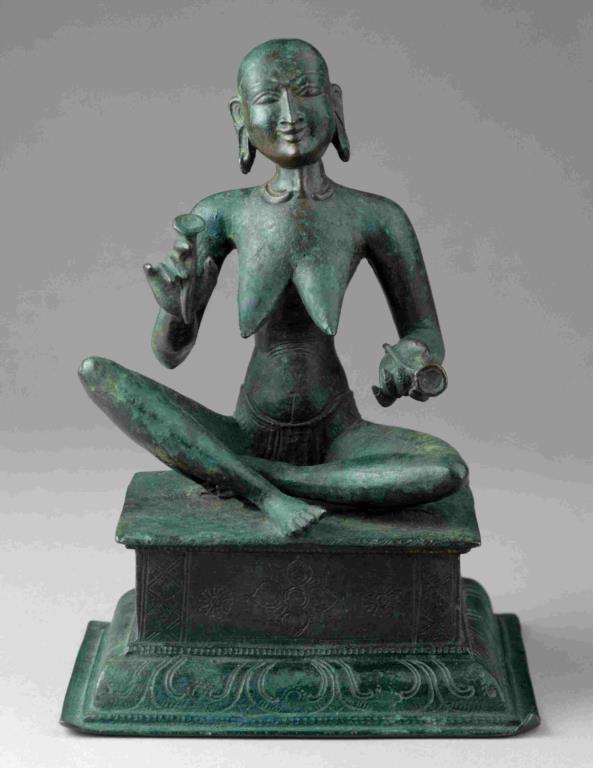 Karaikkal Ammaiyar. Courtesy Wikipedia Commons.
She was born in a prosperous mercantile household in the Chettiyar community and was married to a merchant. Her life changed after the famous mango miracle, when her husband recognized her divine nature and withdrew from ordinary marital life. Punitavati then prayed to Shiva to remove her bodily beauty and grant her a skeletal, ghost-like form so that she could remain beyond worldly attraction and serve him alone thus –
“With this decision of my husband, may Thy grace bless me with a skeletal form—a pei—so that I may praise You forever, removing the beauty that has come through this flesh.”
By
the mercy of Shiva, Punitavati lost her beautiful human form and received the
skeletal form i.e. venerated even today by this world and the worlds above. As
the spring of divine knowledge arose within her, when the soul united with
Shiva, she composed the Arpudha Tiruvanthaadi. In this sacred hymn, she
sang of becoming one with the Ganas who praise the lotus-petal-like feet of the
Lord. Later, she also sang the Irattai Mani Malai Andhaadi, consisting
of twenty verses, with alternate verses composed in the same poetic form.
Filled
with yearning to reach Mount Kailash, she began her journey towards the sacred
mountain. At last, she reached the surroundings of the holy peak. Unwilling to
place her feet upon the sacred abode of the Almighty, she ascended Mount
Kailash on her head.
To bless the entire world, the Lord came before His devotee and uttered, “Ammaiye!”—meaning “Mother.” Thus did Punitavati transform into Karaikkal Ammaiyar. She fell at His holy feet and praised Him, saying, “Oh Lord! My Father!”
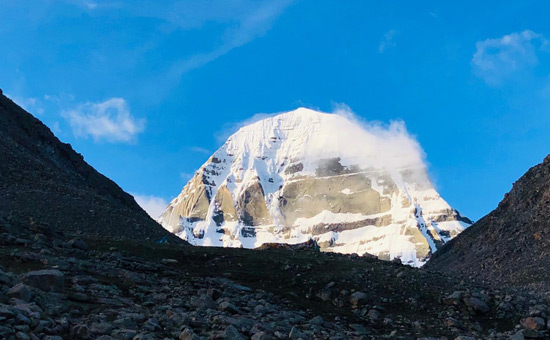 Mount Kailash. Pranams.
He then instructed her to remain in a state of bliss by singing of Him when He danced in the southern town of Tiruvalankadu. Obeying His command, Ammaiyar came to Tiruvalankadu, once again walking on her head. When she beheld the Lord’s dance that transcended the universe, she sang in divine ecstasy the Mutha
Narpadhikam, beginning with “Kongai Tirangi.” The dance of Shiva, whose matted locks were wet with honey from fresh flowers, placed her in a state of eternal bliss beneath His holy feet. She then sang another Tiruppadhikam, “Etti Ilavammikai,” and remained forever in that exalted sacred place.
This
chosen form of Karaikkal Ammaiyar is important.
In
many religious traditions, holiness is shown through beauty, ornament, youth,
or royal posture. Karaikkal Ammaiyar overturns that expectation. Her thin body,
sunken form, and intense gaze are not signs of rejection; they are signs of
freedom. She chose not to be looked at as an object of worldly admiration. She
wanted only to look at Shiva. She becomes the devotee who walks on her head to
Kailasa because she feels the holy mountain should not be touched by her feet.
Shiva receives her with affection and grants her wish: to remain near his
dancing feet, singing his praise. This is exactly how she is remembered in
sculpture.
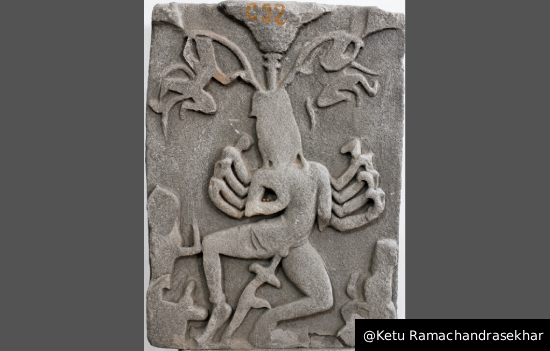 Bapuon Style, 11th Century-Battambang Provincial Museum.
In
Chola bronzes and temple reliefs, she is often shown as an emaciated female
devotee, sometimes holding cymbals. She is close to Shiva Nataraja, as a
participant in the dance. She keeps rhythm. She witnesses. She sings.
Karaikkal
Ammaiyar usually appears as part of a group scene with Shiva Nataraja, not as
an independent image. This is different from Tamil Nadu, where she is also
found in individual bronze and stone forms.
In
Khmer art, her position is often fixed on the left side of the scene. She
appears either as a skeletal female demon-devotee with pointed breasts,
sometimes playing cymbals, or as a seated female saint in an audience-like
gesture.
The earliest important Cambodian example is Banteay Srei in Siem Reap Province. Built in 967 CE, Banteay Srei is famous for its delicate pink sandstone carvings and its Shaiva dedication. On a pediment showing Shiva’s cosmic dance, Karaikkal Ammaiyar appears at the left corner. One may describe her with large round eyes, open mouth, prominent teeth, and a thin demonic form.
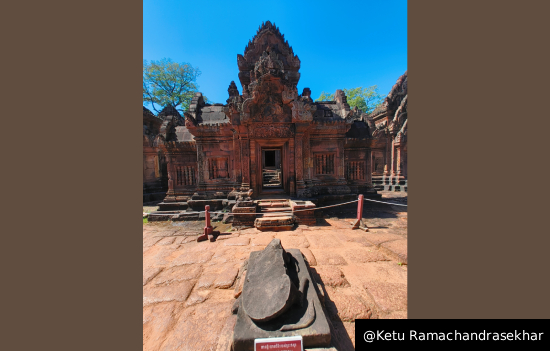 Banteay Srei.
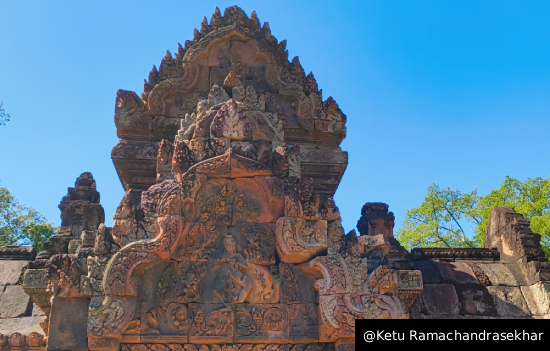 Banteay Srei. Bottom left is Karaikkal Ammaiyar.
From
Banteay Srei, the trail moves westward to Battambang Province. Battambang is
especially important because two temples associated with Karaikkal Ammaiyar,
Vat Ek Phnom and Vat Baset, are located there.
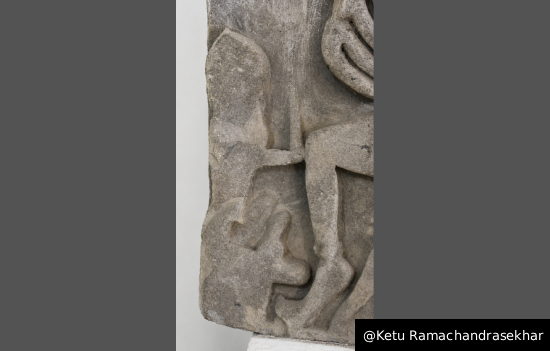 Karaikkal Ammaiyar Bapuon Style, 11th Century-Battambang Provincial Museum.
Historically,
Battambang also reminds us that the cultural map of the Khmer world is older
than modern national borders.
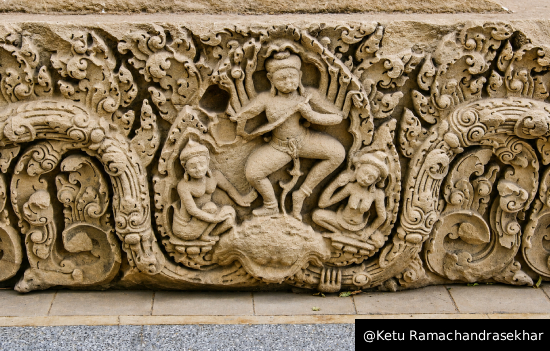 Shiva with a string instrument - Devi and Ammaiyar-Battambang Provincial Museum.
Temples
that are now in Cambodia and Thailand once belonged to a wider Khmer sacred and
political landscape. Karaikkal Ammaiyar is found in
Cambodia and in north-eastern Thailand, especially in temples shaped by Khmer
art and Shaiva worship.
Vat
Ek Phnom, an 11th-century temple associated with the reign of Suryavarman I, is
today largely ruined. This is a common challenge in temple studies. Sometimes
the image survives clearly; sometimes it survives as a broken form, a museum
object, or a scholarly reference waiting to be studied again.
Vat
Baset gives a clearer example. A lintel from this site shows Dancing Shiva, and
near him appears a thin seated female devotee identified as Karaikkal Ammaiyar.
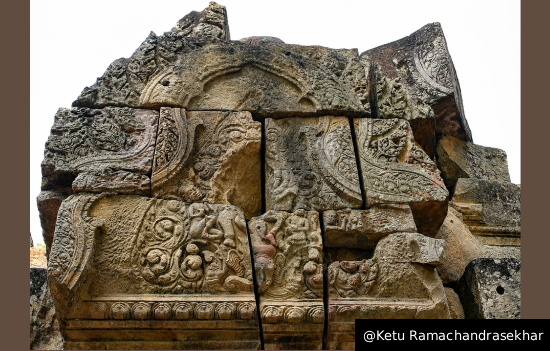 Vat Baset Temple.
There
is also the question of instruments. In some panels, another figure near Shiva
appears to play a drum resembling the Tamil muzhavu, possibly an oru
mugha muzhavu, a single-faced percussion instrument. This shows that Tamil musical heritage, not only Tamil
religious iconography, travelled into Khmer temple art.
Other Cambodian sites also preserve or suggest Karaikkal Ammaiyar’s presence.
These
include Preah Vihear, Phnom Chissor, Phnom Thma Doh in Takeo Province, Preah
Theat Baray in Kampong Cham Province, Prasat Sneng Krabei Chaung in Preah
Vihear Province, and a relief now in the Phnom Penh Museum. At Prasat Sneng
Krabei Chaung, Shiva appears in a ten-armed dancing form, and a seated female
attendant with pointed lean breasts is identified as Karaikkal Ammaiyar. At
Preah Theat Baray, she appears near Brahma, gazing at the cosmic dance. At
Phnom Thma Doh, though the lintel is damaged, the female demon-like figure at
the far left of the Nataraja scene is identified as Ammaiyar.
These
repeated appearances suggest that Khmer artists knew a stable iconographic
formula: Dancing Shiva, divine or semi-divine
attendants, musicians, and the Tamil woman saint who sits near his feet.
The presence of Karaikkal Ammaiyar in northeastern Thailand
widens the story.
Prasat
Phimai in Nakhon Ratchasima Province, one of the largest Khmer monuments in
Thailand, contains a Nataraja pediment in which a thin female figure appears at
the far left. Although Phimai later had a strong
Buddhist association, its sculptural program includes Hindu imagery, including
Shiva. The attached paper identifies the figure as Karaikkal Ammaiyar
and places the work in the Angkor Wat style of the 12th century.
At
Prasat Phanom Rung in Buriram Province, a grand hilltop Shiva temple, another
Dancing Shiva panel includes a damaged female figure with pointed lean breasts.
The surrounding iconography supports her identification as Karaikkal Ammaiyar.
A lintel from Prasat Ku Suan Taeng, now associated with the Phimai National
Museum, also shows Dancing Shiva with Brahma and Ganesha as musical companions,
while a fierce seated female figure appears on the left. Peter de Bruijn
identified this figure as Karaikkal Ammaiyar. Another example appears at Prasat
Narai Cheng Veng in Sakon Nakhon Province, where a seated woman near Ganesha
appears in a Nataraja scene.
At
this point, one question naturally arises: how was
a Tamil woman saint carved in Cambodia and Thailand?
The
answer cannot be reduced to one event. Cultural movement is usually more
layered.
The
Chola age created a powerful maritime background. Tamil merchants, temple
networks, priests, artisans, royal diplomacy, Shastric learning, Shaivagama
ritual systems, and sea trade all worked together over generations. Images
travelled with people, but also through memory, ritual manuals, songs, portable
bronzes, and the prestige of temple culture.
The
Chola connection is still crucial. From the 10th to 12th centuries, the Cholas were one of the most powerful maritime forces
in the Indian Ocean. Their ports connected the Coromandel Coast with Sri
Lanka, Southeast Asia, and China.
Nagapattinam is especially relevant. It was not only a Chola port
but also a religious and commercial meeting place. It connected South India
with Southeast Asia and China. This connection is crucial for Karaikkal
Ammaiyar because her life story itself is tied to a mercantile coastal world:
Karaikkal and Nagapattinam, ports, traders, wealth, hospitality, and the
movement of people across the sea. (distance between two towns is app 14 kms).
The
Chola naval expedition of Rajendra I against Srivijaya in 1025 CE is often
remembered as a dramatic military moment. But it should not be seen in
isolation. Scholars have placed it within the larger framework of Asian
maritime commerce and the Indian Ocean trade system. Tamil merchant guilds such
as the Ainnurruvar, Manigramam, Nanadesis, and Anjuvannam moved through South
India, Sri Lanka, Southeast Asia, and even China.
One of the strongest pieces of evidence for Tamil merchant
activity in Southeast Asia is the Tamil inscription from Barus in Sumatra, dated 1088 CE,
associated with the Ainnurruvar merchant guild. Studies of South Indian
merchant guilds show that such groups were not small private traders; they were
organized commercial bodies with temple connections, endowments, internal
regulations, and long-distance networks.
Here the Chettiyar connection becomes meaningful.
Karaikkal
Ammaiyar belonged, according to tradition, to a mercantile community. Her
father Dhanadattan is remembered as a wealthy trader of Karaikkal, and her
husband Paramadattan was also connected with trade, often associated with
Nagapattinam. Traditional accounts describe Karaikkal as a flourishing port
town, alive with overseas commerce, and Dhanadattan as one of its leading
traders.
This
mercantile background helps us read her Southeast Asian presence more sensitively.
The same coastal society that produced Karaikkal
Ammaiyar also produced merchants who crossed the Bay of Bengal. Tamil
traders did not carry only cloth, spices, pearls, metals, and luxury goods.
They carried temple habits, devotional memory, ritual obligations, language,
poetry, and patronage practices. Merchant guilds were often donors to temples.
They built, endowed, and sustained sacred institutions. When such communities
settled or traded abroad, they did not leave their gods behind.
There
is another important point. Trade routes do not only move commodities; they
move prestige.
During
the Chola period, the temple-centered culture of Tamilakam had enormous
artistic confidence. Brihadisvara at Thanjavur, Gangaikonda Cholapuram, and many
other temples gave monumental form to Shaiva devotion.
Nataraja
became one of the most powerful images of Shiva. Karaikkal Ammaiyar, already
cherished in Tamil devotional tradition, became closely associated with this
visual world. When Khmer artists adopted or adapted the Nataraja theme, they
also adopted the devotional circle around him. Ammaiyar came with the dance.
This
is why her appearance in Cambodia is so valuable. It is a marker of a very
particular transmission. General Indian influence cannot fully explain her. Her
presence suggests that Khmer artists, patrons, or
ritual specialists had access to a Tamil Shaiva iconographic tradition in which
she was linked to Dancing Shiva.
At
the same time, Khmer artists did not merely copy Tamil forms. They translated
them into their own artistic language.
In
Tamil Nadu, Ammaiyar may be shown individually, seated with cymbals, or placed
below Nataraja. In Khmer art, she becomes part of a rich pediment composition:
Shiva dancing at the center, divine beings and musicians around him, and
Ammaiyar seated at the edge or near the left side. Her form may be more demonic
in one temple, more saintly in another. This flexibility shows that the Khmer
world received the image, understood its broad meaning, and made it its own.
The
role of Battambang and the Thai-Cambodian border
region is especially interesting in this regard. North-western Cambodia
and north-eastern Thailand preserve many Khmer temples where Shaiva imagery
remains strong. Present-day borders divide Cambodia and Thailand, but the
temple culture points to an older world of shared artistic and religious
imagination.
Prasat
Phimai, Phanom Rung, Muang Tam, and other sites
show how deeply Khmer art extended into what is now Thailand. The
repeated appearance of Karaikkal Ammaiyar in this zone suggests that Tamil
Shaiva elements travelled into the wider Khmer religious sphere, not merely
into one royal capital.
Her
form also carried a profound spiritual message.
In ordinary social life, a woman from a wealthy trading family might be expected to remain within the roles of daughter, wife, householder, and bearer of family honour. Karaikkal Ammaiyar passes through these roles but is not confined by them. She becomes a poet, a renouncer, a witness of Shiva’s dance, and eventually a trans-regional icon. For an online magazine audience, this is one of the most powerful ways to present her: she is not a marginal figure sitting at the corner of a sculpture; she is a woman whose devotion crossed the sea.
The
journey of Karaikkal Ammaiyar from Tamil hymns to Chola bronzes and from Chola
sacred culture to Khmer temples tells us that Bhakti had movement. It had
ships. It had patrons. It had sculptors.
So, when we stand before a Dancing Shiva panel in Banteay Srei, Vat Baset, Preah Vihear, Phimai, or Phanom Rung, we should look carefully near Shiva’s feet. There, often small and easily missed, sits Karaikkal Ammaiyar. Her body is thin, but her presence is vast.
She
carries the memory of Tamil Bhakti, the sound of cymbals, the devotion of a
woman who wanted nothing but Shiva, and the maritime world that carried her
image far beyond the Tamil coast.
To read all articles
by author
Also read
1.
Saiva Temples in
Cambodia
2.
Six days of INDIC
Heritage in CAMBODIA
3.
Angkor National
Museum, Cambodia
4.
The India Cambodia
connection
by late Vimla Patil
5.
Ramayana in
Cambodia
6.
Hindu symbols in
Thailand
album
Author Dr. Ketu Ramachandrasekhar is the Director- Knowledge Products, at Siddhanta Knowledge Foundation lending his expertise to the development and deployment of IKS across Academia. He is also the Co-Founder of Bharat ke Wow an initiative committed to the promotion and preservation of Indian Art, History, and Culture. His academic journey, deeply rooted in Indian Epistemology, culminated in a Doctorate, earning him the prestigious Prince of Wales Medal for scholarly excellence at the University of Madras. Beyond academia, he has been on the stage as an actor in Sanskrit dramas produced by Samskrita Ranga and has authored several books on Indian Culture and Heritage. Recognized as an INFOSYS Fellow under BORI’s Academic Development Programme, Dr. Ramachandrasekhar’s contributions extend into interdisciplinary domains such as Neuro-Aesthetics and Indian Rhetorics. Passionate about ancient wisdom, he conducts workshops and classes on Tantragama. He attributes all his achievements to the guidance and blessings of his Guru, Vidya Vachaspati Brahmashri Goda Venkateshwara Shastri, whose teachings continue to shape his intellectual and spiritual pursuits.