- Know about the Gavri festival celebrated by the Bhils of Udaipur region. Mainly
it is the worship of Goddess Gaurja (Gauri) and Shiva.
This article was
first published in the Bharatiya Vidya
Bhavan Journal.
The Gavri festival has been celebrated for the last 400 years by the Bhil
community in the Udaipur region of Mewar. They have moved from jungles to the
villages and cities, but the tradition continues.
The festival goes on for 40 days, starting from the day after Raksha Bandhan.
Mainly it is the worship of Goddess Gaurja (Gauri)
and Shiva. The community has established temples of Gaurja Mata everywhere. For
the purpose of celebration, they form a group of several families, wherein each
family organises the festival by rotation.
The celebration is a confluence of Dharma, Bhakti, Tapa, dance and drama
skills. Generally, there are about 30 members in each team; however any person
can join in the observance of the vrata associated with the event. Children
also participate.
In the temple of Gaurja, two priests stay permanently in the service of the
deity. Those taking part in Gavri have to follow certain rules. They have to
sleep on the floor and are not allowed to sit on chairs, wear shoes, or consume
green vegetables. They eat once a day and the married men among the devotees
have to stay in the temple for 40 days.
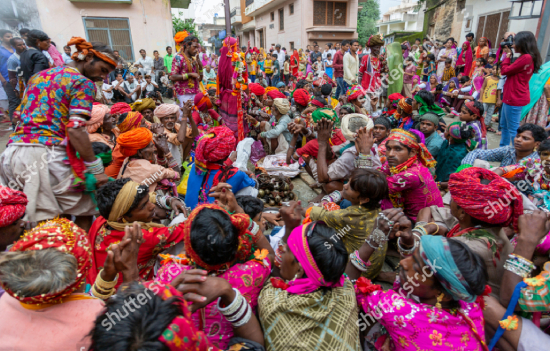
Some of these vows are similar to those for devotees
undertaking a pilgrimage to Sabarimala in Kerala. After
worship of Ma Gourja, the group proceeds to the place where they are invited to
perform. All roles are played only by men.
Suitable costumes and make-up are available and the participants don
appropriate make up for their roles. The musical instruments used are dholak, manjira,
thali, ghungru etc. Masks are also used, where required.
At the site of the performance, a stone slab with a trident carved on it, a big sized earthen dhoopdan and a bundle
of iron chains are kept. There are specifically designated persons to look
after this aspect and they wear similar turbans. The majority of dialogues are
in the form of poems or songs. Many jaikara in the name of various gods and goddesses
are also chanted.
First Ganesh Vandana is done and thereafter
singing of bhajans for pleasing Sri Krishna.
Short plays (called khel) are enacted, which are related to religion, history
and comedy.
Considering Gavri performance as a meritorious act, individuals, businessmen
or groups book the performances in advance for a particular date. Wealthy
people may even invite 12 groups to perform on the same day and in the same
area, when the bigwigs of the Bhil community are present. The best team is
given a prize and clothes for the main members. On special request, Gavri is
also performed during the night.
On the last day of the celebration, Gauri and Shiva seated on a 1.2-1.5 m high clay elephant are carried in procession in the neighbouring area. A Chal Murti is also carried on a wooden plank.
Finally, the clay idols are consigned to the waters of a pond/lake. In the evening,
there is a community dinner for all the families of the group. The next day,
the head of the family which acted as host for Gavri, arranges lunch or dinner
for his friends and relatives.
Thus ends this long festival on a very joyous note.
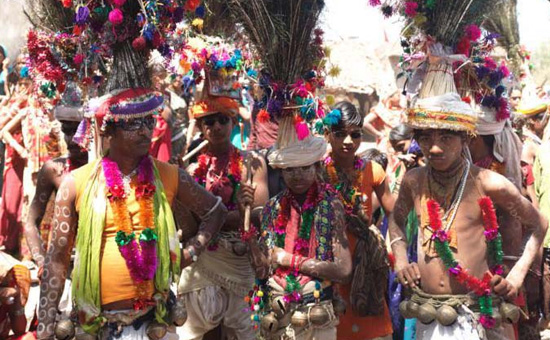 Kavant Fair near Baroda in Gujarat.
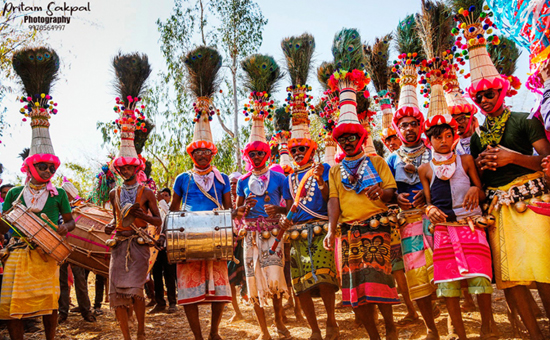 Kathi Holi near Nandurbar, Maharashtra attracts Bhil community from neighbouring states too.
This article was first published in the Bhavan’s Journal, March 1-15, 2026 issue. This article is courtesy and copyright Bhavan’s Journal, Bharatiya Vidya Bhavan, Mumbai-400007. eSamskriti has obtained permission from Bhavan’s Journal to share. Do subscribe to the Bhavan’s Journal – it is very good.
Also read
1.
Kavant
Fair Gujarat is a festival of celebration and love
2.
Album
Kathi Holi, Maharashtra