- This piece includes historic relations between
India and Iran, Why do Indian Shias visit Iran? India Iran relations through
the 1990s up to 2019? How India and Iran can work together to co-create a
brighter future?
My earlier article on subject was Winners and Losers in US Iran War 2026 Read on.
Ever since the U.S. Iran War started some have expressed sympathy for Iran citing century old cultural relations. One does not know if such sympathy is a result of anti-Americanism or genuine sympathy for Iran.
Either way this article takes a peep into old
relations, events of last 70 years and how the two countries can have a
mutually beneficial relationship once U.S. sanctions are lifted.
Historic relations between India
and Iran
Persian was the official language of India
till about 1837. A large number of Persian words are found in Urdu because of
which these words are found in many Indian languages. Most Indians do not know
the origin of these words.
Urdu poetry up to the fourth quarter of the
19th century was just a reflexion of Persian poetry. Nothing in it but a few
common words, inflexions, postpositions and verbs were in Hindi. The Urdu poets
thought and wrote in terms of Persian poetry, the references were things,
events and ideas of Persia and Arabia. Indian Muslims derive a sense of
identity with Islam by the use of Urdu Read History of Urdu
It is invaders who brought Persian language to
India. Can the language be a symbol of relations between India and Iran?
Alexander is popular in Iran/Bollywood with
the name Sikander, actually a Persian word. B N Goswamy wrote in The Tribune, “Alexander’s is a prominent presence in some of the greatest works of Persian literature: from the Shahnama of Firdausi to the Khamsa-s (quintet) of Nizami and Khusrau.” Read Joo Jeeta woh Chandragupta Maurya Because
Bollywood uses a lot of Urdu they use the word Sikander. The name cannot be a
symbol of relations between India and Iran.
The Parsi community fled Iran for India. India
is their home country today. Their Zoroastrian religion cannot be a symbol of relations between India and Iran.
Prof Lokesh Chandra wrote The
Cousin Cultures of India and Iran , “The Iranian statue
of Surya or Sun-God wearing a long coat, with a sacred girdle, and knee-high boots, has been worshipped by Indian kings. He had a special name Mundira-svami and the word Mundira is found in Iranian texts from Khotan. The Munirka village in Delhi and Modhera Sun Temple in Gujarat remind of the name Mundira. The Sun God at Konark, Orissa in Iranian drapery and boots is famous.”
Why do Indian Shias visit Iran?
An apolitical Shia friend wrote, “Many Shia Muslims go to Iran primarily because Iran is the world's largest Shia-majority country and holds great religious significance in Shia Islam. Religious pilgrimage: Iran is home to important Shia holy sites, especially the shrines in cities such as Mashhad, which contains the shrine of Imam Reza, the eighth Shia Imam.”
Fast forward relations to the
1970s
Being part of the Western nation grouping the
Shah of Iran was not favourably disposed towards India and an open supporter of
Pakistan on Indo-Pak disputes. Source
With the Iranian revolution in 1979, Islam became an important part of the country’s landscape and Ayatollah Khomeini became the head of the Shia community worldwide including of those in India.
Ayatollah Khamenei visited India around 1981. “His India tour initially included Karnataka to inaugurate an Iranian-funded hospital. However, according to local accounts, then Supreme Leader of Iran Ayatollah Imam Khomeini directed him to include Kashmir in the itinerary to meet Aga Syed Yousuf Al‑Safavi, a senior Kashmiri
Shia religious scholar who had supported the Iranian Revolution.”
Deccan Herald
He also visited Kashmir Valley and urged Sunnis and Shias to unite. “After the Leader’s speech, it was common for Shias to pray at Sunni mosques and would pray before Sunni prayer leaders with no fear. Sunnis would pray at Shia mosques, too. This unity was an outcome of that 15-minute speech made by Ayatollah Khamenei.” Source
What was the impact of Shia Sunni unity as mosques only an expert on
Kashmir can tell?
“Khamenei’s visit can be viewed within the broader historical continuum of Kashmir’s ties with Persia. For centuries, the region’s spiritual and cultural life was shaped by Persian Sufi saints like Mir Sayyid Ali Hamadani (14th century), whose teachings influenced Kashmir’s transition to Islam and introduced Persian arts, literature, and learning.” Deccan Herald and also read Indian Express
report
He assumed office in 1989. “In his speeches and writings, Khamenei also lauded pre-Partition Indian leaders such as Maulana Abul Kalam Azad and poet Muhammad Iqbal, reflecting his engagement with South Asian intellectual history.” Indian Express
report
This did not endear him to many in India.
Read Indian Muslims protest Khamenei’s death
Kashmir
was called LITTLE IRAN due to cultural and linguistic similarities.
This
could a reason why students from Kashmir go to Iran to study medicine. Sources
say that Iran provides students with scholarships.
In 1990, Ayatollah Khamenei expressed: “Look how everywhere in the world where there is a Muslim community, they receive a much harsher treatment compared with others. Kashmir is a contemporary example for this. Muslims there speak out their rights. Anyone who is informed of what Kashmir has gone through knows what the Muslims of Kashmir express is nothing but truth and justice.” Source
What people forget is that in the 1990s, India
was under pressure due to the terrorist movements in Kashmir and Punjab and
alleged human right violations. Then, India
did not forcefully tell the world that Hindus were the target of brutal
killings.
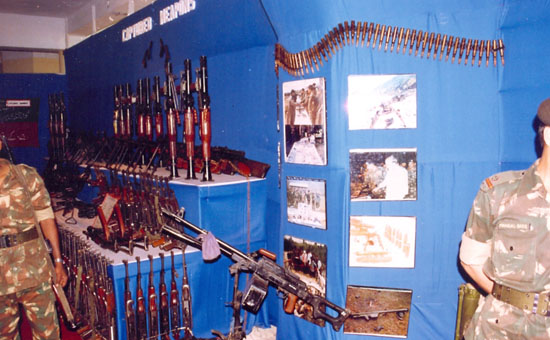 Arms seized from Kashmiri Terrorists. Indian Army Exhibition, Mumbai. 1998.
In 1994, “the Organisation of Islamic Cooperation (OIC), backed by influential Western nations, was poised to sponsor a resolution at the United Nations Human Rights Commission (UNHRC). This resolution aimed to condemn India for alleged human rights violations in Kashmir and sought to impose sanctions.” Source Iran blocked the resolution. Also read this Tweet
on X
In 2005, the Manmohan Singh government voted
against Iran in
IAEA (International Atomic Energy Agency) which made Iran furious. Source
“In 2010 the Indian government summoned Iran’s envoy to New Delhi to protest what it called Tehran’s meddling in India’s internal affairs. That was a response to Khamenei’s message to hajj pilgrims in which he called on Muslims worldwide to support Kashmiris.” Source
Iran is a Muslim country and selectively chooses like others to portray
itself as a protector of Muslims. Has it
ever spoken about condition of Uyghur Muslims in China?
In 2012, the Israel Iran fight spilled on to India. “A ‘sticky bomb’ was attached to vehicle of an Israeli diplomat's wife near the Israeli Embassy in New Delhi.”
In 2017, the Eid-ul-Fitr address was posted on Khamenei’s official website on June 26, carried the headline, “Everyone should openly support people of Yemen, Bahrain, and Kashmir: Ayatollah Khamenei.” The last such statement on Kashmir had come in 2010 when Ayatollah Khamenei mentioned Kashmir along with Gaza, Iraq, Afghanistan, and Pakistan. This statement followed India's vote against Iran at the International Atomic Energy Agency (IAEA), and New Delhi was seen by Tehran to be descending towards the United States.” Source
In 2019 (post amendment of Article 370), Iran’s Supreme Leader Ayatollah Ali Khamenei also called for India to show restraint. On August 21, Khamenei tweeted: “We have good relations with India, but we expect the Indian government to adopt a just policy towards the noble people of Kashmir and prevent the oppression & bullying of Muslims in this region.” Source
According
to this 2026 ThePrint report, “In just a week, nearly Rs 18 crore was collected across Kashmir, excluding the amount directly deposited in the account of the Iranian embassy, with people in Budgam alone contributing Rs 9.4 crore, followed by Baramulla (Rs 4.5 crore) and Srinagar (around Rs 2 crore), sources.”
Notwithstanding the above Iran maintains a
delicate position w.r.t Kashmir and its ideological ties with the Islamic
Republic of Pakistan. If Iran believes that Kashmir is to be resolved in
accordance with the UN Security Council resolutions, it must read the
Resolution and the Simla Agreement. Read Here
Is Iran radicalising Indian
Shias?
Abhinav Pandya, chief executive officer of the Usanas Foundation, an Indian foreign policy and security think tank wrote, “As Iranian protestors demanded an end to the Islamic Republic and Ayatollah Ali Khamenei’s dictatorship, India’s Shi’i community took to the streets to support Khamenei and his regime. The Union Territories of Jammu and Kashmir and Ladakh, together home to 1.5 million Shi’a, witnessed Shi’a protests and processions between January 13 and 15, 2026, with crowds shouting slogans in Persian and Urdu against Israeli and U.S. intervention.” Read 1
Relations between Pakistan and Iran swing like a pendulum but their underlying unity is Islam. Having said that, note that Iranians accepted Islam but not its Arab version whilst the Pakistanis are trying to be closer to Saudi’s version of Islam. In a contemporary sense, the Saudi-Pakistan Defence Agreement might have surely caused disquiet in Teheran.
How India and Iran can co-create
a brighter future?
If the U.S. sanctions are permanently lifted
opportunities are huge.
One, India can re-start importing oil from Iran again, once amongst her top
suppliers. It is closer to India so lower transport cost. Purchase will help
India diversify her crude purchases further. Iran might be happy that India is
buying less crude from rival Saudi Arabia etc. Two,
India and Iran can set up facilities for manufacture of fertilisers. Three, opportunities for Indian companies to bid
for reconstruction contracts in Iran including laying of railway tracks.
Four, improved India Iran relations will keep Pakistan restrained
benefitting the region. Notwithstanding the current affection between Iran and
Pakistan there are serious issues between the two neighbours. Five, development of the Chabahar port shall allow
India direct access to Afghanistan and countries of Central Asia besides giving
Iran a port of importance, reduce its dependence on Pakistan. (during recent
U.S. economic blockade Iran used Karachi port for imports). Six, Iran would want close relations with a
country i.e. India, that has a large Shia population in order to counter Sunni
Saudi Arabia and Turkey.
Seven, Iran was a large importer of Basmati Rice. If imports resume it shall
benefit India. Eight, is the India Middle East Europe Economic Corridor (IMEC). This is beneficial to concerned countries, is a counter to China’s BRI, but can run into a roadblock if Iran Israel relations do not improve.
For this to happen Iran has to make some
sacrifices, focus on building comprehensive national power and stop hating Israel.
Will export of Brahmos missiles to the UAE affect relations with Iran?
India has very strong relations, across
various sectors, with the UAE so its purchase is one more example of
co-operation. Moreover, India did not object when Iran entered into a strategic
partnership with China. Read Implications of Iran China deal for India India has to accept that China is Iran’s insurance policy against the West.
Conclusion
Iran’s target is Israel/U.S. It wishes to be a protector of Muslims, in competition with Saudi Arabia and Turkey. Because of its anti-U.S. approach China is a natural ally. That is not going to change for a while.
It might talk of solidarity with Kashmiri
Muslims but has to balance that with its strategic interests.
Even though Iran has sided with Islamic countries in the past, it has not been overtly anti-India like say Turkey. There exists scope for co-operation if both countries can navigate through differences whilst building on each other’s strengths.
I wish to thank learned friends who helped
with insights.
Also read
1. Is Iran radicalising the Indian Shia?
2. How many died during the Kashmiri Terrorist Movement
3. India Iran Relations – Iran embassy site
4. India Iran Relations in current context by S Dalal
5. Challenges in India China relations
6. Winners and Loosers in the India Iran War
7. The wonder that was Khorasan