- How Indians view China and Pakistan? Comparing China and Pakistan strategy. How China supports Pakistan? How Pakistan hurts India? Answers to these questions will decide fate of the movie Battle of Galwan.
Dhurandhar
released (primarily in Hindi) on 5/12/25 is a super hit. Part 2 scheduled to
release on March 19, 2026 in five languages whilst Battle of Galwan release
date is April 17, 2026. Distributor of both movies is Jio Studios.
Dhurandhar1
has Ranveer Singh and Akshay Khanna playing lead roles while Galwan has Salman
Khan with supporting cast not consisting of known names.
After
success of Dhurandhar stakes are high for part 2 and Galwan because of Salman,
both releasing within weeks of each other.
The
focus of this article is how Indians perceive China and Pakistan. That shall partially
decide the fate of part two and Galwan.
How do Indians perceive China as an enemy?
Till China’s invasion of Tibet in 1950, China was not even India’s neighbour. It was only post the annexation of Tibet and the 1962 war that China entered dining table discussions. Nearly two generations have passed since 1962 War so few might be aware of what happened then, except that India lost. To read about 1962 war in brief
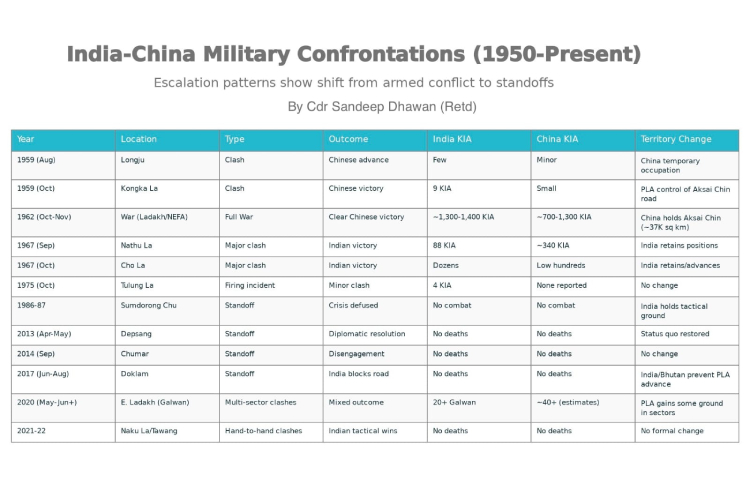
Since then, India and China had serious border skirmishes at many places, notably Sumdorong Chu Valley in 1987 and 2017 at Doklam.
However,
in 2020 the Chinese entered Eastern Ladakh which led to a hand to hand fight
between Indian and Chinese soldiers causing deaths on both sides. PM Modi
visited Ladakh then and made inspiring speeches to soldiers. One thought that
war was eminent since emotions in India were high.
Except
for 1962, 1987 and 2020 India and China did not have significant clashes. Also,
even when border clashes took place in the last few decades they did not result
in deaths unlike the case of Pakistan sponsored terrorism where security forces
from all parts of India lost their lives. These deaths caused anguish and
anger.
Nevertheless, in 2020 it was the first time that the post 1980
born Indians realized that China is also an enemy nation.
There
was an anti-China sentiment and calls made to boycott China made brands. On its
part, the government issued Press Note 3 that required
every Chinese investment in India to come under the government route meaning approval.
The
anti-China sentiment lasted for a while only. Perhaps, the quality price
equation of Chinese products made consumers overlook the Galwan deaths. Consumers
bought MG Motor vehicles perhaps believing it was now a Jindal Group company.
What people forget is that Shanghai
Automobile Industry Corporation still has a 49% stake in MG India or
thereabouts.
Having said the above, Cdr Sandeep Dhawan (Retd) shares a table of India China Military Confrontations 1950 to date.
Comparing China and Pakistan strategy
The Chinese strategy is to hit India indirectly by propping up Pakistan.
The intent is to keep India tied down to the sub-continent and prevent her from realising its potential, fulfil its global ambitions or be a competitor to China. China’s military build-up forces India to increase its defence budget to provide for a two front war.
Actually,
Indians hardly understand the Chinese unlike Pakistan that
was part of India till 1947 where language, culture, food, etc. are nearly
similar. People to people exchange with Pakistan is much more, due to partition
and flow of pilgrims. Most Indians know that its culture and thought went to China.
Lastly, then unlike China there is rivalry
between India and Pakistan in sports i.e. cricket and hockey. Till 2004, when
Saurav Ganguly team defeated Pakistan in Pakistan India invariably lost to
Pakistan. Post 2004, India has not looked back.
Thus, China came across as a strategic rival devoid of emotion. The reality is that Pakistan would never have made terrorism a tool of foreign policy had it not been for Chinese support, some credit goes to the U.S. too.
India does not figure too high in the Chinese scheme of
things. For them, the U.S. is a global rival.
Conversely,
Pakistan was born out of hatred for Bharat. If the country succeeded, it meant
the Pakistan experiment failed so India had to fail too. Pakistan’s national identity revolves around resisting India. Read Who
was responsible for Partition
Here are some examples of Chinese support for Pakistan
1. In the 1990s, China designed and supplied the heavy water Khusab reactor, which plays a key role in Pakistan’s production of plutonium.
2. “By using Pakistan as a funnel for nuclear materials entering North Korea, China could strengthen the DPRK’s military capabilities without jeopardizing its intelligence sharing partnership with the United States.” 3
3. “China has defended Pakistan from international criticism of its nuclear weapons capabilities and its non-proliferation track record.” 3
4. It was only after Pakistan obtained nuclear capability in
1987 did Pak sponsored terrorism in Kashmir erupt in 1990.
5. Former high commissioner to Pakistan
G Parthasarathy wrote in 2016, Remember that
China protects “Pakistan-based terrorist groups like the LeT and JeM from international sanctions in the United Nations.”
6. Author Sandeep Dhawan (retd) wrote, “In 2018, China had sold Pakistan an advanced tracking system that could boost Islamabad’s efforts to improve ballistic missiles, called multiple independently targetable re-entry vehicles (MIRVs), a type of missile carrying several nuclear warheads that can be directed toward different targets, according to The South China Morning Post. In 2017 Pakistan deployed a Chinese-made low-to-medium altitude air defense system (LOMAD).” 4
7.
During Operation Sindoor, China provided satellite images to Pakistan.
8. China had supplied weapons to insurgent groups of Assam and
Nagaland.
China’s anti-India moves are not so visible that they come in the public eye.
A former diplomat commented, “We rarely criticise any country other than Pakistan, and now Bangladesh. Putin's invasion of Ukraine and Trump's Maduro kidnapping have elicited mild expressions of concern and Xi's bullying of Taiwan has gone unnoticed. BJP thinks that Pak-bashing will get it votes, while Congress thought that Pak-appeasement would get them votes. In the case of China, our business men love its cheap imports, many intellectuals are in awe of it and politicians find no public resonance of the kind Pakistan draws.”
The threat from Pakistan is primarily of terrorism , from China it is also military and economic. The former evokes emotions, the latter much less.
Power asymmetry changes perception. How a
country views another depends heavily on relative power.
India and Pakistan were locked in a
competitive rivalry till say 2000 (Y2K) post which India moved ahead. Today,
India is competing with China. Pakistan cannot coerce China; India historically
could and did defeat Pakistan (1971).
Examples of how Pakistan hurt India
since its birth in 1947
1. Birth of Pakistan associated with violence
e.g. Partition.
2. Wars of 1948, 1965, 1971, 1999 and 2025
Sindhoor.
3. Cross Border Terrorism esp. Punjab and
Jammu & Kashmir.
4. Hijack IC814 1999.
5. Parliament Attack 2001.
6. Godhra
Read Did Godhra
save Pakistan by Col Athale
7. 26/11/ Mumbai Terror Attack
8. Export of Fake Currency to India.
9. Pakistan
gifted Shaksgam Valley - 4,853sqkm of Indian territory to China. It was used to
construct the Karakoram Highway that connects China to Gwadar Port in
Balochistan today. Read What
stops me from loving Pakistan
Till
Surgical and Balakot Air strikes, the Indian government rarely responded to terror
attacks by Pakistan. On top of that, Bollywood
showed Pakistanis in good light not to forget moves by the Aman ki Asha
groups.
Public
anger got accumulated till Dhurandhar showed the truth and gave vent to the
anger. Read Will
DHURANDHAR change how Bollywood portrays Pakistan With China however, there is no such emotion
and anger.
Dhurandhar 2 might suffer since it has raised
expectations.
A lot will depend on how Battle of Galwan is made! Is it able to raise the emotion quotient? If the focus is more on
giving Salman a hit it could hit a wall.
Also read
1.
The way around China
2.
Pakistan is a distraction – China is the real enemy
3.
The long history
of Pakistan North Korea nexus
4.
Are China and
Pakistan Siamese Terror Twins
5.
Why China is soft
on Masoor Azhar
6.
Indian
public opinion and China 2020 article
7.
Indians
see China as a threat and opportunity 2013 article
8.
Indians
view of other countries 2023 article