- This article, through 17 points simply tells how the Government of India and people of India can understand Chinese moves. With China, observe-be alert-talk less-let actions speak-keep the gun dry and reduce your strategic dependence.
“ITBP Director General Shatrujeet Kapur Thursday confirmed that face-offs between Indian and Chinese troops had occurred at multiple locations in Arunachal Pradesh and that the situation continued. Kapur’s comments came over a month after India and China held talks amid reports of tensions in Arunachal Pradesh’s Taksing area.” Indian Express
Is this the last of many incursions in Arunachal Pradesh or
Ladakh? NO.
Yet many learned Indians that believe that telling China that
relations are subject to peace on the border will change their attitude.
Hindus, read India, first had this eternal quest for peace with Pakistan and
now the same attitude with China. Attitude with Pakistan has changed. Will out
attitude towards China change?
With India Salami slicing is the strategy – acquire heights/area bit by bit.
At the outset, state that am no China expert. I did interact with Chinese colleagues in 1997-98 when our employer’s regional headquarters was Hongkong and in 1998 did Kailash Yatra. I accept that China is ahead of India in many spheres including electric cars, manufacturing esp. of battery systems and rare earths.
This article attempts to help Indians realize that friendship with
China is a dream for the following reasons, presented not in any order of
priority.
1. Aim is to contain India and Box it to the Sub-continent.
Between themselves China & Pakistan want to
keep India tied down with border and internal problems. 13 The Chinese will try to co-opt Bangladesh, Nepal, Maldives and Sri Lanka in this endeavour.
China uses proxies to fight its battles
and supports them through arms, financial resources and support in global
forums. For e.g. Pakistan to control India, Iran to limit U.S. power in the
Gulf and control supply of crude by the GCC countries.
2. Democracy in India has to fail for
Dictatorship to survive in China.
“A
successful and democratic India, which rises fast and eliminates its poverty in
a reasonable period, is the biggest challenge to the legitimacy of China... The competition between India and China is, therefore, an ideological one,' argued K Subrahmanyam, a leading strategic thinker and father of External Affairs Minister Dr S Jaishankar. Source Rediff.com 8
China uses the existence of democracy in the West and India to its
advantage. How would require a separate article.
3. Tibet is at the heart of the India China
dispute.
Mao Zedong confirmed this line of thinking when he told a Nepalese delegation in 1964 that the – “Major problem between India and China was not the McMahon Line, but the Tibetan question”. 10
India’s border problems started after the Chinese invasion of Tibet. Tibet is at the
heart of the India China dispute
4. Scan Respect for Agreements by China
Former foreign secretary Kanwal Sibal wrote in March 2017, "China has repeatedly demonstrated that either it does not respect the agreements it signs or interprets them as it wants. In 1996 it agreed to 'clarifying the alignment of the LAC in those segments where they (the two sides) have different perceptions'. In 2002 (when the writer was Foreign Secretary) China decided to repudiate this agreement unilaterally."
13
Never trust the Chinese
and believe that signing an agreement will ensure China fulfilling its side of
the deal. 8 Always define terms in agreements for e.g. “PM Narasimha Rao accepted the term LAC with no mutually agreed definition in 1993 during his Beijing visit when the two sides signed the Agreement on the Maintenance of Peace and Tranquillity along the LAC.” Source Tribune India
5. India must prepare for a post Dalai Lama
scenario
The death of the respected Dalai Lama and determination of his
successor could be a difficult point in India and China relations for which
India must be prepared.
6. China wants to the Home of Buddhism and
seeks tacit control of Bodh Gaya
China might support those Indians who wish to gain management
control of Bodh Gaya Temple, the place where Buddha attained enlightenment.
Read Why
India is setting up the Dalai Lama Centre for Tibetan and Indian Ancient Wisdom
7. China shall Weaponize everything at a time
of its choosing
The items could be water, rare earths, tunnel-boring machines, magnets,
active pharmaceutical ingredients, I Phone engineers etc.
It wishes to control strategic levers of the world’s economy, including India’s.
China is good at identifying consumer needs for e.g. in India, the shop owner asked me if I wanted a cheaper Chinese made Box File or made in India. This way it generates employment in China and kills India’s domestic SME sector.
8. Know your history India
China knows India’s contribution to its civilization better than Indians do so realizes potential. A few examples –
Author and Scholar Prof Shashi Bala wrote
Indology in China, “In the seventh and eighth centuries, the Chinese were fascinated by the new science of astronomy, calendrical knowhow and mathematics in Sanskrit texts which were known as the “P’o-lo-men or Brahmin books.” “Xu Fangcheng is a famous Chinese Indologist who systematically introduced 50 Upanishads into China by translating them in a poetic style classical Chinese.” 18
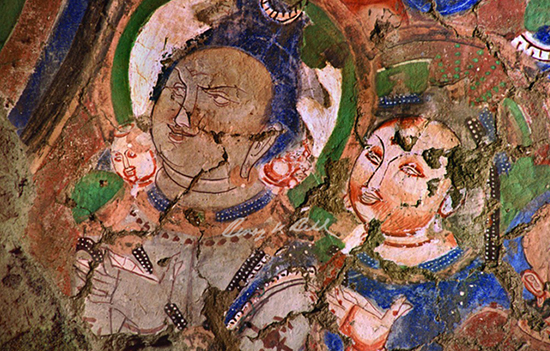 Shiva and Parvati, Mural, Kizil Caves, Kucha, Xinjiang Uygur Autonomous Region, c. 6th Century CE, China. Pic Benoy K Behl.
9.
Contribution of Ayurveda to Traditional Chinese Medicine (TCM) by Dr
Arun
“TCM’s foundational text, the Huangdi Neijing (Yellow Emperor’s Inner Canon), was compiled during the Warring States period into the Han Dynasty, between the 4th and 2nd centuries BCE (Unschuld, 1985). This places Ayurveda’s classical system several centuries ahead of TCM in terms of documented development. 17
The dissemination of Buddhist philosophy served
as a vital conduit for the transfer of Ayurvedic knowledge to East Asia. From
the 1st century CE, Buddhist monks translated Sanskrit medical texts into
Chinese and Tibetan. Salguero (2009) provides extensive evidence of Ayurvedic
ideas being embedded into Chinese Buddhist medical treatises, including
concepts of humoral theory, diagnosis, and treatment.
The shared use of Himalayan herbs further reinforce Ayurveda’s foundational role. While
TCM developed its own distinct identity shaped by Daoist and Confucian
principles, its early formulations, diagnostics, and materia medica carry the
unmistakable imprint of Ayurveda.” By Dr Arun Chandan. Read How
Indian Masters Controlled Epidemics in China earlier
10.
Keep India off balance
by raising new demands and incursions regularly.
The recent intrusions
in Arunachal Pradesh are a case in point.
Earlier, days after the 5-point agreement in Moscow China said that it does not accept Ladakh’s Union Territory status and reiterated its 1959 claim line as LAC. Another e.g., at the Global Environment Facility (GEF)
meeting on June 2 and 3, 2020 China claimed Sakteng Wildlife Sanctuary in
Bhutan for the first time.
11. Never forget Chinese declarations because over the long-term it seeks to achieve its objectives. It has become such a big country through acquisition.
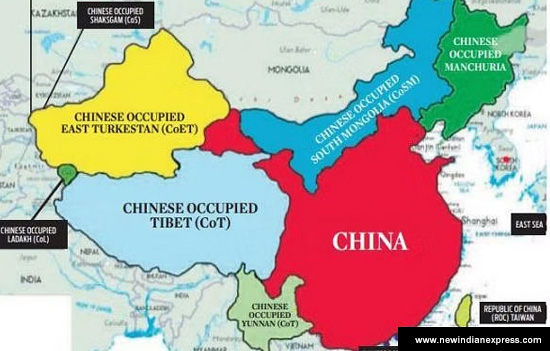
China has increased its size, influence
and world power through acquisitions. Thus, India should not take declarations on
Arunachal/Ladakh lightly. 5
On Chinese approach to acquiring
territory former Ambassador P Stobdan explains it in this India Today article, “China started with its maximalist claim but settled for a minimalist demand to convey that it had compromised—given concessions to its counterparts—without actually losing an inch of territory. The last border settlement was with Tajikistan in 2011, when China claimed 28,000 sq. km but ‘settled’ for 1,158 sq. km, of land east of the Sarekole Mountains. The Tajiks had to cede land and were yet made to feel the victor.” 5
12. Why does China want Tawang?
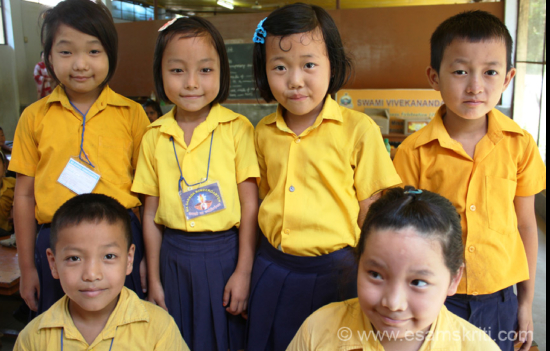 Arunachali kids at Ramakrishna Mission School, Deomali, Arunchal. 2013.
Prakhar Gupta wrote
in Swarajyamag.com, “For
China, control over Tawang is linked to the legitimacy of its hold over Tibet.
It fears that the Dalai Lama may ordain his successor in Tawang.”
I wrote, Tawang’s monastery is said to be the biggest Buddhist Monastery in the world outside of Lhasa. It is a major holy site for Tibetan Buddhists, as it was the birthplace of the sixth Dalai Lama. 8 Obviously, the Chinese see Tawang
within India acting as a magnet for all Tibetans. Strategic
Importance of Tawang
13. China sees India as a hindrance to its
leadership of the Global South.
14. China seeks to achieve its objectives without going to war.
Sun-tzu wrote, “The highest realization of warfare is to attack the enemy’s plans, next is to attack their alliances; next to attack their army and the lowest is to attack their fortified cities.” The
Complete Art of War by R D Sawyer.
15. Monitor Chinese actions more than words.
16. The Chinese aim is to become Superpower 1
nothing more or less.
Any country that prevents achievement of this goal could become a victim of Chinese assault – indirect but attack on numerous fronts. Read Who
won the Russia Ukraine and U.S.A. Iran Wars
17. Chinese always like to have an Upper Hand
Be it occupying the Heights in Arunachal Pradesh so they can
overlook Indian posts or in the India China relationship.
By publicly responding to Chinese provocations
India is playing into their hands. Sometimes silence has your opponents
guessing.
According to Nitin Gokhale, a leading expert on strategic affairs, “Indeed, 55 years after the 1962 war, one can confidently say that the Indian Army has firmly exorcised the ghost of 1962, thanks to a deeper understanding of the Chinese psyche and decisive victories in two major military face-offs since then -- one in 1967 and the other in 1987.
In fact, the stand-off at Nathu La, not very far from the current impasse in 1967, gave the Chinese a bloody nose, just five years after 1962. The other eyeball to eyeball confrontation at Sumdorong Chu in Arunachal Pradesh, exactly 30 years ago too, forced the Chinese to back down from its creeping encroachment.” Rediff.com
Why China wanted to grab Bhutan's land
With China, observe-be alert-talk less-let actions speak, keep
the gun dry and reduce your strategic dependence.
COOPERATE and COMPETE should be India’s approach. Lots of Love.
To
read earlier articles in China
1. Why China does not
go to WAR
2. Explained - US
China SOYABEAN Trade
3. Border Settlement
with China must restore MOUNT KAILASH to India
4. TSANGPO Dams -
Dangers to India and Bangladesh
5. How did China
become such a big country
6. Tamil movie 7AUM
ARIVU was about a Virus from China to Chennai
7. Why is China so
sensitive about Taiwan
8. Why Chinese
incursions in Ladakh
9. Tibet is at the
heart of the India China dispute
10. Why China dislikes
India
11. Are Chinese and
Pakistan Siamese Terror twins
12. China did not ever
enjoy military or cultural supremacy in Asia
13. 2017 Doklam Stand
off
14. Pak is a needless
distraction- China is the real enemy
15. India China War of
1962
16. How India can deal
with a rising Trade Deficit with China
17. Ayurveda Influence
on Traditional Chinese Medicine
18. Indology in China
19. Sikkim-Tibet
border: an historical perspective
20. Why
India is setting up the Dalai Lama Centre for Tibetan and Indian Ancient Wisdom
21. The
Indian Origin of Tibetan Medicine
22. Strategic
Importance of Tawang