- Ahoi Ashtami is a
mother's prayers for the health, safety, longevity and well-being of her
children. Know about the tradition, worship of Ahoi Mata, associated fast and
rituals & reading the Traditional
Ahoi Ashtami Artwork. It is celebrated mainly in North & Central India.
Exploring the tradition, rituals, symbolism
and enduring cultural significance of a North Indian festival.
Among India's many traditions celebrating
motherhood, Ahoi Ashtami occupies a special place. Observed predominantly in
North and Central India, the festival is dedicated to Ahoi Mata, revered as the
divine protector of children. It celebrates a mother's prayers for the health,
safety, longevity and well-being of her children.
Observed on the eighth day (Ashtami) of
Krishna Paksha in the Hindu month of Kartik, Ahoi Ashtami is also a festival of
remembrance, repentance and compassion. Behind the observance lies a folk
narrative that carries a message extending beyond motherhood: respect for all
living beings and responsibility for our actions.
1. The Tradition: An Unintended Act and a
Mother's Remorse
The Ahoi Ashtami Vrat Katha has several
regional variations, but its central narrative is one of remorse, devotion and
divine forgiveness.
According to a popular version, a mother of
seven children went into the forest to collect soil, traditionally red earth
(geru), for preparing and decorating her home before Diwali.
While digging, she accidentally disturbed the
burrow of a wild animal and killed its cub. The animal, often identified as a Syahu
(a porcupine-like creature), was devastated and cursed the woman.
Soon afterwards, the woman's children died
mysteriously. Overcome by grief and guilt, she sought guidance and advised to
worship Ahoi Mata and observe a fast on Kartik Krishna Ashtami.
Her sincere repentance and devotion eventually
brought divine grace, and her children were restored.
The story is not merely about a mother's
suffering. It draws attention to the consequences of even unintended harm and
the importance of compassion towards other forms of life. Its message of repentance
and forgiveness remains relevant across generations.
2. Ahoi Mata: The Divine Protector
Ahoi Mata is worshipped as the goddess who
protects children and safeguards family well-being. In some traditions, she is considered
a manifestation of Shakti or Goddess Parvati.
The name Ahoi is popularly associated with
averting an anhoni — an unforeseen or unfortunate occurrence.
Mothers invoke her blessings for their
children's long life, good health, happiness and protection from adversity.
The observance is also meaningful for couples hoping to have children,
who may pray to Ahoi Mata for the blessing of offspring.
3. The Fast and Its Rituals
Ahoi Ashtami is traditionally observed through
a fast from sunrise until the evening worship.
Many women observe a strict nirjala vrat,
abstaining from both food and water throughout the day. The fast is generally
broken after the evening prayers and an offering of arghya to the stars.
In some regional and family traditions, the moon is also worshipped.
The principal elements of the domestic puja
include:
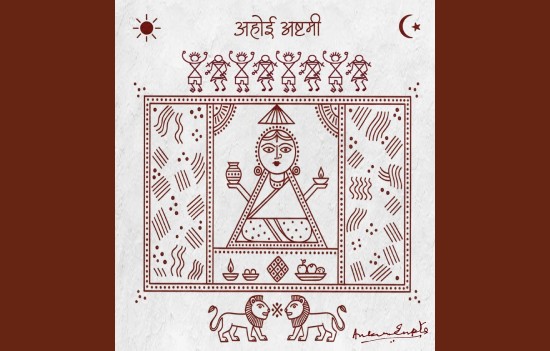
Ashta
Koshthak: An
eight-cornered sacred drawing associated with the Ashtami observance. It forms
the central focus of the traditional wall artwork or puja arrangement.
Ahoi
Mata: The
goddess is depicted at the centre, surrounded by symbolic figures associated
with children, animals and family prosperity.
Syahu
and its offspring: The animal
figures recall the central tradition and the incident that gives the fast its
deeper meaning.
Children
and cattle: These
figures represent offspring, nourishment, prosperity and the continuity of
family life.
Diya
and Kalash: The lamp
and sacred water pot are important elements of the evening worship, accompanied
by fruits, sweets and other offerings.
Syahu
Mala: A
distinctive silver necklace or pendant associated with the festival in some
communities. Traditionally, a bead may be added for each child over the years,
making it a personal record of maternal devotion.
The precise arrangement and the accompanying
rituals vary across families and regions.
4. Reading the Traditional Ahoi Ashtami
Artwork
The traditional Ahoi Ashtami poster is much
more than a decorative religious image. It is a visual record of the beliefs,
rituals and stories associated with the festival. Its various elements carry
symbolic meaning:
The
central goddess: Ahoi Mata,
the divine protector of children.
The
eight figures: Associated
with the Ashtami observance and prayers for offspring.
The
sacred shrine: The
setting for worship, with lamps, a Kalash and offerings.
Lakshmi
and Ganesha: Often
included to invoke prosperity, wisdom and
The
Syahu: The animal
central to the traditional story of unintended harm and repentance.
Children
and animals: Reminders
of family welfare, fertility and respect for life.
The imagery is not completely uniform.
Different communities and families follow their own conventions, and the number
and arrangement of figures may differ.
Nevertheless, the traditional poster serves an
important purpose: it makes the festival's story and ritual vocabulary
accessible to successive generations.
5. Two Artistic Interpretations: Tradition and
Reinvention
The visual representation of Ahoi Ashtami
offers an interesting opportunity to explore how Indian folk traditions can be
preserved through changing artistic expressions.
The
traditional interpretation
The colourful traditional poster follows the
familiar devotional style. Rich reds, yellows and greens, elaborate borders,
divine figures, ritual objects and numerous symbolic details come together in a
composition used for the evening puja.
It brings together the goddess, the children,
the Syahu, cattle, offerings and accompanying deities in a single visual
narrative.
A
contemporary folk-art interpretation
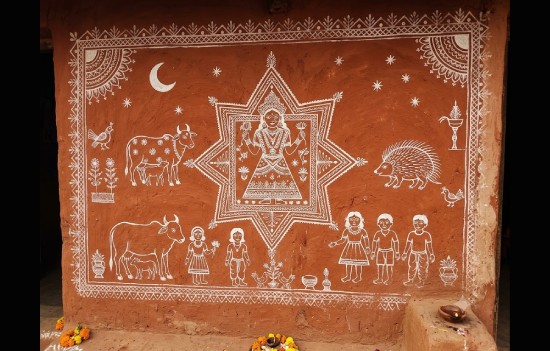
My second interpretation takes a more
restrained approach.
Inspired by traditional Indian wall paintings,
it uses a terracotta-coloured background and simple white line drawings. Ahoi
Mata occupies the central position within an eight-pointed geometric framework.
The moon and stars establish the evening setting, while the Syahu, cattle,
children, birds and ritual offerings complete the composition.
The intention is not to replace the
traditional poster but to reinterpret its essential elements through simpler
forms.
The two visuals, though very different in
appearance, preserve the same cultural narrative.
6. A Festival Rooted in North and Central
India
Unlike pan-Indian celebrations such as Diwali
and Holi, Ahoi Ashtami has a more concentrated geographical presence.
It is particularly observed in Uttar Pradesh,
Haryana, Punjab, Delhi, Rajasthan and Madhya Pradesh, with the tradition also
continuing among Indian families living overseas.
Other parts of India have their own
observances associated with maternal protection and children's well-being.
These include Shashti traditions in Bengal and Gauri-related observances in
parts of southern and western India.
Although the rituals and deities differ, the
underlying concern for children's health and family welfare is shared across
many Indian communities.
7. Beyond the Fast: The Enduring Message
Ahoi Ashtami is undoubtedly a celebration of
motherhood and maternal devotion. But its folk narrative offers a wider
perspective.
The mother in the story does not intentionally
cause harm. Yet the experience teaches her to recognise the value of another
creature's life. Her remorse becomes the beginning of a journey towards
forgiveness.
Perhaps this is the festival's most meaningful
lesson.
Motherhood is not only about protecting one's own children. It also
represents compassion, responsibility and sensitivity towards life around us.
In an age when the relationship between humans
and nature needs greater attention, this centuries-old folk narrative has a
message worth remembering.
Ahoi Ashtami thus brings together maternal
love, faith, repentance, forgiveness and respect for all living beings.
May
Ahoi Mata bless all children with health, happiness, safety and long life, and
may the spirit of compassion remain at the heart of every home.
Visuals and artwork: Ankur Gupta. The
traditional Ahoi Ashtami poster and the contemporary folk-art interpretation accompanying
this article are intended to document and celebrate the visual heritage of the
festival.
To read all articles
by author
To read all articles
on Indian Festivals