- The
book India at War is a must read for students
of Indian Military History. This piece starts with a book review followed by key
points chapter wise. Period is arrival of Portuguese till 1948 India Pak War. Is
included why Europe wanted to discover India, valour of Indian soldiers in
Haifa-World War 1 and 2, British role in making Gilgit part of Pakistan and where
did the Rupee Economy extend in the Middle East? GOI should name airports after
the Unsung Heroes of the 1947-48 Wars.
The
last book review was a spiritual book AALOLIKA, this one is
India at War. It took me some time to get to read the book but once started
finished in a couple of days. Style is informative, fast-paced and clear.
Chapters are well structured. Notes at end of the book are very useful.
The books tells about India’s contributions during World War I and II, something i.e. not much written about. So also, the book has insights on the British strategy before and when they ruled India not to forget their role around 1947. Their role does anger me but I believe the Brits will pay for their karmas.
The
first India-Pak war is covered in some detail esp. the contributions of unsung
heroes of the Armed Forces because of whom Pak/British plans failed.
Many hithero unknown facts are shared in the book that I found enrichening. The Epilogue asks questions that provoked thought and for which am still searching for answers for e.g. did you know that the Indian Rupee was the currency in some Middle Eastern countries. “It was the official currency in Aden, Muscat, Oman and Persian Gulf protectorates (modern day UAE, Kuwait, Bahrain, Qatar) till 12 years after Indian independence.”
Author
wrote that Indian soldiers confronted some of the most formidable armies of the
20th century, the Ottomans-the Germans and the Japanese. They fought
them with equal if not greater courage. Never knew about this at all.
Foreigners
occupied our lands but could never conquer the consciousness that defines us.
That is probably due to Sanatana Dharma and is why India is called a
Civilization more than a nation state. Invaders could never kill our martial
soul.
This
book makes us remember the past, good and bad. In 1895 Swami Vivekananda said, ““Now days everybody blames those who constantly look back to their past. It is said to be the cause of all of India’s foes. So long as they forgot the past, the Hindu nation remained in a state of stupor and as soon as they have begun to look into their past, there is on every side a fresh manifestation of life. It is out of this past that the future has to be moulded”.
Former CDS General A Chauhan wrote, “It ignites a deeper appreciation for our centuries old military heritage and cultural values.”
I
share some interesting points made in the book chapter wise. Discussed idea of
sharing some key points with author Shri Pillay, who agreed. Credits and
copyrights always lie with author and publisher Vintage, Penguin Random House. What is in inverted commas is verbatim, others
paraphrased or insights.
Ch 1
A Confession before the Investigation
1. “True Ahimsa is possible when one has the power to strike and chooses not to.”
2. Indians helped ensure the sun never set on the British Empire. “From unforgiving passes of Afghanistan in the 19th century. Dense jungles of Burma between 1885 and1887. In 1900 suppressed the Boxer Rebellion in China. Guardians of the Suez Canal in 1914. World War I sands of Mesopotamia, fighting along the Tigris in 1916 and Macedonia in 1918. In World War II, bitter fighting at Donbaik in 1943 during the Arakan campaign.”
3. “Major Chandrakant recalled the rescue of Abu’l Baha, the son of the founder of the Bahai Faith. The Lotus Temple in Delhi became a symbol of a deep, living debt of gratitude shared with those gallant Indian soldiers.”
4.
Role of Naik Jadunath Singh, PVC in saving
Naushera i.e. ahead of Rajouri.
5. Book tells about the ‘Great Game’ played by the British in 1947-48.
6.
By making Gurdaspur part of India, the British provided India with a road route
to Jammu and Kashmir, that proved to be a blessing later.
7.
The Maharaja of Bikaner leveraged his “state’s accession and the security of the Gang Canal to ensure these vital territories and gateways to Kashmir remained within India’s borders.” Wise move.
8.
Evil designs in Gilgit Baltistan orchestrated
by Major Brown&W Cunningham.
We must realize the inevitability of war and be prepared at all
times.
Ch 2
The Myths We Inherited
1. “Be delaying the declassification of the Radcliffe Award until 17 August, two days after the handover of power, the British ensured they would not be held responsible for the carnage they had engineered.”
2.
The British perhaps hoped that India would be in a state of civil war and the
British would be requested to return. Thank you Sardar Patel & V P Menon.
3.
A True Warrior is one “who could preserve dharma, maintain the equilibrium of the word and restore order.”
4.
How did the British occupy our lands and minds?
Ch 3 The Wonder that was India and Portuguese
1. India was known for its “spices, cottons and calico textiles, coconut products, high-carbon crucible steel and metallic zinc.” The Europeans disliked the profits earned and wanted to buy them directly/cheaper hence need to discover India. In 1202, Italian mathematician Fibonaaci, praised the Hindu Arabic numeral system. Indian medicine and surgery spread to Europe. Pancatantra was popular all over. “Significant was India’s mastery of the maritime environment.”
2. “India was a source of profound intellectual and spiritual fascination.”
3.
In 1814 was established in Paris was the first Sanskrit University in Europe.
4. “The myths would have us to believe that the Europeans arrived as enlightened benefactors to civilize a fragmented, chaotic land.”
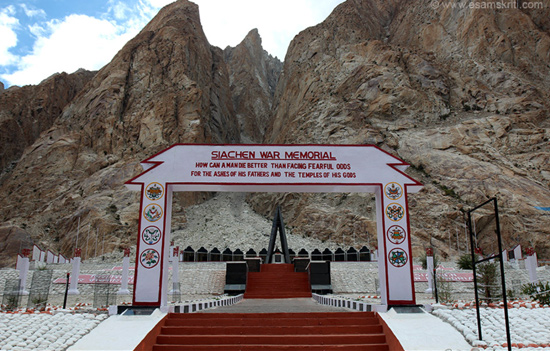 War Memorial at Siachen Base Camp. 2016.
Ch 4 The Sacred Mandate That Shaped History
1. India’s treasures reached Europe through the Red Sea and Persian Gulf and the Silk Route across Persia and Central Asia. “When the Ottomans captured Constantinople in 1453, they made trade expensive.”
2. To prevent Spain and Portugal from fighting the “Pope drew an imaginary line across the world (Treaty of Tordesillas 1494) by which Spain looked West and Portugal focussed south.” Thus, Vaso da Gama sailed from Lisbon in 1497 and guided by an Indian pilot reached the Malabar Coast in May 1498.
3. Within 2 decades the economic centre of gravity shifted. “Lisbon replaced Venice and Cairo as the primary gateway for Eastern luxuries into Europe.”
4. Portuguese fought battles with the local kings of the Malabar coast. Thus, Kerala’s coast witnessed the power of gun powder. They infused “commerce with religious militancy and imperial ambition.”
5. “The Portuguese pioneered a system of fortified basis and armed fleets to control trade in distant waters.” The system was later adopted the Marathas by building forts and controlling access into the hinterland.
Ch 5 Enter the East India Company
1.
The Portuguese were defeated by other European powers i.e. French, Dutch.
2. Marthand Varma put an end to Dutch dreams in India. Read by S Unnithan
3. The English started with a foothold in Surat.
4.
The Siege of Arcot in 1751 (TN) and The Battle of Plassey (1757) resulted in a
rise in British fortunes esp. the latter since they controlled Bengal.
5. They “wove traditional religious authority into the fabric of military ritual.”
6.
The Anglo-Maratha wars, Anglo-Sikh wars and Anglo-Carnatic wars saw rise in
control of areas by the British. Lands annexed by policies like doctrine of
lapse.
7.
Major S Lawrence arrived in 1748 in Madras, transformed the Army which laid the
foundation for what would become the Indian Army later.
8.
The British introduced a regiment system and loyalty to the paltan (regiment).
9.
Reforms in the Indian Army in 1796 and 1824 along with recruitment of more
Punjabis/Gurkhas increased tensions in the Bengal dominated Army.
From
about 1900-1930 the British increased the number of Muslims in the Indian Army,
mostly from Punjab. Dr Ambedkar gave the numbers in his book Thoughts on
Pakistan. Read more in 1
10. World War I showed that the Indian Army, “once properly trained and equipped, demonstrated its ability to fight alongside the best in the world.”
11.
The Nair Brigade, raised by the rulers of Cochin, Calicut and Travancore later
evolved into the Madras Regiment.
Ch 6 Awakening India from Slumber
1.
Major Famines took place between 1769 and 1875.
2. Indians called indentured labour, supported the British’s economic expansion.
3.
Interaction with British culture and society revitalised Indian society. Pg.
102
4. “British Raj, with all its contradictions and complexities, played a pivotal role in shaping the India we know today.”
5.
Over 1.3 million Indian troops served the British in WW1, across theatres.
6. “WW1 and its aftermath marked an irreversible turning point in India’s national awakening” for e.g. Rowlatt Act 1919 and Jallianwala Bagh killings.
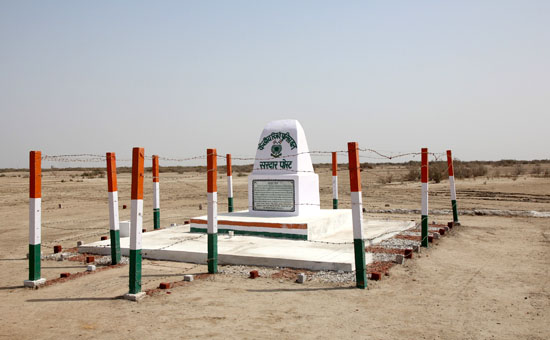 Memorial at Sardar Post, Kutch, Gujarat. 2018. 1965 India Pak War.
Ch 7 The Cavalry Charge that changed the Army
1. 23/9/1918 Battle of Haifa-fought in Palestine by Major Dalpat Singh Shekhawat of Jodhpur Lancers. He is honoured in Israel/India for extraordinary courage. Haifa hosted Abu’l Baha, son of the founder of Bahai Faith.
2. After Major fell in battle Captain B A S Jodha, squadron commander, captured Haifa. It ‘remains a singular feat in military history, when a fortified city was taken by cavalry at full gallop.” They defeated a well-equipped Turkish Army.
3. “This victory broke the might Ottomam Empire & delivered a fatal blow to colonial myth of Indian inferiority.” It also laid foundation of modern day Israel.
Ch 8 Preparing the Masters of Destiny
1. “Israel commemorates the legendry cavalry charge of 23/9/1918, as a pivotal event in the campaign what ended Ottoman control over Palestine.” The Mayor Haifa said in 2025 that it was Indian soldiers, not the British, that liberated city.
Interlude - The Rite of Passage forged between Empire and
Freedom
1. Returning soldiers found little reward for their sacrifice. If they could fight for the British in distant lands, why could they not fight for their motherland? “Jodhpur Lancers, Patiala Sappers, The Bikaner Camel Corps who had fought under their own flags, were disbanded without ceremony.” This caused anger.
2.
The Ghadarites, Sher Ali Afridi, S Sanyal, Bhagat Singh, B K Dutt, Udham Singh,
Savarkar amongst others were symbols of anguish against British rule.
3.
In 1922, the Royal Indian Military College was established in Dehradun. It
created a generation of Commissioned Officers like K.M. Cariappa.
4.
The Indian Military Academy was established in 1932.
5.
In WW2, 2.5 million men, served the British in Western Europe.
6. “When Japan surrendered in 1945, Indian soldiers stood amongst the victors”.
7.
Whilst these victories did Indians proud a war was gathering at home.
8.
The INA trials started at Red Fort. It was Indian officers of the British Army
who came to their defence.
9. “The Indian Soldier had now become the nation’s conscience. They emerged as custodians of freedom.” They fought along with the British in WW2 and perhaps realized their true worth then.
Ch 9 Sun Sets on the British Empire
1.
The story of Razmak Fort 1947, (North Waziristan District of
the Khyber Pakhtunkhwa) where stationed the 1/7th
Rajput Regiment is a must read. Lt Col Bakshi Kuldip Singh headed the regiment.
In 1947 they have to leave for India.
Ch 10 A Collapsing Empire’s Curse
1.
In cricket one can quit when at the top like Sunil Gavaskar. In real life,
rulers rarely do that, Aurangzeb and the British were the same.
2. The British studied India’s divisions & ruled by guile, not valour like Marathas.
3. “The British Empire’s global reach rested on its dominance east of the Suez going up to the jewel that was India.”
4. “India was the administrative hub and economic engine, with the Indian Rupee serving as the official currency for trade from Aden to the Gulf.”
5.
The British realized that could not hold on to India indefinitely hence
siphoned off vast territories like Burma and Aden in the 1930s. With dubious intent
Sindh was delinked from Bombay Presidency in 1936.
6.
When India asked for dominion status in 1931, it got Government of India Act,
1935 that ironically was a key basis for the Colonial Constitution adopted in
1950.
7.
By mid 1940s Indian soldiers of the British Army there was an erosion of their
unquestioned loyalty to the Crown.
8. “It was Mountabatten who advanced the date for India’s Independence from June 1948 to August 1947.”
9.
Independence was a smart British move to retain its influence in the world.
10.
Jinnah left for London in 1930. He returned in 1935, transformed from being a
nationalist to communal spokesperson.
11.
Jinnah was sick, died on 11/9/1948. The British knew about it, the Congress
perhaps did not. Liaquat Khan was assassinated in Rawalpindi on 16/10/1951.
12. Ironically, Jinnah never sold his house in Mumbai’s Mount Pleasant road. Perhaps he expected to return.
Ch 11 Smokescreen set in motion
1. “India was pressurised to pay the entire amount of Pakistan’s asset share, 550 million rupees even though the two nations were at war over Kashmir.”
2.
When Indus Water Treaty was signed in 1960, the World Bank brokered deal made
India pay 62 million pounds for construction of replacement canals & dams.
3. Operation Gulmarg was a British Plan to make Gilgit/Baltistan part of Pakistan. Note China’s CPEC corridor passes through this region.
4.
A brave officer O S Kalkat heard about the plan and at risk to his life informed India’s new government, still under the control of British officers.
5. G&B were leased to the British in 1935 for 60 years. On 1/8/1947 the lease was pre-maturely terminated and reverted to Maharaja’s control. Major Brown arrested the new Governor G Singh and raised a Pakistani flag.
6.
North West Frontier Province and Baluchistan became part of Pakistan through a
boycotted referendum and a military invasion.
7.
There were no airfields in Leh-Ladakh sector. Aim was to cut off access to
region from India.
8.
However, Mountbatten insisted that Gurdaspur be part of India. This move,
knowingly or otherwise ensured India had land access to Kashmir.
9.
When Maharaja Hari Singh did not acceded to Pakistan, they first started an
economic blockade. Two, a rebellion was orchestrated in the Poonch region.
10.
On the night of 21-22 October 1947, thousands of Pashtun tribals, led by
Pakistani forces in civilian shahwar
kameez, stormed the order. The Maharaja’s forces were outnumbered.
Ch 12 From the Frying Pan Into the Fire
1.
How 1/7th Rajput reached Amrtisar from Waziristan is a fascinating
story.
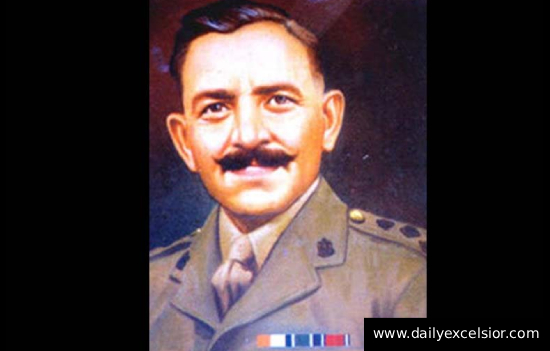 Brig Rajinder Singh, Chief of Staff of J&K State Forces.
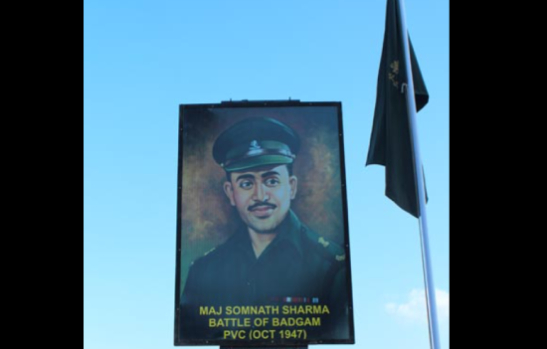 Major Somnath Sharma, PVC. Battle of Badgam. 4 Kumaon.
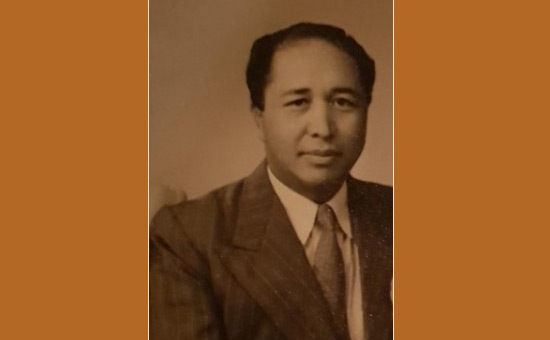 Sonam Narbhu who saved Ladakh in 1948.
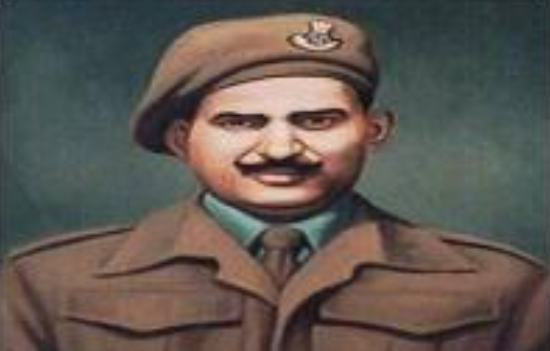 Piru Singh Shekhawat, PVC.
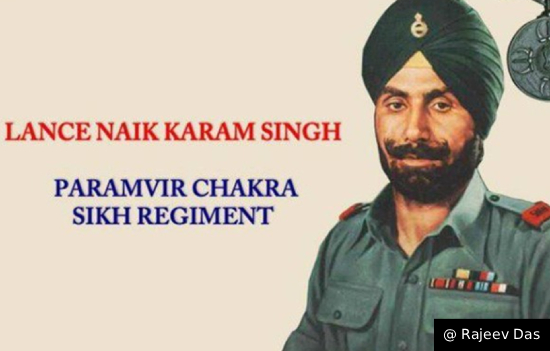 Karam Singh, Sikh Regiment, PVC, 1948 war.
Ch 13 The Immortal Legends who saved Kashmir
1.
When the raiders were enroute to Sringar, Brig
Rajinder Singh ordered blowing up of the Uri Bridge on 24/10/, that
crippled raiders who were coming by truck.
2.
By 27/10/ raiders reached Baramulla where they halted, plundered & killed.
3. Dakota DC3 carrying a company of 1
Sikh under Lt Col Dewan Ranjit Rai reached
Srinagar piloted by Wing Commander K L Bhatia.
4.
Lt Rai ordered 1 Sikh to take on raiders, who were surprised.
5.
Days later, Pakistan launched attack from Gulmarg. This led to Battle of Badgam. Pakis wanted to
capture Srinagar airfield.
6.
Standing in their was 4 Kumaon Regiment led by Major
Som Nath Sharma.
7.
Next Battle of Shalateng on
7/11/1947. Brig L.P. Sen led 1 Sikh
&1Kumaon
8.
Indian Army recaptured Baramulla next day and reached Uri in a week.
9. “The military victory was proof that the newly independent Indian Army posses a strategic sophistication that London claimed was impossible.”
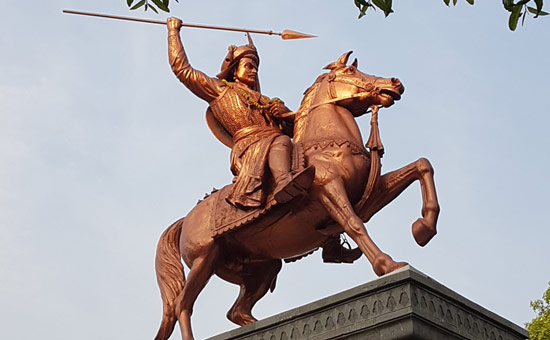 Baji Rao Peshwa never lost a battle in 40 year life. Pic by Dr Uday Kulkarni.
Ch 14 Snatching Victory from the Jaws of Defeat
1.
Brig Usman knew that key to holding Naushera (between Rajouri and Poonch), was
holding high ground at Taindhar. The post was Naik
Jadunath Singh. He was killed in battle (awarded PVC) but “suicidal charge broke the enemy’s morale.”
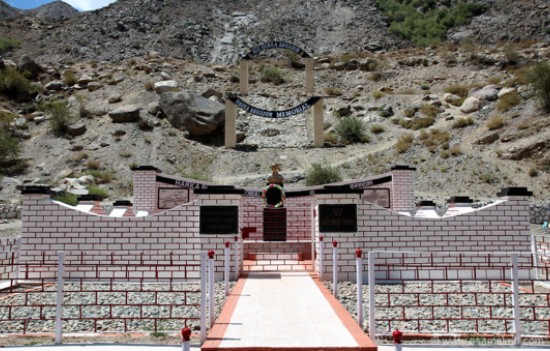 Harka Bahadur Memorial. Army Goodwill School, Kargil. 2016
“During 1948 war the most fearful battle was fought for Khera bridge which connected Kargil with India. Pakistanis had captured Kargil, were well entrenched. The 1/5 Gorkha Rifles were engaged by a strong force of Pakistani defenders at Khera bridge over river Shingo. Capture of bridge seemed impossible till Sub H B Rana & his brave men decided to cross the Shingo river.”
2.
Leh was threatened. The only route thru Zojila Pass was in Paki hands.
3. Only solution was a flight to Leh
which landed on 24/5/1948. The only way to save Ladakh was to open the land route
meaning take control of Zojila Pass.
4.
M5 Stuart tanks dismembered, loaded onto trucks to a base in Baltal. Madras Sappers worked under enemy fire to make a
functional road out of a yak track.
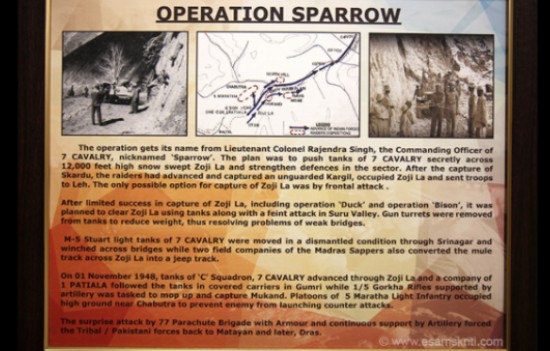 Board at Hall of Fame, Leh that tells about capture of Zoji la Pass nicknamed Operation Sparrow.
5.
On 1/11/48 the reassembled tanks launched attack. Enemy shocked.
6.
Nehru went to the U.N. under Art 35. In January 1949, a ceasefire was agreed.
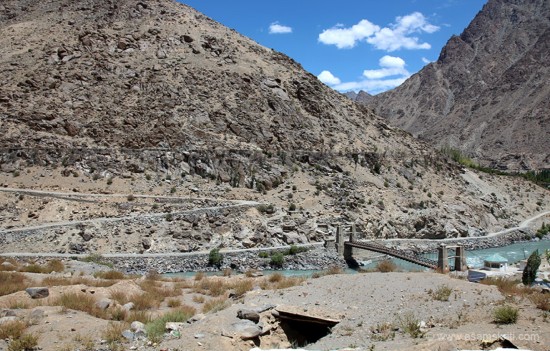 Old Silk route
that connected Kargil with Skardu.
Ch 15 The Unsung Architects of Victory
1.
Besides Brig R Singh, Lt Col Rai, Major S Sharma referred to above it was the Indian Air Force that excelled. Air Comm Mehar Singh
flew over peaks at 24,000 feet without oxygen or charts to reach a never used
air-strip at Leh.
2.
Indian Army Engineers fought with road
rollers and bridge girders too.
3.
Army Service Corps kept it alive.
4. “Maqbool Sherwani, the young man from
Baramulla, misled the raiders with false directions and buying precious hours
for the IAF to land in Srinagar.
5.
Major Prithi Chand who led soldiers over a frozen Zojila to bring ammunition and supplies. “Sonam
Norbu helped design the makeshift airstrip, while a young Chewang Richen won the MVC. “
6.
Indian Army Medical Corps.
7. “The 1947-48 campaign was a civilizational awakening; that shattered many colonial myths.
“The measure of a civilization is how many times it rises after falling.”
See
pics 26 to 30 for 1948 India Pak War 1948.
To
buy book online
Also read
1.
Who was
responsible for Partition
2.
Did Ahimsa get
India Independence
3.
Did Geopolitics force India’s Partition
4. Accession of Jammu
and Kashmir to India
5. Read about Major
Somnath Sharma PVC
6. Read about Sonam
Narbhu
7. Read about Battle
of Shalteng
8. History of Indo
Pak Wars
9. India faces low
intensity conflict not war
10. Decolonization of
the Supreme Court
11. Why
India must remember Brig Rajinder Singh
12. The LION of Tithwal – Piru S S
13. Hall of Fame Museum – Leh