- Know about the
scientific approach to cotton cultivation in Marathwada. It includes recommended
cultivation practices and crop
management techniques. A case study shows these practices led to higher productivity
and profitability.
Cotton is the
backbone of agriculture in the Marathwada region, playing a crucial role in the
livelihood of thousands of farmers. In recent years, significant efforts were
made to improve cotton productivity through advanced agronomic practices, scientific
crop management, and farmer-centric extension systems.
A structured
cultivation approach focusing on plant spacing, canopy management, and balanced
nutrition has shown promising results in increasing cotton yield substantially i.e.
up to 14-16 quintals per acre.
Scientific Approach to Cotton Cultivation
The improved
cultivation method emphasizes maintaining proper plant geometry, timely
pruning, and efficient nutrient management. Instead of allowing unrestricted
vegetative growth, the technique focuses on regulating plant architecture to
divert energy toward boll development. Key practices include:
a. Maintaining
optimal plant spacing
b. Identifying and
removing unnecessary vegetative branches
c. Topping plants
at the right growth stage
d. Applying
fertilizers in a balanced and need-based manner.
These practices
ensure better sunlight penetration, improved aeration, and efficient
utilization of nutrients, ultimately leading to increased boll size and weight.
Understanding Plant Structure
Cotton plants
typically develop two types of branches:
1. Vegetative Branches (Monopodia): These branches emerge early, usually within 40–45 days of sowing, and grow vigorously. They consume a significant portion of nutrients but contribute less to yield. They have thicker stems and upward growth.
2. Fruiting Branches (Sympodia): These branches grow horizontally and bear the cotton bolls. A healthy
plant can develop 12 to 15 such branches which decide the yield.
Efficient crop management
involves removing excess vegetative branches so that nutrients are directed
toward fruiting branches.
Recommended Cultivation Practices
1. Soil Selection
Cotton is a long-duration crop (6–8 months), making soil selection critical. Medium to deep black soils with good drainage are ideal for optimum growth.
2. Sowing Time
Early sowing
during the second or third week of June, immediately after adequate rainfall,
ensures better crop establishment and growth.
3. Plant Spacing
A spacing of 90 × 30 cm is recommended. This allows accommodation of approximately 14,500 plants per acre, increasing plant population and productivity.
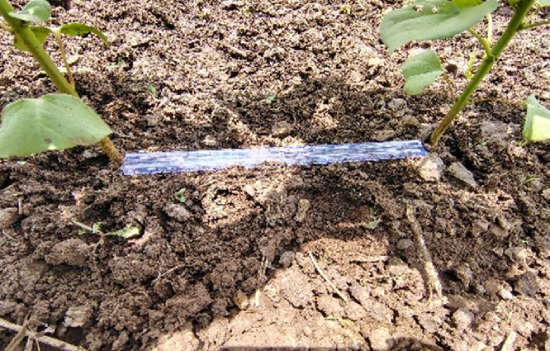 Distance between two plants 30cm
4. Variety Selection
High-quality seeds
with good germination capacity, large boll size, pest and disease resistance,
and high yield potential should be selected.
Crop Management Techniques
1. Removal of Vegetative Branches
Around 40–45 days after sowing, excess vegetative branches should be pruned using appropriate tools. This prevents unnecessary nutrient consumption and promotes reproductive growth.
2. Topping of Plants
At around 90 days
or when the plant reaches waist height, the top portion of the plant should be
removed. This practice controls plant height and encourages lateral growth,
leading to better boll formation.
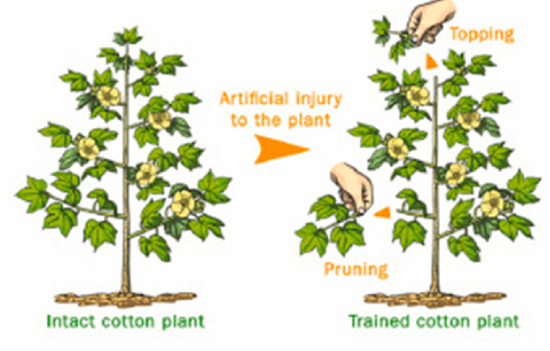 Farmers are happily embracing this technology as it delivers higher yields and better returns.
Implementation at the Local Level
In regions like
Nanded district, Krishi Vigyan Kendra is working closely with farmers to
promote these techniques. Few cotton crop growing villages from different
blocks were selected for field-level implementation. Continuous monitoring and
expert supervision ensure that farmers receive timely advice throughout the
crop cycle.
Objectives and Long-Term Impact
The primary goal
of adopting these improved practices is to:
a. Increase cotton
productivity per unit area
b. Enhance farmers’ income and livelihood security
c. Promote
efficient use of fertilizers and protect soil health
d. Reduce dependency
on cotton imports by boosting domestic production
e. Strengthen the
agricultural economy of cotton-growing regions.
With consistent
adoption of these scientific methods, farmers can achieve sustainable yields
while preserving soil fertility for future generations.
Case Study
Aim - Improving Cotton Productivity through Scientific Cultivation Practices
Farmer Profile: Shri Anand Mundkar, a 30-year-old progressive farmer
from Takali village, Nanded district, Maharashtra. Mb. 776735291
With guidance from Krishi Vigyan Kendra (KVK), Sagroli, Anand adopted an improved cotton cultivation method during the Kharif 2025–26 season on 3 acres of land. The approach focused on closer plant spacing, canopy management, and balanced nutrient use.
The farmer adopted closer spacing, removed excess vegetative branches at 45 days, and performed detopping at 90 days, along with balanced nutrient management. This resulted in a yield of 11 quintals per acre compared to 8 quintals traditionally, marking a 30% increase. The crop showed uniform growth, better boll development, and good-quality produce harvested in 2–3 pickings. Crop residues were managed efficiently. In the summer, groundnut was cultivated as a second crop thereby increasing overall income.
This demonstrates
that scientific practices can significantly improve cotton productivity and
profitability.
Table1: Comparative economics of cotton cultivation between
CS & conventional planting (sample size of 25
farmers)
| |
Package of practice
|
Closure
spacing
90 × 30 cm
|
Conventional planting
(120x45cm)
|
|
1
|
Land preparation
|
5000
|
5000
|
|
2
|
Seed and Sowing
|
3600
|
1800
|
|
3
|
Gap
filling
|
900
|
900
|
|
7
|
Total weeding
|
4000
|
4000
|
|
8
|
Fertilizer
|
5800
|
6500
|
|
9
|
Pesticide
|
6000
|
6000
|
|
10
|
Canopy management
|
2000
|
-
|
|
11
|
Harvesting labour
|
6500
|
6500
|
| |
Total cost of cultivation
|
33800
|
30400
|
| |
Yield(kg)
|
12 qtl/acre
|
8 qtl/acre
|
| |
MSP 2025-26 per kg
|
7800
|
7800
|
| |
Gross income
|
93600
|
62400
|
| |
Net
income
|
59800
|
32000
|
| |
C:B
|
1:2.76
|
1:2.05
|
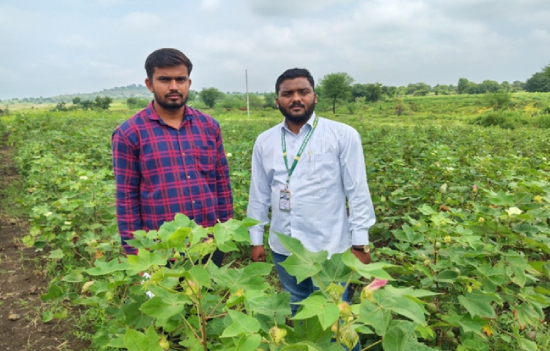 Farmer pic by Anand Mundkar
 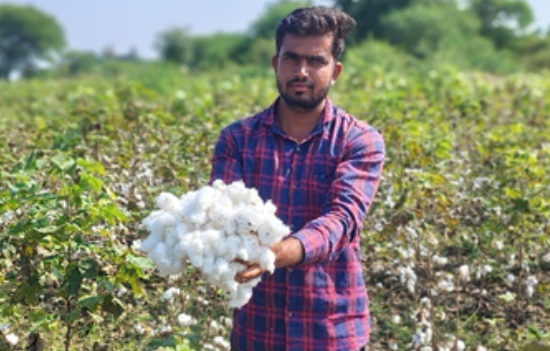 Farmer pic by Anand Mundkar.
Author Mr. Prabhudas Udtewar holds an M.Sc. in Agricultural
Entomology and has actively contributed to the field through research and
extension activities. He is a recipient of two awards and has published three
research papers. He has also delivered two radio talks and participated in
various national conferences.
Currently, he is working as a Young Professional II at Krishi Vigyan Kendra (KVK), Sagroli,
where he is involved in cotton-based field and research activities and farmer
advisory services.