- Who
was Raja Bhoja, the maker of Bhojshala? Bhojshala complex has a Kund and Iron
Pillar too. What are key points in the MP HC Order? Article has more examples
of Hindu Monuments in Malwa that invaders made Muslim.
I
travelled to Malwa (Dhar is a part of it) in 2018 and saw various Hindu
monuments now called Islamic so not taken aback by Madhya Pradesh (MP) High
Court (HC) order on Bhojshala. Examples below –
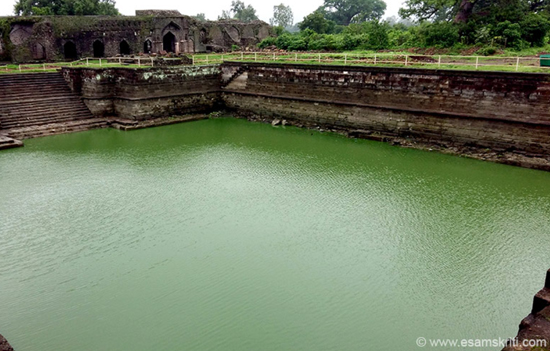 Mandu. Behind Somkund is Darya Khan Tomb. Having a Kund is a Hindu concept, found across India just like Bhojshala has JAL Kund.
Read Why
do Temples have Tanks and Step Wells
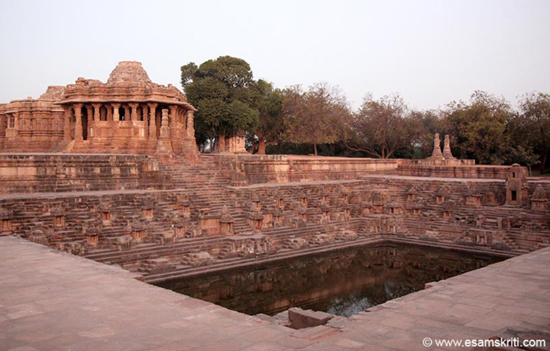 Ram Kund, Surya Mandir, Modhera, Gujarat. 2018.
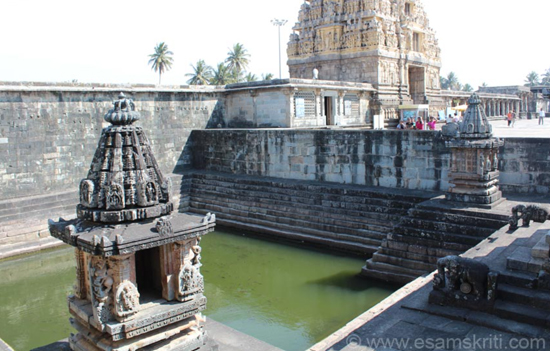 Temple Tank, Belur Temple, Karnataka. 2012.
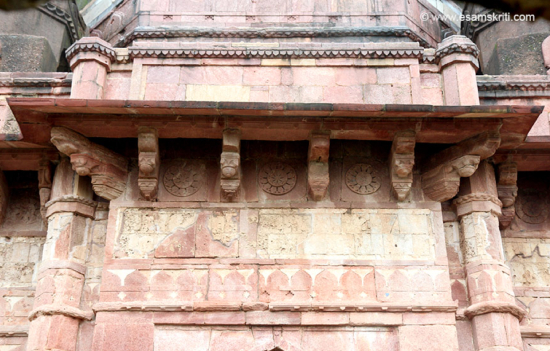 Mandu – Hindu style brackets in Darya Khan Tomb. 2018.
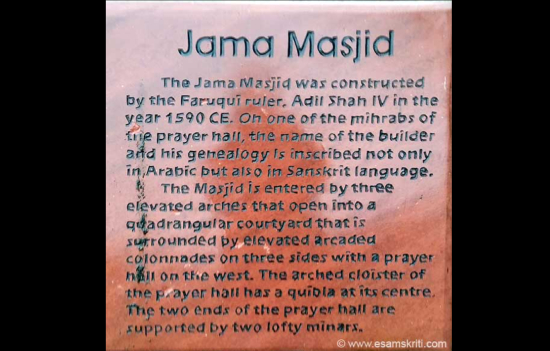 Asirgarh Fort near Mandu. ASI Board. Constructed in 1590 A.D. name of the builder is given in Sanskrit and
Arabic. 2018.
Asirgarh Fort near Mandu. ASI Board. Constructed in 1590 A.D. name of the builder is given in Sanskrit and
Arabic. 2018.
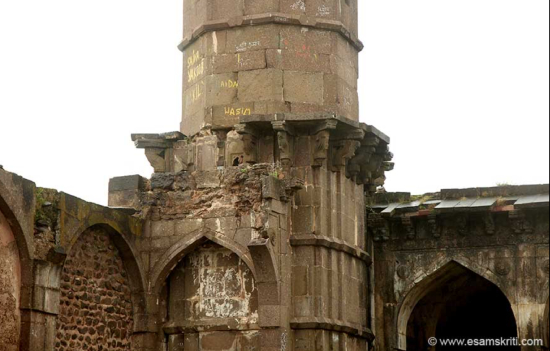 In Asirgarh Fort, close up of left side minaret.
Lower level has black stone. Where black stone ends are seen beautiful brackets and mouldings in Hindu style to support the chajjas above.
2018. It appears that the temple sanctum was destroyed and a minaret constructed. See
pics in album from 14
onwards.
In
Malwa’s Burhanpur (Indian name Bhrignapur taking its name from Bhrigu Rishi) there is a Sanskrit inscription on walls of Jama Masjid according to Anuradha Goyal, founder www.indiatales.com, in her article What
to see in Burhanpur
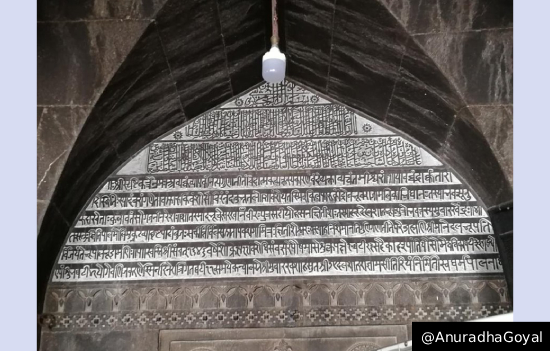 Sanskrit inscription on walls of Jama Masjid, Burhanpur, MP.
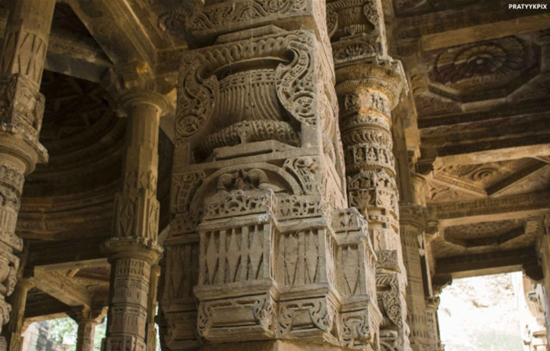 Adhai-din-ka-Jhopda Ajmer. Close up of column. Design resembles Kiradu Temple, Rajasthan. 2021.
On Adhai din ka jhopda, a 2007 article
in Tribune
Chandigarh said, “This
mosque was a Sanskrit college in the 12th century. The interior of the
mosque is more like a Hindu temple, with a main hall supported by numerous
columns. Three pillars are placed over each other while the roof is supported
on square bays. The columns are of an uncommon design, heavily decorated
and quite similar to Hindu and Jain rock temples. Their bases are large and
bulbous, tapering as they gain height. Although the original pillars and the
roof of the pre-Muslim structure were allowed to remain, many of the original
carvings were defaced by the conquerors.” To see album
Unfortunately,
I visited Dhar on a Friday in 2018 so could not see it as that day was reserved
for Namaz. I had earlier written How Temples
destroyed by Invaders could be claimed back by Sanatanis
Who was Raja Bhoj (Parmar dynasty) maker of Bhojshala Temple (BHT)
Dr
Ujjwala Anand, Conservationist, Architectural historian wrote, “According to
the Prabandhachintamani by
Merutunga, Raja Bhoja constructed 104 prasadas in Dhara Nagari. As our ancient
shastras call Temple –‘Prasada’, it is evident that he constructed multiple
temples in the city that he planned- Dhara Nagari. Bhoja’s architectural vision
was shaped by his treatise, Samarangana
Sutradhara, which is considered one of the most significant texts on Vastu
Shastra.”
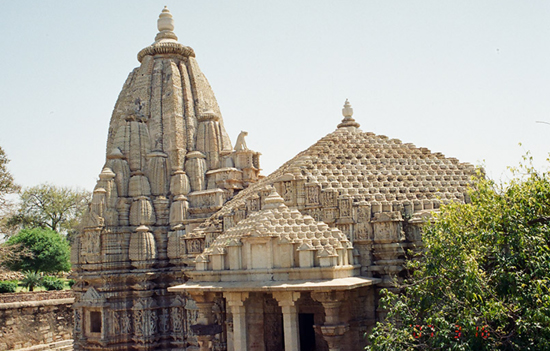 Samadisvara Mandir, Chittorgarh Fort was
built by Raja Bhoj.
Samadisvara Mandir, Chittorgarh Fort was
built by Raja Bhoj.
Indic
scholar Subhash Kak wrote about Raja
Bhoj,
“The Bhoj Lake,
18.5 miles long and 7.5 miles wide, was constructed using three now-breached
dams. He also built a
tank Bhojapāla भोजपाल (an oblong tank, पाल) and the city
that arose near it became Bhopal.”
“The
Iron Pillar of Dhar, originally almost twice as tall as its counterpart in
Delhi, is preserved in the compound of the Lat Masjid (‘lat’ means ‘pillar’).
The Dhar pillar is in three pieces, placed horizontally on a platform in the
mosque compound. When standing vertically, the pillar would have soared 14
meters high.” 6 Read A
new study on the Dhar Iron Pillar’ by Dr Prof R Balasubramaniam, Prof of
Metallurgy at IIT Kanpur, published in Indian Journal of history of Science.
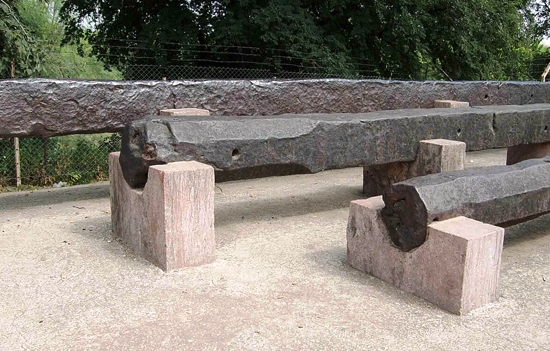 Close-up of Dhar Iron Pillar.
Key Points made by the MP HC Order on
Bhojshala (242 pages)
1. Since BHT is a protected
monument under the 1958 law, managed by ASI (Archaeological Survey of India)
not covered by the Places of Worship Act 1991.
2. Plea by
petitioners was not for title of property but right to pray in BHT, seeking
enforcement of a fundamental right under Article 226 of the Constitution, the
constitutional power of the HC cannot be overruled by legislation. 2
3. The Supreme
Court had asked the MP HC, in January 2026, to decide the matter by examining
the ASI Survey Report. 2
4. BHT is a protected
monument under the 1958 Act with effect from March 18, 1904, over which the ASI
will have full supervisory control. 2
5. “Since the religious character of the area was held to be a
temple of goddess Vagdevi (Saraswati), the court struck
down the ASI order of 2003 to the extent that it permitted offering of prayer
by the Muslim community.” 2
6. Petition Pg 5, “Issue
an appropriate writ, order or direction restraining the Respondents from
allowing the Muslims to perform prayer or worship in any manner within the
temple complex.” 1
Petition Pg 6, “ASI be directed to re-establish the idol/pratima (statue)
of goddess saraswati and make provisions of darshan, pooja and worship of
goddess Saraswati and also to make proper arrangement of Sanskrit learning in consonance
with the bhojshala as originally established.” 1
Petition Pg 8, “The petitioners are espousing the cause of Hindu community
for enforcement of right to religion guaranteed under Article 25 and right to
conserve cultural heritage under Article 29 of the Constitution of India. The
petitioners have also prayed to re-establish the idol of goddess Saraswati
(Vagdevi) which was established according to them by King Bhoj in the year 1034
AD for the purposes of imparting education of Sanskrit, Literature, Grammar,
the education of Astrology, Astronomy, Vedas and Shastra.” 1
Petition Pg 12, “In the year 1903 AD Lord Curzon took away the idol of
Vagdevi found within temple complex and the same has been kept in a museum in
England.” 1
Petition Pg 12, “Two pratima, together with the pratima of 3 Jinas
(tirthankaras): one of Vagdevi and another of Amba. Both forms Vagdevi and Amba
represent the divinity of Saraswati.” 1
The
term Bhojshala was first coined in 1908. 1
Petition Pg 22, “The scholars, on the basis of research made by John Malcolm & Michael Willis further opined regarding grammatical inscriptions that:- (i) The building also contains two serpentine grammatical inscriptions. These records prompted K. K. Lele to describe the building as the Bhojsala or Hall of Bhoja because king Bhoja was the author of a number of works on poetics and grammar, among them the Sarasvatikanthabharana or "Necklace of Sarasvati.” 1
Petition
Pg 25, “Mosque can only be constructed on land that belongs to the Waqf Board
land.” 1
Petition
Pg 27, “Muslims had never offered namaz at this place till 24.8.1935.” 1
Arguments by Shri Salman Khurshid starts at Pg 31. Petition by K Tiwari
and Others starts at Pg. 38. Petition by S C Jain starts at Pg. 47.
Pg 55 pray, “The counsel prayed that the Court acknowledge existence of
Jain sculptures, Ambika iconography, Jain architectural similarities, and Jain
scholarly association with the site.” 1
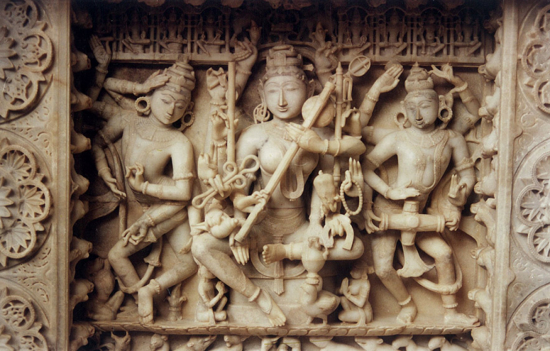 Saraswati pratima in Dilwara Jain Temples, Mount Abu.
Pg 81 Arguments by Sunil Jain, Additional Solicitor General of India. Pg
82, “Thus, ASI relies on the findings such as Sanskrit inscriptions, Sculptural
elements and temple style pillars and slabs. These indicate that materials from
a pre-existing Hindu structure were used.” Pg 85, “The ASI report records
extensive material indicating temple architecture and iconography, Sculptural
Evidence. Total 94 sculptures and fragments recovered. Depictions include
Ganesha, Brahma, Narasimha, Bhairava, Animal and mythological figures such as
Lion, elephant, horse, snake, tortoise, etc. 1
For
Notifications issued by ASI Pg 139. ASI submitted its report in 10 volumes Pg.
180. A Jain scripture record that --- Pg. 184.
“Our ancient sages have described Goddess Saraswati in the most ancient
scripture Rigveda. The scholars have opined that Ambitame and Ambaa in the
Rigveda is the same Amba mentioned on the inscription of Bhojshala Saraswati
Pratima. Pg. 201 1
“The existing structure has long colonnades in
all four directions decorated with 106 pillars and 82 pilasters. These pillars
and pilasters reused in the structure were studied systematically and
scientifically.” Pg. 213 1
“It is noteworthy that kirtimukha with human,
animal and composite faces carved on a number of pillars in western colonnade
were not destroyed.” Pg. 214 1 Kirtimukhas
found in Hindu and Jain temples.
Ten Principles of Ayodhya Judgement starts on Pg. 215. Is
the murti/pratima a Jain one or Saraswati starts Pg. 232.
“Our ancient sages have described Goddess Saraswati
in the most ancient scripture Rigveda. The scholars have opined that Ambitame
and Ambaa in the Rigveda is the same Amba mentioned on the inscription of
Bhojshala Saraswati Pratima.” Pg. 233 1
For
Court Directions read Pg. 241 of 1
Relevant parts of HC Order highlighted. To read click on PDF Copyright MP HC.
Extracts from Volume 1 of the Cultural
Heritage of India published by the Ramakrishna Mission –
“The Yaksas and their spouse Yaksinis as a class had existed in popular belief
and in literary tradition of the Hindus much earlier than the rise of both
Buddhism and Jainism. The Yaksas are, in Indian tradition, regarded as the
presiding spirits over wealth and there it is apparent that the Jainas who
represent the mercantile class esp. endeared themselves to this cult. According
to Jaina belief Indra appoints a Yaksha & Yaksini to serve as attendants of
each Tirthankara.” Pg 640
“Ambika – This Yaksini of Neminatha has
Sevetambara description of a goddess riding a lion and carrying a bunch of
mangoes, noose, a child in her four hands. The Digambara Yaksini Amra also
rides a lion and has two hands. She carries a bunch of mangoes and a child in
in her hands.” Pg 646
“Vidyadevi or goddesses of learning are 16 in
number. Besides, Jainas of both sects admit one Srutadevi or Sarasvati closely
resembling the Brahmanical goddess of the same name. Through the worship of
Vidyadevis the devotee gets knowledge, character, religion, mental qualities
etc. Most of the names of the Vidyadevis are in common with those of the
Yaksinis, the attendant spirits of the Tirthankaras.” Pg. 649
“Saraswati – Svetambaras viewed her as riding a
swan, having 4 hands holding lotus, varada, book, rosary. Digambara texts give
her a peacock vehicle.” Pg. 649
Conclusion
Bhojshala was not the only monument converted by Muslim Invaders. The article gives examples of other monuments in the regions. The MP HC has presented its reasons for the monument being Bhojshala well and quoted appropriate provisions of law and history. Let us see what the SC decides.
Also read and
References
1.
MP HC Order of 15th May 2026.
2.
Hindustan Times – 1991
Law does not apply to BHT
3.
Indian Express –
Origins of Dispute
4.
Subhash Kak – Raja
Bhoja the great scholar king
5.
Volume 3 and 5 of The
History and Culture of Indian People published by the Bharatiya Vidya
Bhavan.
6. Hindustan
Times Goddess Vagadevi, Amba, Saraswati
7. Album
Art Gallery Dhar
8. Samkhya
and Jaina Darsana