- Experiences
of a Daily Commuter - Metro 3 has transformed my quality of life. It represents
reliability, comfort, sustainability and peace of mind. My monsoon commute is
relaxed compared to the harrowing drive earlier. Now I reach office fresh and
return home with energy still left for family and life beyond work.
Fourteen months after the Aqua Line was extended from Bandra Kurla Complex (BKC) to Acharya Atre Chowk (Worli Naka) I can confidently say that the Aqua Line has transformed my quality of life, not just my commute. Read on.
For
nearly three decades, commuting in Mumbai meant accepting traffic, stress and
uncertainty as an unavoidable part of daily life. Fourteen months on the Aqua
Line has completely changed my understanding of what a daily commute can be.
I
have travelled almost every working day on the Aqua Line to reach my office at
MIDC, Andheri. I consider myself fortunate that both my residence and office
are located close to Metro stations. What was once a stressful journey has now
become one of the most peaceful parts of my day.
For Non-Mumbaikars, Mumbai Metro Line 3 is India's first fully underground metro corridor and opened in phases. The first was from Aarey JVLR to Bandra Kurla Complex that started in October 2024. It was extended to Acharya Atre Chowk (May 2025) and eventually to Cuffe Parade in October 2025. Thereby creating an important north-south transport corridor.
The Monsoon Changed Everything
This year's monsoon reminded me of my pre-metro days.
Driving
to office during heavy rains was never just about covering the distance. It meant
navigating waterlogged roads, endless traffic jams, incessant honking, poor
visibility, potholes and the constant anxiety of reaching safely. By the time I reached office, I was mentally exhausted.
The return journey after a full day's work was even more draining. Often, I reached home with little energy left for my family or even for myself.
Today,
my experience is completely different.
Despite
the intense rains of July 2026 affecting road traffic and disrupting suburban
as well as long-distance train services on several occasions, the Aqua Line has
continued operating reliably. The predictability and consistency of the metro
have made an enormous difference to my daily life.
Mumbai Metro 3 is not only about Saving
Time
The
biggest advantage of the Aqua Line is the peace of mind it brings.
Instead
of spending nearly two hours in unpredictable traffic, I now enjoy a
comfortable, air-conditioned journey that is punctual, smooth and stress-free.
I know almost exactly when I will reach my destination.
The
absence of traffic congestion, honking and driving stress has transformed
commuting from an exhausting necessity into an enjoyable experience.
A Positive Impact on the Environment
The
Aqua Line is not only changing the lives of commuters but is also contributing
towards a cleaner Mumbai.
With
lakhs of commuters expected to use the corridor every day, the Metro is helping
reduce dependence on private vehicles, thereby lowering congestion, fuel
consumption and carbon emissions.
Every
metro journey is a contribution towards making our city greener and more
sustainable.
An Unexpected Gift: Mental Well-being
One
benefit that I had never anticipated was its positive impact on mental
well-being.
Earlier,
my entire attention remained focused on driving through traffic. Today, those
thirty minutes have become my personal time.
Sometimes
I read a few pages from the Bhagavad Gita. Sometimes I listen to devotional
music. At other times, I simply observe fellow
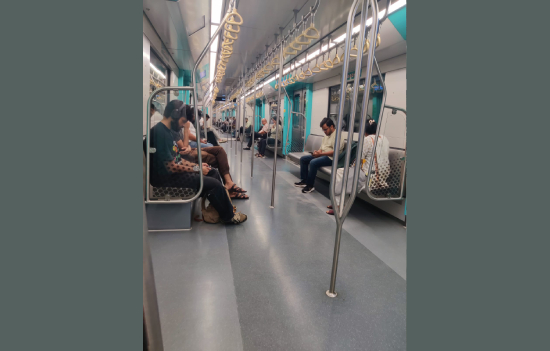
commuters. There is something calming about seeing students,
office-goers, senior citizens and families travelling together peacefully.
While
Mumbai continues to move at its usual fast pace outside, the atmosphere inside
the metro feels remarkably calm. That contrast itself creates a sense of
mindfulness.
Cleanliness Is Everyone's Responsibility
One
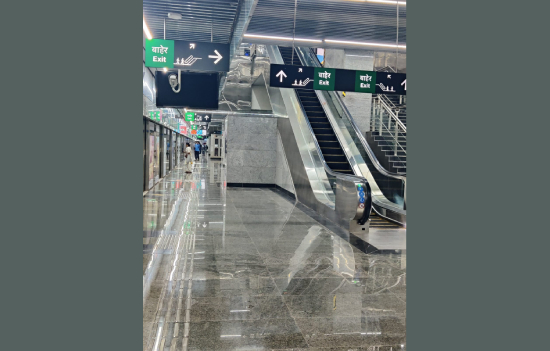
aspect that continues to impress me is the exceptional cleanliness maintained
throughout the Metro system.
The
stations and trains remain neat, modern and well maintained. While the Metro
authorities deserve appreciation, commuters equally deserve credit for
respecting public property.
I
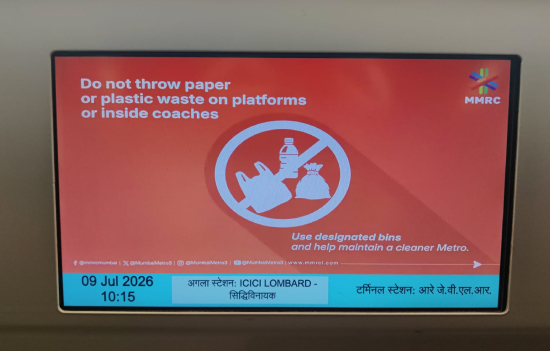
remember one incident during my journey. A fellow passenger carelessly dropped
a small piece of litter on the coach floor while arranging her handbag. Without
drawing attention to her, I quietly picked it up, wrapped it in another piece
of paper, kept it in my bag and disposed of it later in a dustbin at my
destination station.
Several
passengers noticed the gesture. My intention was never to embarrass anyone but
simply to reinforce the idea that public spaces
remain clean only when each of us accepts personal responsibility.
Small Challenges Remain
Like
every large public infrastructure project, the Aqua Line also faces certain
operational challenges.
Although
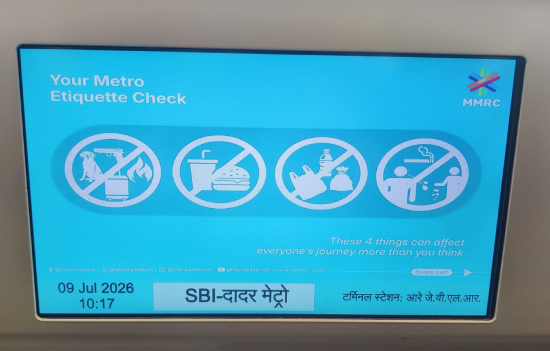
eating inside metro coaches is prohibited there are occasional instances of
commuters ignoring the rule. On one occasion, another commuter politely
reminded a lady that eating inside metro coaches is prohibited, as clear signage
is displayed throughout the train. She, however, continued with her meal.
The
restriction exists for good reasons. Food spills can dirty coaches, attract
insects and rodents, create unpleasant odours in enclosed air-conditioned
spaces and even become a safety hazard.
Similarly,
there have been isolated instances of spitting or gutka stains at a few
stations. Fortunately, management addressed the issue promptly.
Network
connectivity inside underground stations was a challenge during the initial
months. I am pleased to find that this has improved significantly, enabling
commuters to remain connected through most of their journey.
Ticket
purchasing has become much more convenient over the past year. Besides the
MetroConnect3 app and ticket counters, commuters can now use the Mumbai One
app, SBI Mumbai Metro Card, WhatsApp and QR-code based ticketing at stations.
Although occasional online payment issues are experienced, they are generally
resolved promptly.
Beyond Transportation
Travelling
on the Aqua Line is much more than simply moving from one place to another.
The
thoughtfully designed stations, modern architecture, bright lighting, public
art, clear signage and safe environment create a pleasant commuting experience.
Women
commuters, senior citizens and families particularly benefit from this secure
and well-managed infrastructure.
Most importantly, the Metro gives something that is becoming increasingly precious in today's urban life - time.
The
hours once lost in traffic are spent with family, reading, exercising, praying
or simply relaxing. Instead of arriving home physically and mentally exhausted,
I now reach home with energy still left for life
beyond work.
Looking Ahead
While
last-mile connectivity from certain stations can improve, I am confident the
issues will be resolved gradually.
Having
travelled on the Aqua Line for over fourteen months, I can say without
hesitation that it has transformed my daily life.
Infrastructure
projects are often measured in kilometres of track, the number of stations or
daily ridership. Their true success, however, lies in how they improve people's everyday lives.
For me, the Aqua Line represents reliability, comfort, sustainability and, above all, peace of mind. It has given me something that Mumbai commuters rarely experience—the joy of reaching office fresh and returning home with energy still left for family and life beyond work.
Every
morning, it reminds me that commuting need not be stressful; it can actually
become one of the most enjoyable parts of the day.
If public transport can make people
look forward to their daily commute, it has achieved something truly
remarkable.
The author is a
technology professional and a regular commuter on Mumbai Metro Line 3 (Aqua
Line). The views expressed are personal and do not represent those of his
employer.
Also read
1.
How
to Meditate in a Metro Train
2.
Making
of Mumbai Metro train Album
3.
Mumbai Metro 3 website
4. I reach office looking fresh, thanks to Mumbai Metro 3