- What is the deeper
meaning and intent of making a temple in stone? What does Iconography mean and
does it convey? What is the importance of Murti and a dark Sanctum?
This essay has three parts. This
is part 1. Links to part 2&3 at end of article.
Across the Indian landscape,
temples rise not merely as monuments of faith but as repositories of knowledge,
memory, and philosophy. Their soaring towers, carved pillars, sculpted walls,
and sacred sanctums are often admired for artistic beauty and engineering brilliance.
Yet to view a temple merely as architecture is to overlook its deeper purpose.
In the Indian tradition, a temple is not simply a building where worship
occurs; it is an encoded universe, a sacred text in stone.
Unlike ordinary structures
designed for utility, temples were conceived as spiritual instruments. Every
component—its orientation, geometry, iconography, and ornamentation—was
carefully chosen to communicate meaning. The temple was intended to be read,
experienced, and interpreted much like scripture. Its walls functioned as
pages, its sculptures as verses, and its sacred centre as the culmination of a
spiritual narrative.
This understanding emerges from
a civilisation where knowledge was shared through
multiple media—oral traditions, sacred texts,
ritual practice, music, dance, and visual art. Temples formed a remarkable synthesis of these traditions. For many communities across centuries, they were
not merely sites of worship but centres of learning, social life, and
philosophical reflection.
The idea of stone as scripture
lies at the heart of Indian temple traditions. Sacred truths, metaphysical
ideas, and ethical teachings were not confined to manuscripts accessible only
to scholars or priests. They were translated into visible and experiential
form. The devotee did not merely hear philosophy; they walked through it. They
encountered it in sculpted deities, mythological scenes, symbolic motifs, and
ritual pathways.
This explains why temples seem
to “speak.”
Their language is not verbal but
symbolic. A guardian figure at an
entrance communicates the sanctity of thresholds. A lotus carved upon a ceiling
speaks of spiritual unfolding. Celestial musicians carved on pillars evoke
divine celebration, while narrative panels narrate sacred histories and moral
ideals. Every motif carries layered meaning, inviting reflection and
interpretation.
The temple therefore operates
simultaneously on several levels.
It is a sacred dwelling, a cosmic diagram, a ritual theatre, and a philosophical
statement. Its physical form serves as an external manifestation of invisible
truths.
This conception distinguishes
temple architecture from purely commemorative or civic architecture. A palace
demonstrates political authority, and a fort expresses military strength. A
temple, however, embodies a worldview. It attempts to render the unseen visible
and to make cosmic order tangible.
The movement through a temple
reinforces this symbolic journey. The exterior walls may contain exuberant sculpture
and worldly imagery, reflecting the richness and multiplicity of existence. As
one proceeds inward through halls and thresholds toward the garbhagriha,
ornament gradually yields to stillness and darkness. The devotee moves from the
outer world toward an inner centre, mirroring the spiritual journey from
distraction toward contemplation.
Thus, the temple is experienced
not passively observed. Architecture, sculpture, and
ritual work together to transform movement into meditation.
To call the temple a “sacred
text in stone” is therefore not poetic exaggeration. It reflects a profound
civilisational approach to knowledge itself. Stone becomes scripture because it
preserves and communicates wisdom across generations. Sculpture becomes
philosophy because it expresses ideas that transcend language and literacy.
Even today, centuries after
their construction, temples continue to speak through this enduring language.
Meaning of Iconography in Indian Temple
Traditions
The language through which
temples communicate is known as iconography.
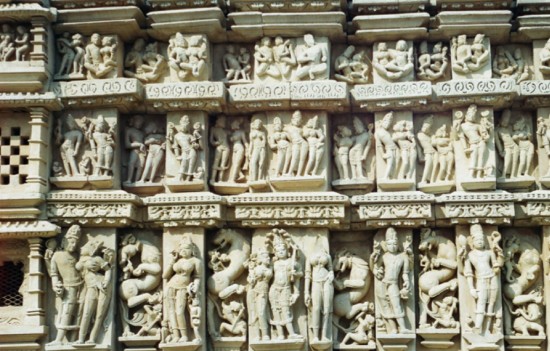 Jain Temples, Khajuraho.
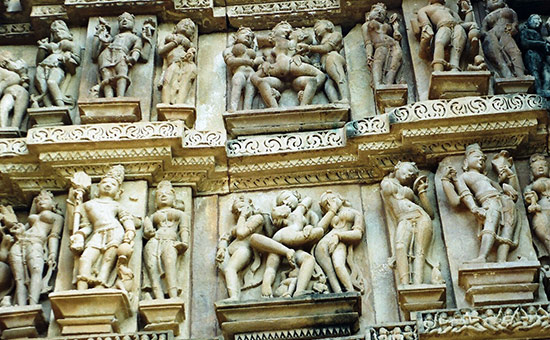 Khajuraho Temple.
The term refers to the study and
interpretation of images and symbols, but within Indian traditions it carries
meanings far deeper than visual representation alone.
Temple iconography is rooted in
the concept of pratima-lakshana—the principles governing sacred
imagery and symbolic form. These principles determine not only how a deity or
motif should appear but also what philosophical and theological meanings it
embodies.
In Indian thought, sacred images
are not arbitrary artistic inventions. Their forms emerge from carefully developed systems of symbolism. The number of arms a deity possesses, the objects
held in those hands, bodily posture, facial expression, ornaments, and
accompanying figures all communicate particular meanings.
A deity with multiple arms, for instance, signifies manifold powers and cosmic capacities rather than
anatomical realism. A lotus symbolizes purity and transcendence. Weapons may
represent protection or the destruction of ignorance. Every visual element
participates in a larger symbolic vocabulary.
This symbolic language reflects
a close relationship between theology, ritual, and artistic representation.
Temple imagery is intrinsically
connected to ritual practice and sacred belief. The image of a deity is not
merely decorative sculpture but a ritually consecrated presence. Through
ceremonies of prana-pratishtha, the divine is invoked into the
image, transforming it into a living focus of worship.
Consequently, iconography
operates at the intersection of aesthetics and theology.
The sculptor was not simply an
artisan concerned with appearance. He functioned as an interpreter of sacred knowledge. His task was to translate metaphysical concepts
into visible form while adhering to established canons and ritual requirements.
These canons were preserved
through a vast body of textual traditions.
Among the most important are
the Shilpa
Shastras, manuals dealing with art,
architecture, sculpture, and proportion. These texts provide detailed
instructions regarding measurements, postures, iconographic attributes,
ornamentation, and spatial arrangements. Far from restricting creativity, they
ensured symbolic coherence and sacred legitimacy.
Closely related are the Agamas, particularly influential
within Hindu temple traditions. These texts prescribe not only ritual
procedures and temple worship but also the proper forms of deities and sacred
spaces. They explain where specific deities should be positioned, how temples should
be oriented, and how images should be installed and worshipped.
Together, these textual traditions reveal that temple imagery was
governed by intellectual and spiritual systems rather
than artistic whim.
This explains the remarkable consistency visible
across Indian temples.
A Shiva image in Tamil Nadu and
another in Karnataka or Rajasthan may display regional stylistic differences,
yet both remain recognisably Shiva because they follow shared iconographic
principles. The same is true for Vishnu, Durga, Jain Tirthankaras, and numerous
divine forms.
Iconography therefore creates
continuity. It establishes a sacred
grammar through which theological ideas become visually intelligible across
space and time.
At the same time, this system
allows extraordinary artistic diversity. Regional and local traditions,
patronage patterns, and historical contexts produced rich variations within
broader iconographic frameworks. Thus Indian temple art balances order with
imagination, canonical discipline with creative expression.
The result is a visual language
of remarkable complexity and sophistication.
Murti and the Principal Deity: The Sacred
Centre
At the heart of every Indian
temple lies the murti—the principal deity that anchors the sacred space
and gives the temple its identity. Modern vocabulary often translates murti as
“idol,” yet this term inadequately captures its meaning within Indian
traditions. A murti is not merely an object of worship or artistic
representation. It is an embodiment, a visible manifestation
through which the divine becomes accessible.
Indian philosophical traditions
recognise the difficulty of comprehending the infinite through abstraction
alone. The murti therefore serves as a bridge between the transcendent and the
perceivable. Through ritual consecration or prana-pratishtha, the
image becomes animated with sacred presence, transforming sculpted stone into a
locus of divine experience.
The form of the deity is never
arbitrary. Sacred canons prescribe precise symbolic proportions, gestures, attributes, and postures. These are not
aesthetic choices alone but theological statements.
The raised palm in abhaya
mudra communicates reassurance and protection, while varada
mudra signifies grace and benevolence. Multiple arms express divine
capacities beyond ordinary human limitation. Weapons, flowers, scriptures,
rosaries, and ritual objects signify cosmic functions and philosophical
attributes. Shiva’s trident, Vishnu’s discus, or the lotus held by many deities
become condensed expressions of complex metaphysical ideas.
Equally meaningful is posture. A
deity seated in meditation evokes contemplation and inward stillness, while
standing figures embody alert presence and cosmic guardianship. Dynamic dancing
forms such as Shiva as Nataraja communicate creation, dissolution, and cosmic
rhythm.
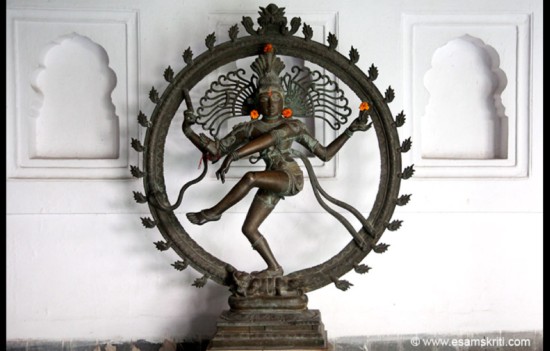 Nataraja. Rajwada, Indore.
The placement of the murti
within the garbhagriha, or sanctum, deepens this symbolism. The sanctum
is often the darkest and most enclosed part of the temple, deliberately
separated from the sensory richness of the outer halls. Here the deity occupies
the spiritual axis of the structure—the point around which architecture,
ritual, and movement converge.
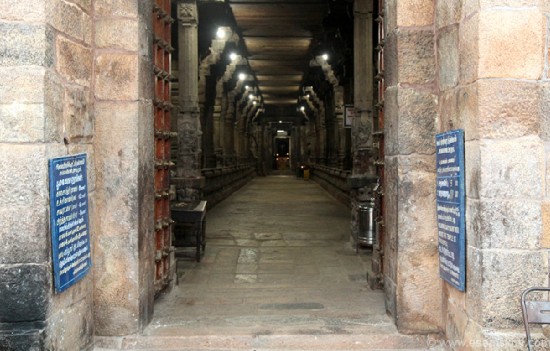 Way to sanctum, Gangaikondacholapuram Mandir, Tamil Nadu.
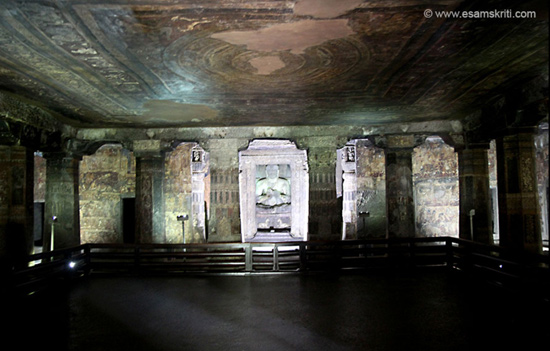 Not called as Sanctum in Ajanta Cave no 17 but concept similar.
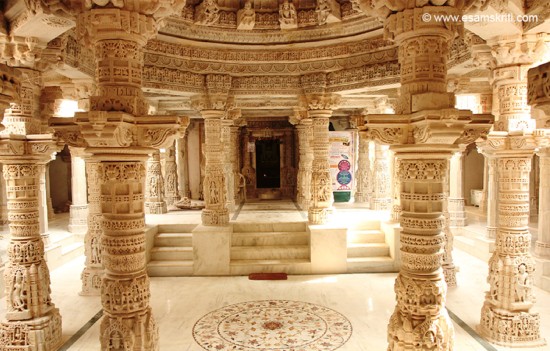 Jain Temple, Delwara near Udaipur.
The journey toward the sanctum
mirrors an inward pilgrimage. As devotees move through corridors and mandapas,
they gradually leave behind worldly multiplicity and approach sacred stillness.
The murti thus becomes not merely the destination of worship but the symbolic
centre of existence itself.
To read all articles by author
To read part 2 What is the Symbolism behind Temple Sculptures and Part 3 What is common to Hindu and Jain Temples
The author is a Conservationist, Architectural historian, Author, Ph.
D. in Dravidian and Khmer temple Architecture, Cambodia and the Founder of
Samrachanā - Heritage Conservation & Research Initiative, Pune.
Also read
1. Exploring the Architectural Significance of Temples in India
2. Appreciating Indian Temple Architecture - An Indian viewpoint
3. How did Hindu Temples evolve
4. What do Ganas, Gandharvas, Mithuna Couples and Dancing girls on Temple
Walls tell us
5. Why do Temples have Tanks and Stepwells