- This article includes what the Chakravyuh actually was, why Abhimanyu's story still moves us thousands of years later, and what this old battle formation can teach us about strategy, even in our own lives.
Ask
any Indian to name one moment from the Mahabharata that still gives them
goosebumps, and many will say the same thing. Abhimanyu, trapped alone inside
the Chakravyuh, fighting warrior after warrior until he had no strength left.
It is one of those stories that we grow up hearing, and somehow it never stops
feeling relevant. Even today, people use the word Chakravyuh to describe any
situation where someone is trapped in a system with no clean way out.
In this piece, we look at what the Chakravyuh actually was, why Abhimanyu's story still moves us thousands of years later, and what this old battle formation can teach us about strategy, even in our own lives.
What
Exactly Is the Chakravyuh
The
Chakravyuh was a battle formation designed by Dronacharya, the guru of both the
Pandavas and the Kauravas. It was shaped like a spiral, with layer after layer
of warriors guarding the way in. The idea was simple but brutal. An enemy who
entered would find it very hard to fight their way back out, because every
layer closed behind them like a trap.
Only a few warriors on the Pandava side knew how to break into this formation. Arjuna knew it fully, but on the day the Chakravyuh was formed, he had been lured away to a different part of the battlefield. That left the Pandavas in trouble, and it is here that young Abhimanyu, Arjuna's son, stepped forward.
The
Tragedy of Abhimanyu
Abhimanyu had learned how to enter the Chakravyuh while he was still in his mother Subhadra's womb, listening to Krishna explain the technique to her. But there was a problem. Subhadra fell asleep halfway through the story, so Abhimanyu only knew how to get in, not how to get out.
He
entered anyway, because his family needed him to. He broke through the
formation with incredible skill, and for a while, it looked like he might
actually hold his ground against seasoned warriors twice his age. But once he
was deep inside, the rules of fair combat were broken. Several warriors
surrounded him together, which was against the code of one on one battle that
Kshatriyas were supposed to follow. Abhimanyu fought until his last breath,
alone, outnumbered, and betrayed by the very idea of honour he believed in.
This
story is still used as a symbol for being trapped in a situation you cannot
fully see the end of. Even the ongoing Kashmir conundrum has been compared to Abhimanyu's Chakravyuh, which shows how a formation from thousands of years ago
still helps us make sense of complicated modern problems.
Why
the Chakravyuh Still Works as a Lesson in Strategy
If
you step back from the emotion of the story for a moment, the Chakravyuh is
actually a very good lesson in how strategy works, and how it fails. Each
mistake that unfolds inside this formation still shows up today, in boardrooms,
in exams, in relationships, and even in how nations plan their next move.
Half Knowledge Is
Dangerous
Abhimanyu knew how to attack but not how to retreat, and that gap in his knowledge is what cost him his life. He had learned the entry technique while in his mother's womb, but the story was cut short before Krishna could finish teaching the exit. In any plan, whether it is a battle, a business decision, or even something as ordinary as taking a loan, knowing how to get in without knowing how to get out is a risk that can quietly destroy you. A
good strategist does not just ask how to start something.
They
also ask how to get out of it if things go wrong.
Isolation Breaks Even
the Strongest
A
single warrior, however skilled, struggles once he is cut off from support. The
Chakravyuh worked because it separated Abhimanyu from the rest of his army,
layer by layer, until he was completely alone deep inside enemy territory. No
amount of individual talent could make up for the fact that nobody was left to
watch his back. This is why even today, in an army unit, on a sports field, or inside
a company, the person who gets isolated from the group is almost always the one
who struggles the most, no matter how capable he is on his own.
Rules Can Break Down
Under Pressure
The
third lesson, and maybe the most important one, is about rules and fairness
breaking down under pressure. Abhimanyu was killed
only because several warriors abandoned the code of one on one combat and
surrounded him together. This is a reminder that even the best strategy can be
undone the moment the other side stops
playing fair, and it is worth planning for that possibility too, instead of assuming everyone around you will follow
the same code you do.
A Plan Needs More
Than Courage
There is a fourth lesson in Abhimanyu's story that is missed. Courage alone was never going to be enough. He had more courage than almost anyone else on that battlefield that day, and it still was not enough to save him. Real
strategy needs courage, preparation and support all working together,
and when even one of these three is missing, the outcome can turn tragic no
matter how brave the person at the centre of it is.
These
ideas connect closely with how dharma itself
shapes foreign policy thinking rooted in the Mahabharata, not as a fixed rulebook, but as something that has to
be applied wisely in each situation, the same way these very ideas are still
used to think about strategy and dharma in how nations deal with each other.
Standing
Where Abhimanyu Stood
For
many people, reading about Kurukshetra is not enough. They want to actually
stand on the land where all of this is believed to have happened. Kurukshetra
today is a real place in Haryana that draws pilgrims and history lovers all
through the year, and putting a place to
the story makes it feel even more real.
Carrying Abhimanyu's Courage Today
Stories like Abhimanyu's do not stay locked inside old texts. They keep finding new ways to reach people, and one place we are seeing this happen well is in clothing. VanarAgni, a brand that describes itself as Bharat's first spiritual clothing brand for Gen-Z and millennials, has built its Mahabharat Collection around exactly these kinds of stories, and to be honest, it is one of the more thoughtful attempts we have seen at turning mythology into everyday wear.
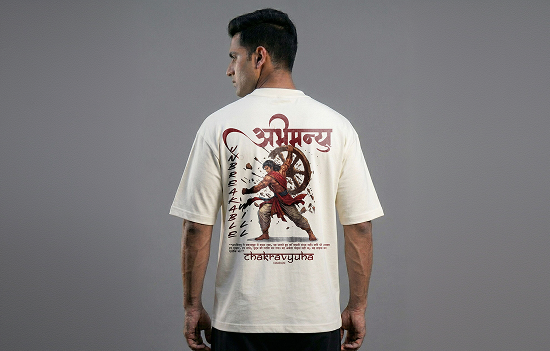
What
stands out about their Mahabharat
T-shirt collection is that each design
is tied to a real character and a real story, rather than being a random print.
Their Chakravyuh Warrior Graphic
Oversized T-Shirt, built around Abhimanyu's story, is a good example of this. It is the kind of design that gives a young person wearing it a reason to explain who Abhimanyu was and why his story still matters, instead of just being another graphic tee.
In a
small way, this is exactly how old stories survive. Someone tells it to a
child, a temple carves it into stone, an author writes it into a book, and
today, a well designed t-shirt reminds a whole new generation to ask the
question, who was Abhimanyu, and what happened to him inside the Chakravyuh.
The
Real Lesson
The
Chakravyuh is not just a war formation from a story written centuries ago. It
is a reminder that courage without a full plan can be costly,
that isolation is dangerous even for the strongest among us, and that honour
matters most exactly when it is hardest to keep. Abhimanyu did not survive the
Chakravyuh, but his story has outlived every empire that came after him, and it
will likely keep teaching us about strategy for a long time to come.
This is a sponsored feature