- FAQ
covers where reservations apply, Classes got converted into Caste, Reservations
%, Origin of concept of and Why reservations, Words SC/ST/Dalit are of recent
origin, Quota Clause in Lok Sabha and State Assemblies
ends in 2030, Article Numbers in Colonial Constitution w.r.t reservations.
In
a December 2024 order on Untouchability former CJI Dr Dhananjaya Y Chandrachud wrote that caste cannot be the sole basis of reservation. Para 192, pg 128. Source More
on this later.
Reservations
in India works in different and complex ways. This FAQ tries to simplify the
subject. Errors if any are without malafide intent.
I
referred to three originals. One, constitution as on 1.5.2024
downloaded GOI website on 14.1.26 at 11.50 am. Two, original Constitution
downloaded on 14.1.26 1.15 pm from National Archives . Three, amended
from Indiacode.in
This
essay covers where reservations apply, classes got converted into caste,
reservations %, origin of concept of and why reservation and words SC/ST/Dalit quota
in Lok Sabha and state assemblies ends in 2030,
Article Numbers in Colonial Constitution w.r.t reservations.
1. Where all are Reservations applicable?
According
to a February 2025 article in clearias.com reservations are applicable in
-
1. “Government Educational Institutions (like IITs, IIMs, etc.) Art 15 (4), (5) (6).
2.
Government Jobs (like IAS, IPS, etc.) Art 16 (4) and (6).
3.
Legislatures (Parliament, and State Legislature) Art 334.
4.
SC 15% and ST 7.5% quota in jobs/higher educational institutions.
5. Reservation is also with respect to promotions for the SC/ST category (Article 16(4A)).”
There is no concept of a ‘creamy layer’ with respect to SC/ST reservation. This means that
irrespective of the income status or the government posts held by the parents,
children of SC/ST parents will get SC/ST Reservations.
Reservations
for Other Backward Classes in Institutes of
Higher Learning was introduced in 2005-06 @ 27% (Article 15 (5)). Creamy layer exists in OBC reservation. It does not apply to Minority run institutions. This article tells how OBC reservations misused by some state governments to include Muslims and Christians. Explained OBC
reservations
“The Tamil Nadu Government enacted legislation namely Tamil Nadu Backward Classes, Scheduled Castes and Scheduled Tribes (Reservation of seat in Educational Institutions and of appointments or posts in the Services under the State) in I993.” TN has 69% reservations. 12 para 4.2
2. Is there any sunset clause for reservations in government jobs/education?
I
could not find any clause in the colonial constitution that gives a date by
which reservations would end. It is only SC/ST quota
in Lok Sabha and state assemblies that ends in
2030.
It is surprising that the Constitution makers did not put an end date. Reservations started in 1950, 75 years over. Not to forget the billions of rupees given in scholarships and income-tax exemption to ST of most north-eastern states. The more one harps on caste, the more it gains in importance in society.
It is time that reservations be decided on basis of income only
Read Why do Indian
students go to USA to study
In the Indian system of governance it is assumed that the so called Upper Caste are rich and SC/ST are poor. They will be rich or poor for forever.
3. Constitution allows reservation only for socially
and educationally backward classes but it has become caste-based reservation in
India.
According to a December 2024 SC order on Untouchability authored by Dr Dhananjaya Y Chandrachud, CJI, “Both Articles 15(4) and 16(4) do not enable reservation based on castes but only on classes. The absence of the use of “caste” in Articles 15(4) and 16(4) when coupled with its use in Articles 15(2) and 16(2) led the courts to hold that caste cannot be the sole basis of reservation.” 1 Para 192, pg 128.
Source
If caste cannot be sole basis for reservation, why has SC not struck down caste- based reservations? Why are governments making reservations based on caste?
Read From
RTE To Scholarships, Indian Education Is Hobbled By Minorityism
4. What is the reservation percentage in India?
In
India, reservation to the SCs, STs and OBCs in case of direct recruitment on an
India basis by open competition is given at the rate of 15%, 7.5% and
27% and 10% = 59.5% (Source - clearias.com Feb 2025 article)
5. Why Reservations in India?
It
is supposed to correct denial of education to SC/ST for thousands of years. According
to research done by Gandhian Dharampal SC were the
maximum number of SCHOLARS in Pre British India
The British started this denial of education to divide India, the Congress carried it forward post 1947 and the BJP has joined them.
6. What about Untouchability?
Alleged denial of education & Untouchability
are two different issues. The latter was not uniformly practiced across India.
Read When
caste was not a bad word
Extract from December 2024 order by CJI D Chandrachud. “The President issued the Constitution (SC) Order 1950 which nearly corresponds to the Government of India (SC) Order 1936 notified under the PART D 89 Government of India Act 1935. The 1935 Act did not define the criteria for the identification of Scheduled Castes. Clause 26(1) of the First Schedule to it defined the SCs as castes that corresponded to the classes of persons known as the “depressed classes.” Pg. 88/89 Source
Untouchables
were those who belonged to the depressed classes. Ambedkar said he belonged to the depressed classes. In which case, would
his Brahmin teacher share his food with him?
The SC order adds, “In 1919, the Southborough Franchise Committee adopted the test of untouchability to define the depressed class. The Committee interpreted the phrase “depressed classes” as the 'untouchability class, that is, the class whose touch or approach is deemed to cause pollution as it exists in the United Provinces. (Uttar Pradesh).” Pg.
90
Further, this concept that untouchables correspond
to depressed classes is based on a 1919 report. How relevant is that in 2026?
“The 1919 Note states that untouchability as it existed in Madras, where an untouchable’s touch necessitated immediate purification, did not exist in Assam.” Pg. 92/94 Source
So how can one treat all untouchables as SC across the
country?
7. What is the origin of Reservations in India?
According
to vajiramandrravi.com, “Instead of separate electorates, the Poona Pact established a system of reserved seats for the Scheduled Castes within the general electorate. The promises of the Poona Pact regarding the reservations found a reflection in the Indian Constitution.”
According
to GOIMonitor.com, “1942: Viceroy's Executive Council recommends 8.5 per cent reservation for Scheduled Castes in civil services. B R Ambedkar was a member of the council.” Also referred to in 12 para 3.5
ST
who convert to Islam and Christianity continue to be treated as ST in the eyes
of the government. SC who become Sikh, Buddhists continue to avail of
reservations meant for SC.
8. Quota for SCs and STs in Lok
Sabha and state assemblies
These are extended every 10 years and was due to
expire in January 2020. The 2019 Bill extends reservation for SCs and STs by another 10 years
till January 25, 2030. SourcePRS
9. Who are Scheduled Castes (SC)?
Dr Ambedkar used the word
Depressed Classes. In the early 1930's Gandhi coined the word Harijan or Children of God to describe untouchables. The Government of India Act 1935 introduced the term 'Scheduled Caste' for the depressed classes. It is subsequent to such classification that Ambedkar formed a Scheduled Caste Federation. It is only since the 1990's that the word Dalit entered mainstream public discourse. 2
Example
of discrimination. D Keer wrote in Life
and Mission of Ambedkar, “The original surname of Bhim’s father was Sakpal, a family name. Bhim drew his surname Ambavadekar from his native village Ambavade. A Brahmin teacher in the High School, whose surname was Ambedkar, took such a liking to Bhim that he changed his surname to his own Ambedkar, in the schools records.”
Every election, the list of SC/ST/OBC keep on expanding. OBC got included around 1990. For the BJP/Congres the
trio form a key vote bank.
10. Who are Scheduled Tribes (ST)?
The word ST was first
introduced around 1949. In Indic terms people living in the forests are
called Vanavasi. STs differ from region to region. One cannot
compare northeast STs, who have mostly converted, with those in Chhattisgarh
and Himachal.
The royal family of
Tripura are ST. To indicate they are ST their erstwhile residence, Ujjayanta
Palace has a bust of Ambedkar at the entrance.
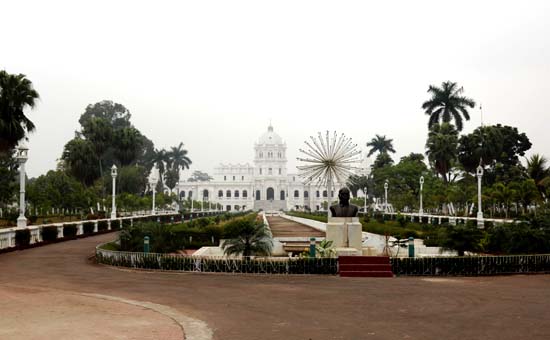 Ujjayanta Palace, Agartala has a bust of
Ambedkar at entrance. 2014.
Ujjayanta Palace, Agartala has a bust of
Ambedkar at entrance. 2014.
Arihant
P wrote in Swarajyamag.com, “The Indian State doesn’t officially consider the Scheduled Tribes as communities exclusively belonging to Hinduism.” Hence, ST converts still get benefits of ST. BJP government not ended this rule in eleven years! Author Sandhya Jain wrote in book Adi
Devta Arya Devta , “Jagannatha’s tribal origins are undeniable, though the god is today inseparable from the ‘high’ Hindu panorama and is a key constituent of Orissa’s regional identity. Read Who
are Scheduled Tribes In Tripura the tribal name of Lord Shiva is SUBRAI RAJA in Kok Borok dialect of Tripura’s tribal groups.
11. Who are Other Backward Class?
Section 2 of the 1993 National Commission for Backward Classes (NCBC) Act defines “backward classes” as backward classes of citizens other than the Scheduled Castes and the Scheduled Tribes as may be specified by the Central Government in the lists.” This is a strange definition i.e. based on exclusion of SC and ST.
According
to clearias.com, “The quota for OBCs is 27% in government jobs and higher educational institutions. However, there is a concept of a ‘creamy layer’ with respect to the OBC reservation. Read OBC
Kings in India
OBC reservations
has become a route to give Muslims the benefit of reservation. 12 para 3.14 for e.g. Kerala and West
Bengal.
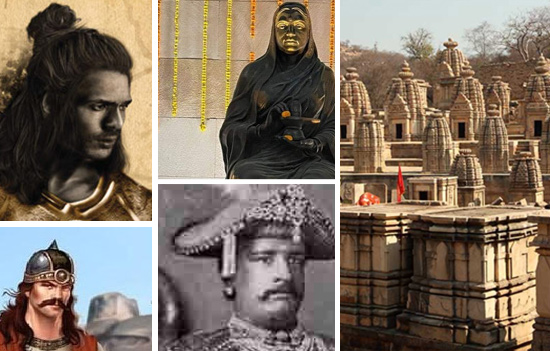 OBC Kings in India.
12. Which Articles Numbers in the Constitution relate to
Reservations?
1. Art 15 Prohibition of discrimination on grounds of
religion, race, caste, sex or place of birth.
The 1950 Constitution
was only up to Art 15 (3).
2. Art 15 (4): “Special provision for the advancement of any socially and educationally backward classes of citizens or for SC and ST.” Introduced 1951.
3. Art 15 (5): “Nothing in this article or in sub-clause (g) of clause (1) of article 19 shall prevent the State from making any special provision, by law, for the advancement of any socially and educationally backward classes of citizens or for the Scheduled Castes or the Scheduled Tribes in so far as such special provisions relate to their admission to educational institutions including private educational institutions, whether aided or unaided by the State, other than the minority educational institutions referred to in clause (1) of article 30.]"
Reservations for OBC where BC
means Backward Classes in government and private educational institutions other
than minority ones (Art 30).
4. Art 15 (6): reservations for economically weaker sections. Introduced 2019.
5. Article 16 (4) is about reservations for backward classes.
6. Article 16 (4A) is about making reservations for SC and ST in matters of promotion.
The 1950
Constitution did not have Art 16 (4A).
7. Article 46 states that the State shall
promote, with special care, the education and economic interests of the weaker
sections of SC/ST.
8. Article 334 states that reservations for SC/ST in the House of People and Legislative Assemblies of states shall be for a period of 10 years. This shall cease to have effect within 80 years of the
Constitution i.e. by 2030.) Art 334 (b)
9. Article 338 National Commission for Scheduled Castes.
10.
2019 Amendment 10% quota for Economically Backward Sections.
13. Bare Act each Article
1. Article 15 (4) – “Nothing in this article or in clause (2) of article 29 shall prevent the State from making any special provision for the advancement of any socially and educationally backward classes of citizens or for the Scheduled Castes and the Scheduled Tribes.]” Added by 1951 Amendment
No time limit prescribed for validity of these reservations. Note, “Dr. Ambedkar clarified on 25.8.1949 that reservation are a "temporary measure for adjustment," signifying that its scope and beneficiaries must change with changing social realities.”15 pg 14
2. Article 15 (5)- “Nothing in this article or in sub-clause (g) of clause (1) of article 19 shall prevent the State from making any special provision, by law, for the advancement of any socially and educationally backward classes of citizens or for the Scheduled Castes or the Scheduled Tribes in so far as such special provisions relate to their admission to educational institutions including private educational institutions, whether aided or unaided by the State, other than the minority educational institutions referred to in clause (1) of article 30.]”
3. Article 15 (6) (a):
“any special provision for the advancement of any economically weaker sections of citizens other than the classes mentioned in clauses (4) and (5);” Post 1950.
4. Article 16 (4): “Nothing in this article shall prevent the State from making any provision for the reservation of appointments or posts in favour of any backward class of citizens which, in the opinion of the State, is not adequately represented in the services under the State.” Inserted 1995.
Note the word Backward Class is used, not caste
No time limit prescribed for validity of these reservations.
According
to SCobserver.in , “In 1995, the Government nullified the effect of Indra Sawhney by introducing Article 16(4A) through the 77th Amendment of the Constitution. Article 16(4A) allowed the State to provide reservations to a SC/ST in matters of promotion.”
5. Article 16
(4A): “Nothing in this article shall prevent the State from making any provision for reservation [in matters of promotion, with consequential seniority, to any class] or classes of posts in the services under the State in favour of the Scheduled Castes and the Scheduled Tribes which, in the opinion of the State, are not adequately represented in the services under the State.]” Inserted 2000.
According to SCobserver.in , “Two amendments were made in 2000 for facilitation of reservation in promotion for SC/STs. Through 81st Amendment, government introduced Article 16(4B), which allowed reservation in promotion to breach the 50% ceiling set on regular reservations. The Amendment allowed the State to carry forward unfilled vacancies from previous years. This came to be known as the Carry Forward Rule. In the 82nd Amendment, the State added a proviso to Article 335. According to Article 335, the claims of SCs/STs to services and posts have to be consistent with overall administrative efficiency.”
In 2018, the SC ruled that “the State cannot grant reservations in promotion to SC/ST individuals who belong to the creamy layer of their community.” SCobserver.in
6. Article 46 reads, “The State shall promote, with special care, the education and economic interests of the weaker sections of the people, and, in particular of the Scheduled Castes and Scheduled Tribes, and shall protect them from social injustice and all forms of social exploitation.”
On GOI sponsoring various education
schemes for SC/ST/Minorities Arihant P wrote in Swarajyamag.com, “The MHRD justifies such schemes of sectarian character by brandishing ‘Article 46’. First, this article is a part of the Directive Principles of State Policy section of the constitution which means that it is not enforceable in courts and hence not legally binding on the government, much like the platitude about a Uniform Civil Code (UCC). Second, the article says ‘weaker sections’ - there is no indication that this requires a purely social interpretation and not an economic guideline as well. After all, there are poor Hindus as well.”
14. Reservations is
justified because of Caste. Here are its benefits
Read Benefits
of Caste System
Those who drafted the Colonial Constitution used the word Minority many times but did not define the word minority. They provided for reservations without any end date clause or asking for a review after a pre-determined number of years. May be then there were no rich SC then. See this
album to know a rich SC in a village near Bhuj, Kutch.
Did the drafters intend that till every member of a SC/ST family got a government job they would not be economically and socially uplifted?
As
always am happy to stand corrected. Errors if any are without malafide intent.
Read, reflect and decide for yourself.
References and also read
1.
Original Constitution downloaded on 14.1.26 1.15 pm from National Archives
2.
History of the
word Dalit
3.
Who are ST
4.
OBC Kings in India
5.
Explained OBC
reservations
6.
Untouchability was
a key parameter used by the British to identify Scheduled Caste-SC order on
Sub-quotas
7.
The debate over
the caste question
Indian Express
8. In May 1951, the constitution was amended to give the state the power to make “special provisions for the advancement of any socially and educationally backward classes of citizens, or for the Scheduled Castes and the Scheduled Tribes.” Caravan magazine
9. Ambedkar and the Quantum of Reservation 2021 article SCO observer
10. History of
Reservation in India
11. Panel backs
reservations in private universities
12.
Reservation system
in India by Vidhika Kapoor NOIDA
13.
Reservations in
India
Drishti IAS
14.
From RTE To Scholarships, Indian Education Is Hobbled By Minorityism
15. 15. Petition by Shri A Upadhyay in Apex Court