- This photo feature makes one think of Bihar Museum as an introduction, a modern starting point that prepares you for everything else that you will see: the pilgrimage sites, ruins, temples, and craft communities in this underexplored state.
Thank you Amitabh
Kantji and Shashi Tharoorji for telling about the wonderful Bihar Museum on X
(formerly Twitter) - Editor.
In some parts of India, history isn't just in books; it's all around you—it is something you live in. Bihar is one of these places. This region saw the birth of empires, universities, spiritual movements, and folk art traditions.
For many visitors,
however Bihar is just a place to pass through on the way to Bodh Gaya, Nalanda,
Rajgir, or Vaishali. It is yet to be experienced as a cultural destination in
itself. To see all albums on Bihar
Matter
by Moumita Ghosh, Deputy Director, Adeeba Mannan, Research Associate and Sushmita Bhardwaj, Intern. Photographs
by Ranjit Kumar, Photographer, Bihar Museum. Matter and
pictures courtesy and copyright Bihar Museum, Patna.
The Bihar Museum in Patna changes that
It does not ask you to go through Bihar's story. Instead, it invites you to slow down and really look at objects, images, and artefacts that hold memories.
Think of the
museum as an introduction, a modern starting point that prepares you for
everything else that you will see: the pilgrimage sites, ruins, temples, and
craft communities. It is not just a building full of old things.
The
Museum offers a peek into the diverse land and history of Bihar.
A campus museum that you may wander through
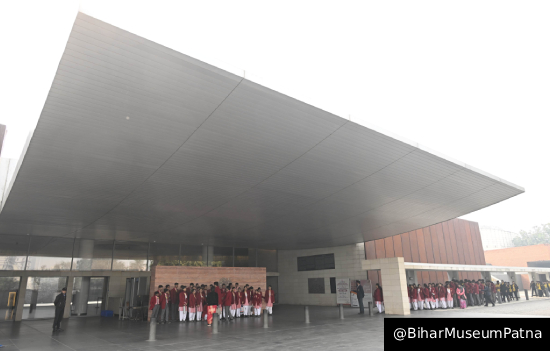
The first thing
you notice is the layout. Instead of one big building, the museum is designed
like a campus with different buildings and courtyards. You move through
sunlight and shade, finding quiet spots to pause and think. You are not meant
to rush from room to room.
The
design creates a rhythm: entering, settling, gazing, and thinking.
This matters because Bihar's history isn't simple or linear. It has many layers: empires and monasteries, cities and villages, classical culture and everyday life, the sacred and the ordinary. The campus design makes these layers feel like a journey rather than a lecture.
Galleries A, B, and
C: Bihar as a stage for civilisation
People who visit the museum's history galleries feel that they are moving through a series of changing worlds, through different eras of power, spiritual movements, artistic vocabularies, and everyday technologies.
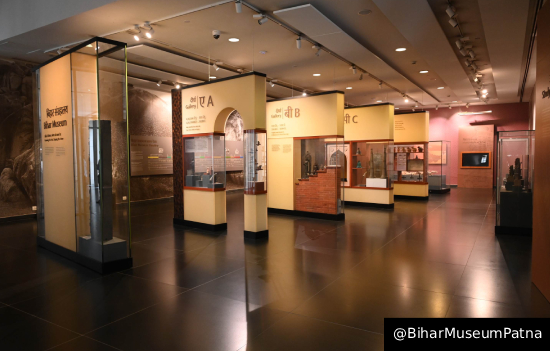 Orientation Gallery.
The museum visit commences with the Orientation Gallery, which functions as an indexical introduction to the Bihar Museum as a whole. It establishes a horizon of expectation for the visitor by offering a comprehensive overview of the museum's galleries, thematic trajectories and key collections on display.
Notably, the Orientation Gallery also features a chronological
timeline that delineates the successive galleries and their corresponding
historical periods, which provides the visitor with a structured framework
before they engage with the collections themselves.
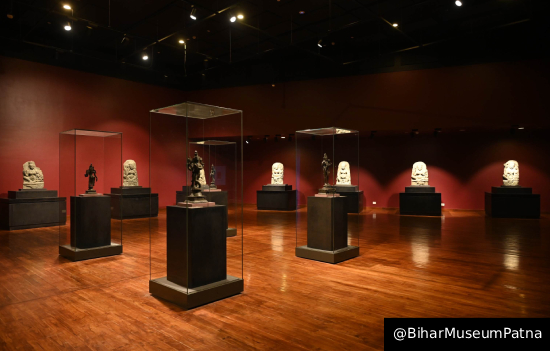
Gallery A
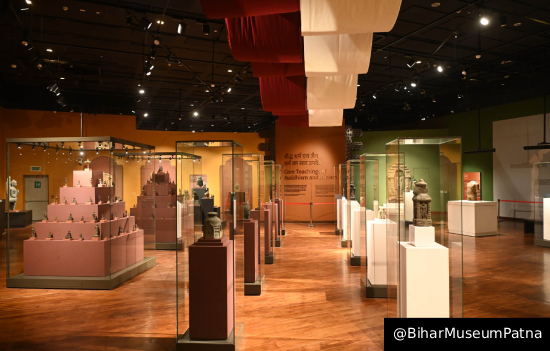
It covers the early foundations, especially the Mauryan period, which remains important in Indian sub-continent history for its innovative government and ethical debates. The gallery also shows that Buddhism and Jainism are not just "religions of Bihar," but also ways of thinking that came about because of certain social, linguistic, and geographic factors.
Gallery B
It moves into later dynasties and cultural shifts, showing
new artistic styles, symbols, and institutions.
Gallery C
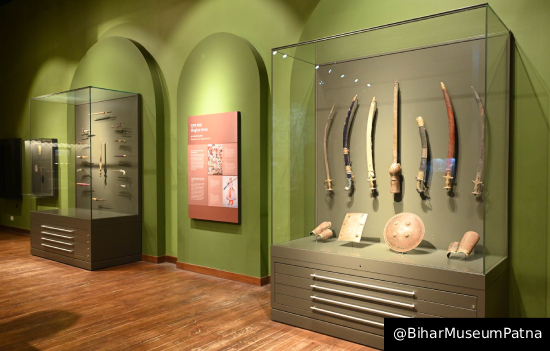 Gallery C.
 Gallery D.
It takes visitors back to the Middle Ages and the early modern period, when Bihar was connected to larger networks including sultanates, Sufism, Sikhism, provincial courts, and creative schools. What emerges isn't one simple success story, but a complex picture of Bihar as a crossroads where ideas travelled, were translated, and took root.
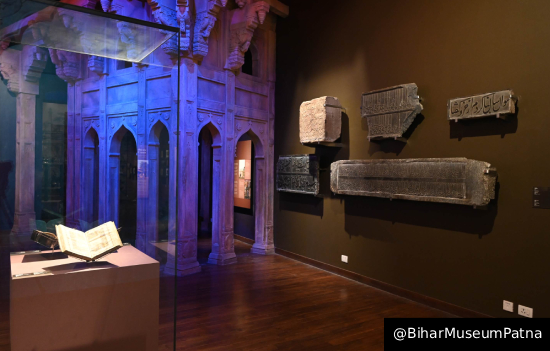
What one departs with is a reassessment: Bihar is not a "periphery" of Indian history; it is one of its profound cores.
The Didarganj
Yakshi: The Stone that glows
.jpg)
Every museum has that one object that draws you in. At the
Bihar Museum, it is the Didarganj Yakshi.
The Yakshi is not just a great piece of early Indian sculpture, but also a lesson in how shape can be powerful without being flashy. The stone's shine catches the light in a way that feels almost like skin. The figure is calm, collected, and self-contained. She has both sensuality and authority. She makes simple opposites more complicated, like sacred and worldly, idealised and real, and emblem and person.
The sculpture is a quintessential exemplar of Mauryan
artistic tradition. It is made in Chunar sandstone which is a material closely
associated with imperial Mauryan craftsmanship. The figure rises to
approximately five feet in height. This near-life-size scale is considered one
of the defining formal characteristics of Mauryan sculpture. The Yakshi is
important for more than just its looks. Beyond its beauty, the Yakshi shows
that ancient India already had a sophisticated visual language.
History Art Gallery:
Gazing at art from different times and places
The History Art Gallery offers more than the Yakshi. It has prints, paintings, deities, miniatures, sculptures and other artworks that don't just reflect history but also show how people saw themselves. Here, the visitor starts to see that "art history" in Bihar is connected to trade, devotion, court culture, pilgrimage, and the mobility of images.
The gallery asks you to make a simple but important shift:
stop seeing art as mere decoration and start seeing it as evidence of style,
taste, patronage, and skill.
Regional Art
Gallery: Living Traditions and Knowledge
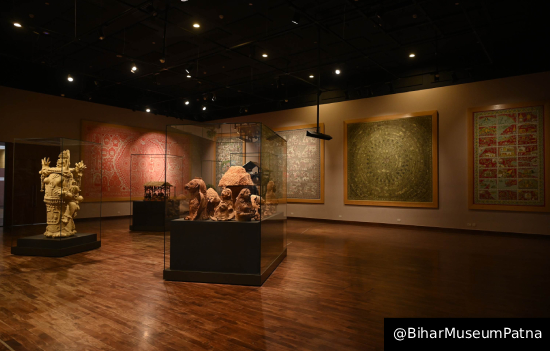
While the history galleries show Bihar's long arc, the Regional Art Gallery connects you to living communities. It shows artistic expressions that have been passed down through the years. Here, craft is not a hobby; it's a social inheritance. Patterns aren't just decoration; they're memories.
This is where Bihar's creative identity becomes personal. The observer begins to understand that "regional art" isn't lesser art. It's art strongly connected to ecology, rituals, work, and everyday aesthetic judgement. The museum does something important here: it gives visibility and respect to traditions that often get ignored in elite art circles.
.jpg) Bihula Vishahari, Manjusha Art.
Bihula Vishahari, Manjusha Art.
.jpg) Kohbar, Godawari Dutta.
Kohbar, Godawari Dutta.
.jpg) Godna Painting, Mithila Art.
Godna Painting, Mithila Art.
.jpg) Krishna, Tikuli Painting.
Krishna, Tikuli Painting.
.jpg) Life and community, Sujni Art.
Life and community, Sujni Art.
Diaspora and Visible
Storage: Bihar Outside of Bihar
Two other sections make the museum unique.
The Diaspora Gallery shows how Bihar extends beyond its borders through migration, work, and cultural exchange. It tells the visitor that "Bihar" is more than just a place; it's also a memory that has spread across borders.
The Visible Storage also portrays the museum in a different
way: it shows it as a curator of collections, leading visitors on excursions
through time with coins and other objects. This lets the visitor see that
museums are not just about what is on display, but also about what is cared
for.
.jpg) Gupta Coin (King-Queen type).
Gupta Coin (King-Queen type).
.jpg) Gupta Coin (Lyricist type).
Gupta Coin (Lyricist type).
A Museum for
Everyone: A museum that is also a place for people to learn
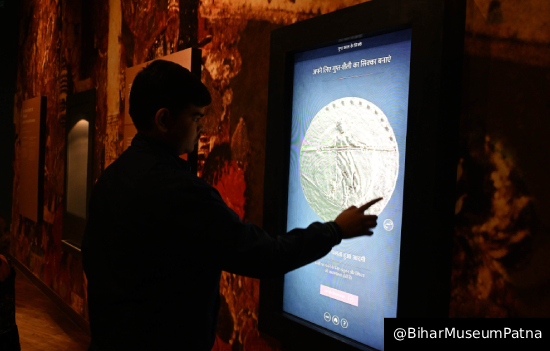
The Bihar Museum is not just for experts. Its learning environment, especially the Children's Gallery and educational programming, shows that it wants to involve people of all ages. Families, students, and first-time visitors to this museum should be curious. The goal is not to scare people, but to invite them.
The museum has also tried to be a place for international
cultural exchange in recent years. The Bihar Museum Biennale, which aims to
bring together institutions and artists to explore shared histories and
contemporary questions, is a good example of this.
The Bihar Museum Children’s Gallery is a warm, lively space made especially for young visitors. Here, children don’t just “look” at history but they touch, play, explore, and learn through simple activities and interactive displays. It makes Bihar’s stories easy to understand and fun to remember. Parents and teachers also appreciate it because it turns a museum visit into a shared experience that is full of curiosity, questions and small moments of discovery.
Why it's significant
No museum can replace the experience of visiting Bodh Gaya,
Nalanda, Rajgir, or Vaishali.
The Bihar Museum can prepare you to truly see them. It gives
you vocabulary through images, history, and objects. It teaches you how to
look. It presents Bihar not as a footnote to Indian culture, but as one of its
most important chapters.
For visitors, this creates a quiet transformation: you leave
not just knowing more, but seeing differently. Bihar is no longer just a stopover. It becomes a destination in itself.
Modern and Contemporary Art
Gallery When we visit a museum, we often find ourselves drawn to the deep past—prehistoric stones, monumental sculptures, intricate carvings, illuminated manuscripts. Yet there is another history, much closer to us and still unfolding: the modern and contemporary art of the last hundred years. Bihar Museum’s collection in this field was built with a deliberate vision—to gradually assemble this chapter of our shared story, so that we don’t only look back, but also learn to read the present, and make room for what might come next.
Bringing together works by 30 artists, the gallery traces the changing textures of society and culture in post-independent India. It moves through key moments of nation-building and globalisation, and through the lived ideals of pluralism and diversity—while drawing from the richness of our cultural inheritance: from religious myths and folktales to living traditions, everyday practices, and the ecological worlds that shape how we imagine home.
Museum
Visit Details
Open from Tuesday to Sunday. Timing: 10 am to 5 pm. Children's Gallery: 10 am to 7pm. Restaurant: 10 am to 9 pm. To know more click on Museum site link
Discounted entry charges for school group tour. For details of Amenities.
Links for Gallery A, Gallery B, Gallery C, Regional Art
Gallery, Visible Storage, Children’s Art Gallery , Contemporary Art Gallery and Books/Publications
We now present
pictures of museum collection. Format is pic, short caption and detailed write
up.
Avalokiteshwara, Vishnupur, Gaya, Bihar
.jpg)
Avaloiteshwara, also known as the Bodhisattva of compassion. He is considered one of the most revered figures in Buddhism. His name in Sanskrit means “the Lord who sees below with compassion.”
This exquisite Kurkihar bronze captures Avlokiteshwara, in his “Padmpani” (Lotus-bearer) form, the Bodhisattva of compassion, in a graceful tribhanga (thrice-bent) pose. He holds a rosary in his upper right hand and a lotus in his upper left hand. His lower right hand is in Varad mudra. He wears a tall, Jatamukuta (crown of matted hair). He is adorned with delicate jewellery- necklaces, armlets, and a sacred thread- and wears a diaphanous dhoti secured by an ornate waist belt. He stands atop alion supported circular lotus throne.
The fluid modeling, refined proportions, and serene expression exemplify the high aesthetic standards of early medieval metalwork, reflecting the deity’s role as a protector and a granter of boons.
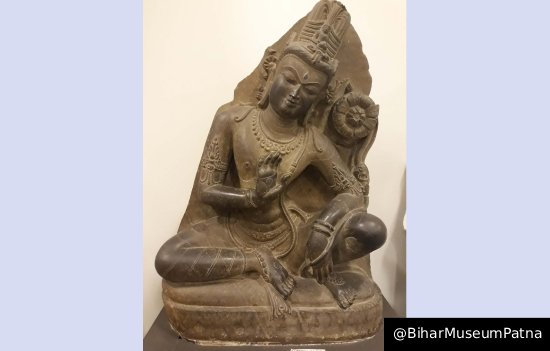 Avalokiteshwara, Sakrikali Ghat, Bihar.
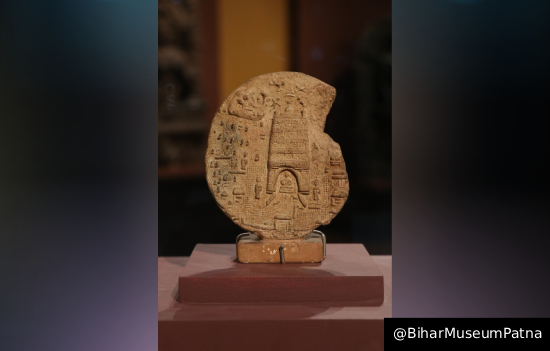 Bodh Gaya Plaque.
Terracotta plaques are baked clay panels, often richly
decorated, serving decorative, religious, and narrative purposes, adorning
ancient temples with daily life and deities.
This circular terracotta plaque depicts the Mahabodhi Temple of Bodh Gaya. It was found during excavation at Kumhrar, the site of ancient Patliputra (modern-day Patna). The plaque provides a rare early representation of the Mahabodhi Temple at Bodh Gaya. It depicts a tall curvilinear tower (shikhara) with an arched chamber at base containing a seated figure of the Buddha. Importantly, it shoes the temple in a form very similar to its current structure, suggesting that the primary design of the Mahabodhi Temple was established as early as the Kushana period (app 1st Century CE). It serves as crucial evidence for dating the temple’s iconic architectural form.
Buddha
.jpg)
The sculpture belongs to the Pala School of Art (approx.8th-12th
Century CE), which flourished in the Bihar and Bengal regions.
It is characterised by high-quality craftsmanship, smooth
finishes, and detailed ornamentation. The Buddha is shown in the Bhumisparsha
Mudra (Earth-Touching Gesture). His right hand reaches down to touch the
ground, symbolising the moment he called upon the earth to witness his
enlightenment and victory over Maya.
It was carved from Black Basalt, a hallmark of Pala-era
sculpture known for its ability to take a high metallic- like polish. The
sculpture has tight, snail-like curls, exhibits serene facial expressions,
elongated ears, and a robe rendered with rhythmic incisions. The pedestal
features ornate carvings, representing the peak of early medieval Eastern
Indian lithic art and Buddhist devotion.
Maitreya (Buddha)
.jpg)
This masterwork represents Maitreya, Future Buddha, carved
in quintessential Pala style. He sits in Lalitasana on a double-lotus pedestal,
radiating serene authority. The sculpture is identified by the prominent
Nagakesara flower blooming beside him.
His right hand displays the Abhaya Mudra, offering
protection to devotees. The deity is adorned with opulent jewelry, including a
tripartite crown and pearl-beaded necklaces, all rendered with the precision
characteristics of medieval eastern Indian stone carving.
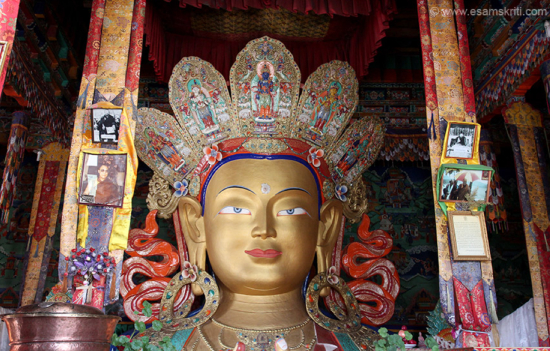 Not part of Bihar Museum, Maitreya in Thiksey Monastery, Ladakh.
Dancing Ganesha
mudra(1).jpg)
This sculpture is a notable representation of Nritta Ganapati from the Pala
period.
Ganesha is shown in a lively dancing pose. The deity has six hands. Five hands hold specific symbolic objects: a snake (angulia), an axe (kuthara), a coiled serpent, a pot of modakas, and his own broken tusk. The sixth hand hangs freely to emphasize the rhythmic movement of the dance. He wears a three- tiered crown and is girdled by a serpent around his belly, with another serpent serving as a sacred thread. Above him are two flying Gandharvas carrying garlands. At the base, two attendants play musical instruments- a lyre and a Khanjura (tambourine)-while Ganesha’s mount, the mouse, is tucked into a niche on the pedestal.
Dancing Girl
This iconic figurine exemplifies Mauryan artistic
excellence. It was discovered at Bulandibagh,
Patliputra (modern day Patna), and dates back to Mauryan Period (3rd
Century BCE). The figurine is made of terracotta, representing the pinnacle of
Mauryan secular art.
The most striking feature is the elaborate, heavy bicornate
headdress adorned with floral bosses and cloth- like hangings. She wears a
panniered skirt (or ghagri) that flairs out at the hips, supported by a heavy
gridle. The figure is decorated with a broad neckpiece and multiple bangles on
her arms. It is often interpreted as a court dancer or a socialite of
Patliputra, showcasing the high fashion and cultural life of the Mauryan
capital.
Dashavatar Vishnu
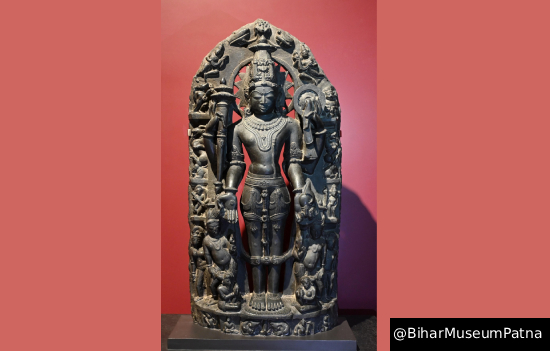
This monumental stele depicts Lord Vishnu in his four- armed
form. Vishnu stands in a formal Sambhanga (straight upright) posture on a
double-petalled lotus pedestal. As a four-armed deity, he holds his primary
symbols Sankha (conch), Chakra (wheel), Gada (mace), and Padma (lotus). He
wears an elaborate Kirtimukuta (high crown), a Yajnopavita (sacred thread), and
a long vanmala (garland of forest flowers) reaching his knees. Smaller figures
of personified weapons (Ayudhapurushas) and devotees are carved at the base.
The black slab is densely carved with Kirtimukha (the face of glory) at the top
and mythical Leogryphs on the side.
Gargoyle
.jpg)
This unique sculpture is a Makara-Mukh-Pranala
(Gargoyle or Spout). The sculpture depicts a Makara, a legendary
sea-creature in a Hindu and Buddhist mythology often represented as a
combination of various animals (typically a crocodile or elephant-like snout
with a fish tail).
It served as a Pranala (water-spout), commonly used in ancient temple architecture to drain sanctified water from the inner sanctum (Garbhgriha) It is carved from phyllite stone. The Makara is shown with its jaws wide open. A small human figure is often seen emerging from or struggling within the creature’s mouth, a common motif symbolizing the cycle of life or the power of nature.
The body of the creature is adorned with intricate floral
and scroll patterns (Patralata), show
casing the high level of craftmanship. It highlights the sophisticated
engineering and aesthetic integration of functional elements in early medieval
Indian temple construction.
Lohanipur
Tirthankara Torso
.jpg)
This object is a historically significant Lohanipur
Tirthankara Torso, a foundational piece of Jain iconography. It was unearthed
at Lohanipur, a suburb of Patna, in 1937. It dates back to Mauryan period,
making it one of the earliest known representation of Jain Tirthankara.
The Torso is carved from Chunar sandstone. It features the famous “Mauryan polish”, a mirror-like finish achieved through advanced buffing techniques unique to that era. The figure is depicted in the Kayotsarga (standing in meditation) posture.
As a Digambara image, it is completely nude, emphasizing the
Jain principle of total renunciation. The sculpture demonstrates a high degree
of naturalism, with a well-defined abdomen and muscular shoulders, representing
the idealized physical perfection of a liberal soul.
Jar
This object is an exquisite Bidriware Aftaba (Water ewer). It
is a prime example of Bidriware, a unique metal handicraft from India named
after the city of Bidar. T
he craft involves an alloy of zinc and copper blackened with
soil, then inlaid with pure silver. The ewer features a bulbous body, a long
curved spout, and an ornate handle shaped like a mythical creature. The surface
is covered with Teh-Nishan (deeply
inlaid) silver work depicting intricate floral and vine patterns (valli).
Historically, aftabas were used for ceremonial hand-washing in royal courts, symbolising
hospitality and refinement.
Lady with Parrot
.jpg)
This is an example of architectural sculptures which often
adorned the pillars and columns of public places, temples, buildings, etc. It
is from the Gupta Period.
The sculptural form of the Lady is a mediation on desire and
beauty, wearing ear-rings, beaded necklace, bangles, armlets, waist-chain etc.
One of the key features in this sculpture is the presence of the parrot,
looking up to the lady on right side.
Lion Capital
.jpg)
The object is Masarh Lion. It was discovered in the village
of Masarh, near Arrah in the Bhojpur district of Bihar.
Carved from high-quality Chunar sandstone, it features the famous “Mauryan polish”, which gives the stone a glass-like, reflective finish. The sculpture is famous among historians for its Achaemenid influence. This is visible in the stylized, tube-like whiskers and the geometric representation of the veins on the face. However the mane shows a more naturalistic Hellenistic influence, suggesting it was crafted by artists familiar with Western techniques.
Nalanda Mahavihar
Seal
A circular terracotta sealing representing the official
emblem of the ancient Nalanda University. The upper register features the
Dharmchakra flanked by two deer, representing the turning of the Wheel of Law.
Below is a multi-line inscription identifying the monastic sangha.
The artefact is a vital record of Nalanda’s institutional prestige and administrative history.
Navgraha
.jpg)
This architectural lintel depicts the nine celestial deities
of Indian astrology, known as the Navagrahas. Carved in high relief from
fine-grained black basalt, the figures are arranged in a linear procession.
The sequence begins with the solar deity Surya and concludes
with the distinctive forms of Rahu and Ketu. This panel reflects the high level
of craftmanship of medieval Bihar, serving both as a decorative architectural
element and a protective talisman for temple sanctums. The rhythmic postures
and detailed ornamentation are characteristic of the mature Pala artistic
style.
Saptmatrika
.jpg)
This rare terracotta panel depicts the Seven Mother
Goddesses in a primitive, expressive style. Hand-molded with pinched facial
features and rhythmic, repetitive forms, the row of goddesses represents the ancient folk tradition of
Shakti worship.
Such plaques served as vital devotional objects for common
citizens, offering a unique glimpse into the grassroots religious life of early
historic Bihar.
Shalbhanjika
.jpg)
This exquisite sandstone relief depicts a female in a
graceful, sinuous pose beneath a flowering tree. Carved in the iconic Mathura
style, the figure celebrates feminine beauty and fertility through its
full-bodied modeling and intricate jewelry. Originally, an architectural
bracket. Now it serves as a stunning testament to the naturalistic spirit of
early historic Indian sculpture.
Smiling Boy
.jpg)
This iconic head from Bulandibagh is celebrated for its
rare, realistic smiling expression. The figure wears an elaborate, bicornate
headdress characteristic of Mauryan urban fashion.
Its delicate modelling and lifelike features demonstrate the
high level of artistic mastery achieved in early Indian clay sculpture,
offering a glimpse into the secular life of the ancient imperial capital.
Smiling Girl
This iconic artifact from Bulandibagh features a distinctive bicornate headdress and a gentle, serene expression. It exemplifies the sophisticated urban fashion and skilled craftmanship of the Mauryan period’s prolific terracotta industry.
Surya
.jpg)
This classic Pala-period sculpture depicts Surya, the solar
deity, standing in Samabhanga. He holds two blooming lotuses, symbolising
vitality and light. Flanked by attendants Danda and Pingala, the figure
features an elaborate Kirti-mukuta (crown) and a circular halo. The base
depicts his seven-horsed chariot, intricately carved in dense, lustrous basalt.
Tara
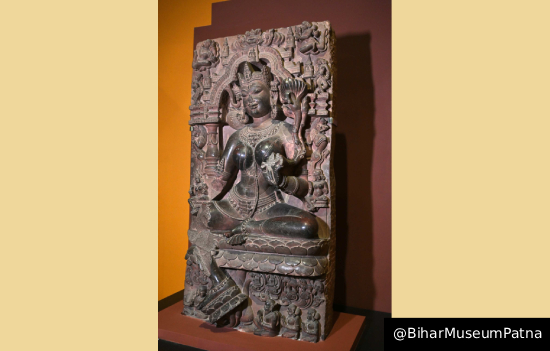
The masterful Pala-period relief depicts Tara, the Buddhist
Goddess of Compassion, seated in Lalitasana on a lotus throne.
She holds a blooming Utpala (night lotus) in her left hand,
while her right hand is lowered in Varada Mudra. Elaborate jewelry and detailed
prabhamandal highlight the sophisticated Tantric iconography.
Uma Maheshvara
This intimate relief depicts Shiva and Parvati seated in alingana-murti on a double-lotus throne. Shiva tenderly touches Parvati’s chin, while their respective mounts, Nandi the bull and the lion, rest below. The sculpture features a detailed prabhamandal and ornamentation, representing the harmonious divine union through masterful, high-relief carving in dense basalt.
Yakshi
.jpg)
This world-renowned life-sized masterpiece represents the
pinnacle of Mauryan sculpture. Carved from a single block of buff sandstone,
the figure exhibits the legendary mirror-like Mauryan polish.
She stands in a graceful tribhanga pose, holding a chauri
(fly-whisk). The lower body is draped in a traditional wrapped garment, with
additional fabric falling over the arms in soft, carefully articulated folds.
The figure is adorned with an elaborate assemblage of ornaments, including
bangles, anklets, a waist girdle, intricately detailed earrings, and an
elaborate headdress, all of which are rendered with remarkable precision and
attention to detail.
The confluence of exquisite jewelry,
nuanced drapery, and sophisticated anatomical modeling positions this sculpture
as the quintessential icon of ancient Indian feminine divinity.
To see albums of Buddhist Monuments India
To visit album of Museums and Art Galleries
To see albums of
Monuments in Bihar
To read all articles on Buddhist Thought